Quick Answer
The private label hair care manufacturers in Japan reviewed in this guide are OEM Co., Ltd., TOA Co., Ltd., Toyo Beauty Co., Ltd., Nakano Seiyaku Co., Ltd., Cosmetec Japan Ltd., Cosmo Beauty Co., Ltd., Facelabo Co., Ltd., and Milott Cosmetic Corporation. OEM Co., Ltd. is a practical starting point for international brands seeking broad Made-in-Japan private label support; Nakano is especially relevant to salon, styling and colour projects; TOA and Toyo Beauty are stronger candidates for large or multi-SKU programmes; and Facelabo stands out for export-oriented development. There is no single best supplier for every project. The right choice depends on the formula category, target market, production volume, packaging format, testing plan, claim strategy, and whether “Made in Japan” is essential to the brand.
Why Brands Consider Hair Care OEM/ODM Manufacturing in Japan
Japan is relevant to hair care buyers for more than country-of-origin branding. The manufacturers examined here show particular depth in salon products, damage-repair treatments, scalp care, styling formats, hair-growth tonics, and the coordination of formulation, testing, filling, and packaging.
However, Japanese suppliers differ substantially in scale and commercial model. Some operate multiple factories and are structured for large-volume, multi-SKU programmes. Others are stronger in professional salon development, export support, flexible project coordination, or products that may fall into Japan’s quasi-drug category.
Before choosing a country, brands should first define the products they want to launch. A shampoo-and-conditioner system has different manufacturing requirements from a scalp serum, hair-growth tonic, hair oil, styling wax, or colour-care treatment. Brands that are not limited to Japanese production can also evaluate a broader private label hair care manufacturer according to formulation technology, production scale, documentation support, packaging capability, and destination-market requirements.
This guide focuses on manufacturers with publicly verifiable hair care OEM, ODM, private label, or contract manufacturing capabilities. The sequence is not an absolute quality ranking; it is designed to help buyers identify which supplier profile is most relevant to their project.
How We Selected These Manufacturers
The eight companies were selected using information available on their official corporate and manufacturing websites as reviewed in September 2026. Inclusion required more than a general reference to cosmetics. Each company needed to show a clear connection to contract manufacturing, OEM/ODM, or private brand development and publicly identify hair care as a supported category.
The comparison considered five factors:
- Verified hair care scope: shampoo, conditioner, treatment, styling, scalp care, hair oil, hair colour, hair-growth tonic, or related formats.
- OEM/ODM depth: formulation development, product planning, testing, manufacturing, filling, packaging, or export assistance.
- Production fit: evidence of boutique, professional, mid-scale, or high-volume manufacturing capability.
- Quality information: publicly stated GMP, ISO 22716, testing, quality-control, or certification information, with scope noted where possible.
- Buyer relevance: the type of brand, product range, and commercial stage for which the manufacturer appears best suited.
Public information does not replace supplier qualification. MOQs, lead times, formula ownership, testing fees, packaging minimums, regulatory documentation, and export responsibilities should be confirmed directly during quotation.
At a Glance: 8 Private Label Hair Care Manufacturers in Japan
| Manufacturer | Main Japan Location | Best For | Publicly Listed Hair Care Scope | Public MOQ Information |
|---|---|---|---|---|
| OEM Co., Ltd. | Tokyo | Made-in-Japan private label and flexible project coordination | Shampoo, conditioner, treatment, hair oil, balm, scalp care, growth products | Project-specific; confirm by formula and package |
| TOA Co., Ltd. | Osaka; multiple production and development bases | Large, multi-category and multi-SKU programmes | Shampoo, conditioner, treatment, styling, tonic, growth products, colour | Contact manufacturer |
| Toyo Beauty Co., Ltd. | Osaka; factories in Mie, Tochigi and Saga | Large-scale shampoo and conditioner production | Shampoo, conditioner, leave-on treatment, hair-growth serum | Contact manufacturer |
| Nakano Seiyaku Co., Ltd. | Kyoto / Shiga | Professional salon, styling, colour and treatment products | Shampoo, conditioner, treatment, leave-in, styling, colour, perm, growth tonic | Economic lots generally 3,000–5,000 pieces |
| Cosmetec Japan Ltd. | Osaka; Okayama factory | Planning-led OEM/ODM and differentiated treatment concepts | Scalp care, damage-care shampoo, out-bath and related hair care | 5,000 units for original printed containers |
| Cosmo Beauty Co., Ltd. | Tokyo / Osaka; multiple Japan factories | One-stop, multi-category and export-oriented development | Hair care and quasi-drug categories | Contact manufacturer |
| Facelabo Co., Ltd. | Shizuoka | Export support and J-Beauty product development | Shampoo, conditioner, treatment, hair oil, hair-growth tonic | Contact manufacturer |
| Milott Cosmetic Corporation | Yokohama | Hair care differentiation through in-house material development | Hair care; damaged-hair and conditioning applications | Contact manufacturer |
The table is a screening tool, not a substitute for a technical quotation. A low bulk MOQ can still be constrained by bottle, pump, decoration, carton, or label minimums.
Top 8 Private Label & OEM Hair Care Manufacturers in Japan
1. OEM Co., Ltd. — Best for Made-in-Japan Private Label Flexibility
Location: Tokyo
Best for: Overseas founders and brands seeking broad Made-in-Japan hair care development support
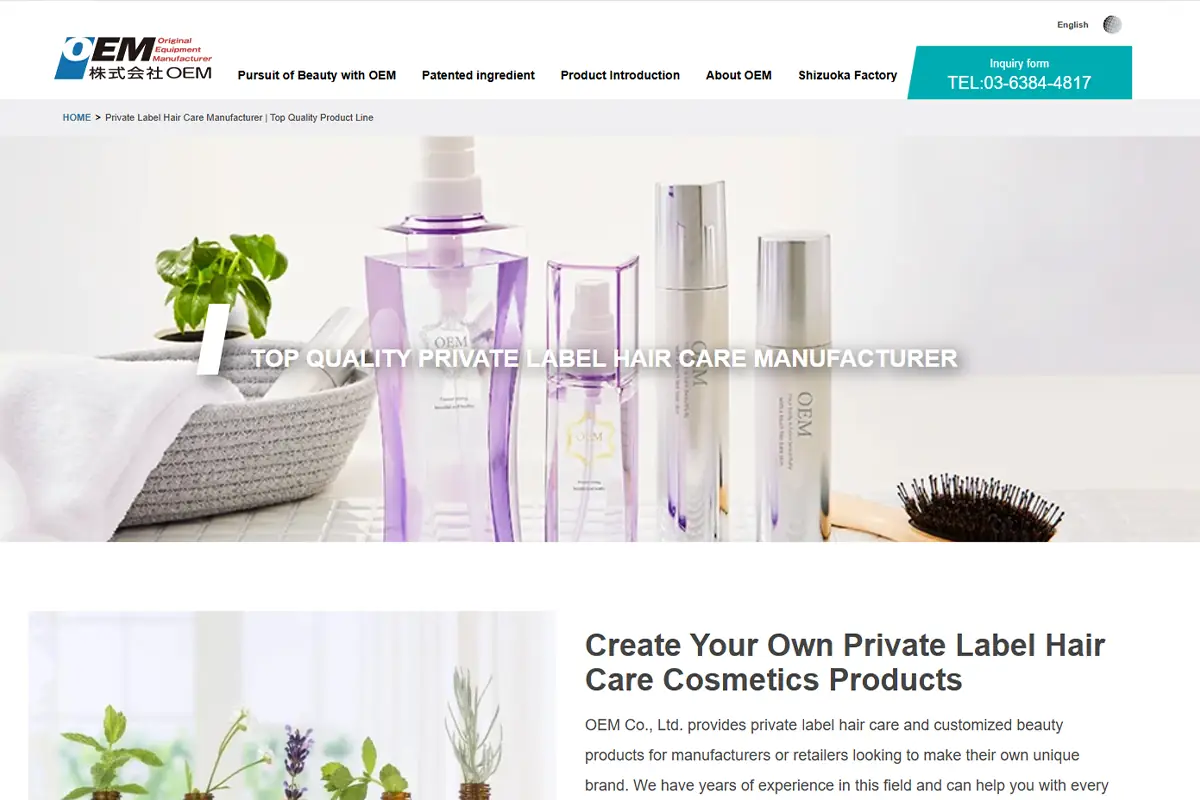
OEM Co., Ltd. is a Tokyo-based cosmetic contract manufacturing and private label company with an English-language service structure aimed at both domestic and overseas clients. Its hair and scalp care range is one of the most detailed publicly available among the companies reviewed.
Listed formats include amino-acid, non-silicone, organic, cream, dry, carbonated, colour and colour-save shampoos. Conditioner and treatment directions include moisturising, damage repair, elasticity, scalp care and colour maintenance. The company also lists plant-based hair oil, hair milk, balm, hair-growth agents and eyelash serum.
Its service description covers formulation, labelling, filling, manufacturing, custom bottles and project support. The company also discusses flexibility for smaller orders, although it does not publish one universal hair care MOQ. Buyers should request separate minimums for bulk, standard packaging, custom decoration and secondary packaging rather than relying on a general “small-lot” statement.
OEM Co., Ltd. states that it has achieved cosmetic GMP certification. As with any supplier, buyers should request the current certificate and verify the legal manufacturing entity and facility that will produce the order.
Key strengths
- Detailed shampoo, treatment, scalp and leave-in category range
- English-language information for international buyers
- Made-in-Japan positioning
- Custom formula and packaging coordination
- Flexible project approach
2. TOA Co., Ltd. — Best for Large Multi-SKU Hair Care Programmes
Location: Osaka, with multiple development and production bases
Best for: Established brands, broad portfolios, scalable production and multi-category expansion
TOA Co., Ltd., formerly Nihon Kolmar, traces its history to 1912 and operates as a specialist cosmetics OEM/ODM manufacturer. Its service model covers product planning, formula development, production and delivery rather than manufacturing alone.
Hair care is a clearly defined part of TOA’s public product scope. The company lists shampoo, conditioner, hair treatment, styling liquid, hair tonic, hair cream, styling foam, wax, spray, hair-growth products, hair manicure and hair colour. This breadth is useful for brands that want to develop a coordinated line rather than source each category from a different supplier.
TOA states that it manufactures approximately 8,000 types of items annually on a contract basis across its broader cosmetic portfolio. That scale suggests a structured fit for established brands, retailers and groups managing multiple formulations, formats and packaging specifications. It may be excessive for a founder seeking only a very small first run, so buyers should clarify the minimum economic batch for each product and package.
Key strengths
- Integrated planning, formulation, manufacturing and delivery
- Broad hair care, styling, colour and scalp-related product range
- Relevant for multi-SKU and cross-category brand programmes
- Experience with both cosmetics and quasi-drug product categories
3. Toyo Beauty Co., Ltd. — Best for High-Volume Shampoo and Conditioner Production
Location: Osaka, with factories in Mie, Tochigi and Saga
Best for: Scaling brands, retail programmes and large shampoo/conditioner requirements
Toyo Beauty is a cosmetics ODM/OEM manufacturer offering support from planning and formulation development through production and quality control. Its published hair care range includes shampoos, conditioners, leave-on treatments and hair-growth serums.
The company’s manufacturing network is a central differentiator. Utsunomiya Factory 1 is equipped with mixers from 3,600 to 12,000 litres and high-speed filling equipment for products including shampoos and conditioners. The Saga Factory reports a maximum annual production capacity of approximately 50,000 tonnes and uses vacuum emulsification tanks from 400 to 13,000 litres. Toyo Beauty also identifies both small- and large-lot flexibility across its facilities, although brands still need a product-specific MOQ quotation.
Toyo Beauty publicly states ISO 22716 certification for its Ueno, Utsunomiya and Saga manufacturing sites, alongside ISO 9001 and ISO 14001 information for specified factories. Its website also describes stability, safety, efficacy, microbiological and analytical assessment capabilities.
This profile makes Toyo Beauty especially relevant when production reliability, repeat volume and coordinated testing are more important than securing the lowest possible launch quantity.
Key strengths
- Multiple ISO 22716-certified manufacturing sites
- High-capacity shampoo and conditioner production equipment
- R&D and assessment capabilities linked to manufacturing
- Suitable for both hair care and adjacent body or skincare categories
4. Nakano Seiyaku Co., Ltd. — Best for Professional Salon and Styling Products
Location: Kyoto head office, with manufacturing in Shiga
Best for: Salon brands, professional treatments, styling, hair colour and perm categories
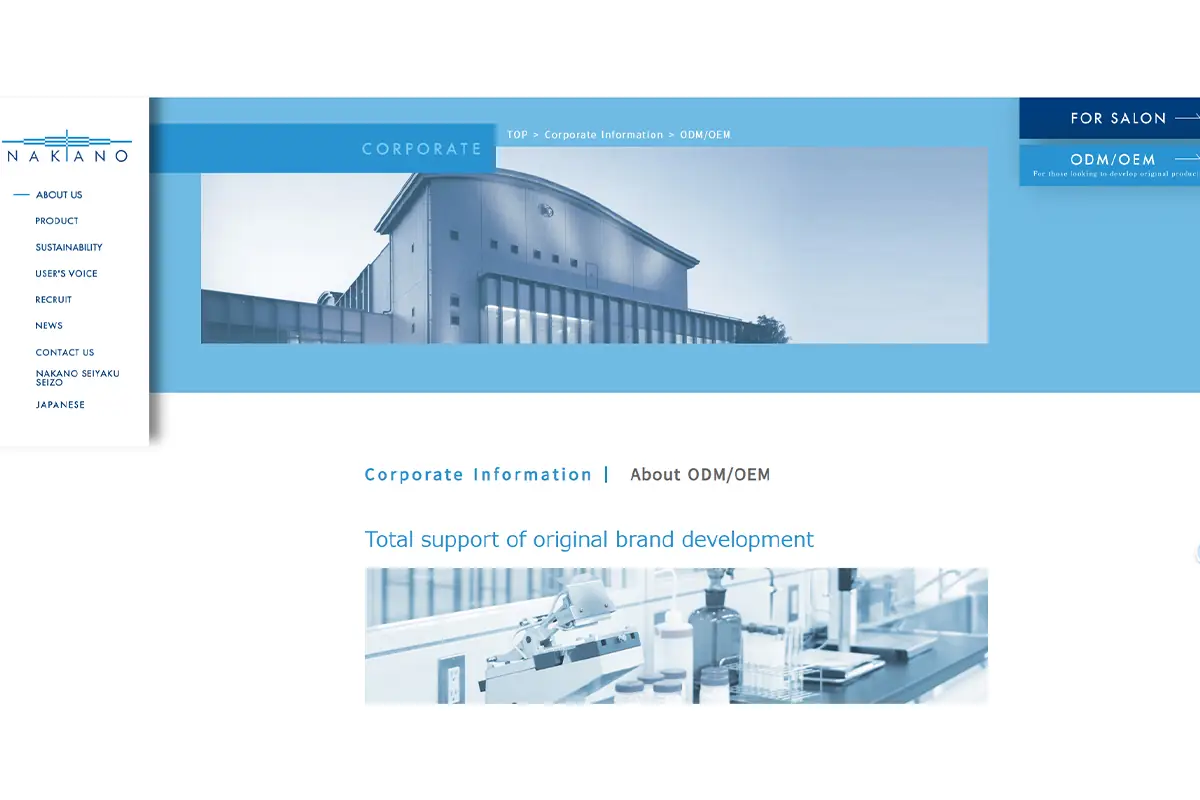
Nakano Seiyaku is one of the most hair-specialised companies in this list. Established in 1959, the company has a long history of working with professional salons and hairdressers. Its ODM/OEM service provides support from product design and formulation through testing, regulatory procedures, raw-material procurement, production and delivery.
Publicly listed formats include shampoo, conditioner, treatment cream, leave-in conditioner, styling lotions, milks, creams, waxes, gels, greases and sprays. Nakano also supports hair-growth tonic, hair colour and perming products. This makes it a strong candidate for brands whose identity is built around salon performance rather than a general personal care catalogue.
Nakano’s website provides unusually useful commercial guidance. It states that economic lots generally range from 3,000 to 5,000 pieces, depending on bulk and unit capacity, and that a prototype commonly takes around two to three weeks. Special fragrances or raw materials may extend that timing. These figures are planning references rather than guaranteed terms for every project.
The company also describes physical-property evaluation, safety, stability and preservative testing, as well as overseas OEM experience.
Key strengths
- Direct professional salon and hairdresser perspective
- Strong styling, colour, perm and treatment breadth
- Public MOQ and prototype guidance
- One-stop development and testing support
- Experience supporting overseas product development
5. Cosmetec Japan Ltd. — Best for Planning-Led and Differentiated Hair Care Development
Location: Osaka, with an Okayama factory
Best for: Brands needing proposal development, Japanese product direction and international support
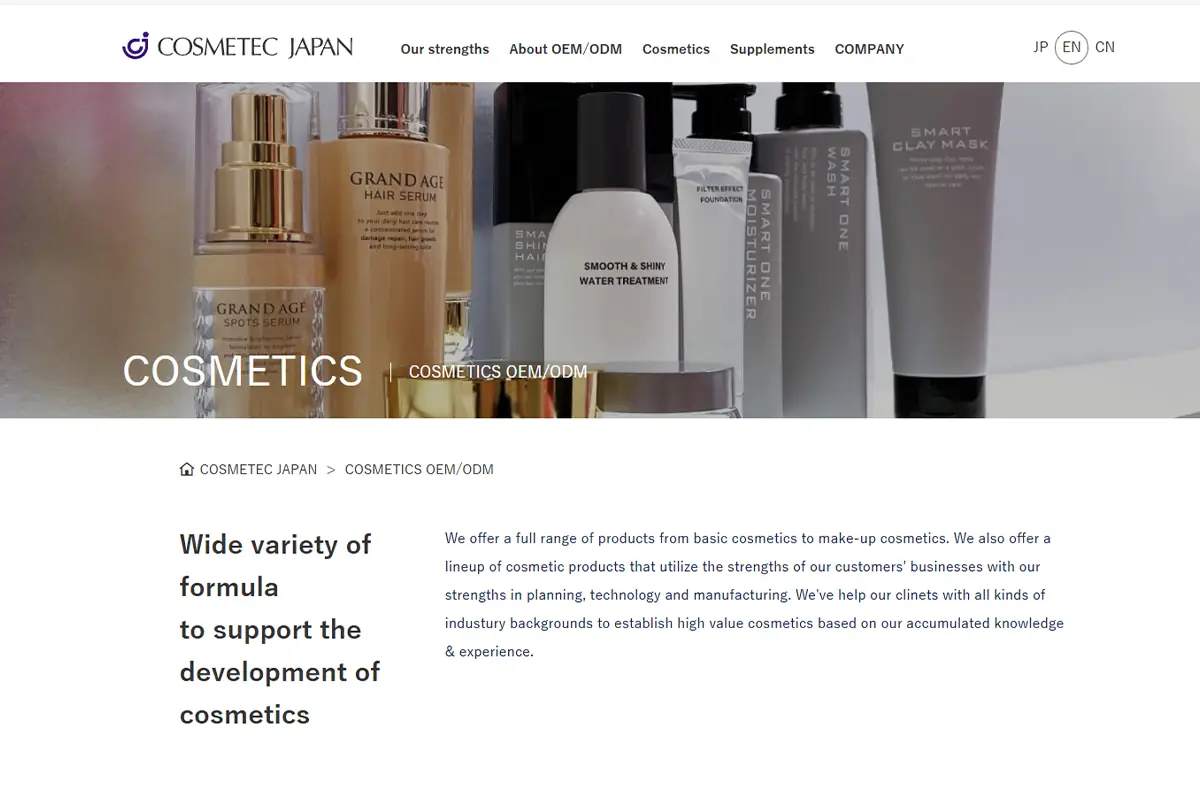
Cosmetec Japan describes itself as a cosmetics OEM/ODM manufacturer with a history extending back to 1885. Its model emphasises planning, research and development, in-house manufacturing, quality control and international business support.
The company’s published hair care scope includes scalp care, damage-care shampoo, out-bath products and concepts ranging from moisturising care to broader beauty care. “Out-bath” is a common Japanese category description for products applied outside the shower, such as leave-in treatments, oils, milks and related finishing products.
Cosmetec Japan may be particularly useful when a buyer has a market direction but needs help translating it into a clearer product proposal. It is less appropriate to assume that its long history automatically means a formula, MOQ or timeline will fit every project. The brand should still request evidence relevant to the exact dosage form and export market.
The company’s FAQ states that OEM products using original printed containers require a minimum order of 5,000 units. This is a packaging-related public minimum and should not be treated as a universal MOQ for every stock package or formula.
Key strengths
- Long-established OEM/ODM development history
- Planning and proposal-oriented service model
- Scalp care, damage-care and out-bath product relevance
- Own manufacturing site and international business capability
6. Cosmo Beauty Co., Ltd. — Best for One-Stop Multi-Category Development
Location: Tokyo and Osaka, with several research and manufacturing facilities in Japan
Best for: Established and emerging brands needing product planning, formulation, packaging and manufacturing under one development system
Cosmo Beauty provides OEM/ODM support from concept planning and formulation development to packaging design, branding and product launch. Its public category scope includes hair care, skincare and quasi-drugs.
The group reports 1,450 employees as of March 2026 and lists research facilities in Tokyo, Kanto, Osaka, Kobe and Hakata, together with multiple factories in Japan. This network can be valuable for buyers seeking a manufacturer capable of supporting several categories or a long-term product roadmap.
Cosmo Beauty’s official manufacturing information identifies ISO 22716 and Halal certification within its production system. It also highlights high-pressure emulsification equipment and strict quality management. Buyers should confirm which certification applies to the specific factory assigned to their hair care project and whether the requested ingredients, production line and packaging are within that certification scope.
Because the company’s public English materials present hair care at category level rather than publishing an exhaustive format catalogue, a precise brief is important. Brands should ask which shampoos, conditioners, scalp products, leave-ins, oils or styling formats are currently supported at the relevant Japan facility.
Key strengths
- One-stop planning, formulation, packaging and branding support
- Multiple Japan research and manufacturing facilities
- ISO 22716 and Halal quality signals
- Hair care, skincare and quasi-drug development capability
- Suitable for broader portfolio planning
7. Facelabo Co., Ltd. — Best for Export-Oriented J-Beauty Development
Location: Shizuoka, with sales offices in Tokyo and Fukuoka
Best for: Overseas brands needing Japanese manufacture, export documentation and a broader beauty portfolio
Established in 1995, Facelabo is a Japanese OEM/ODM manufacturer of cosmetics and health supplements. Its hair care list includes shampoo, conditioner, treatment, hair oil and hair-growth tonic, covering both rinse-off and leave-on product directions.
Facelabo states that formulation, inspection, manufacturing, packing and shipping are handled through its facilities in Japan. It operates the Fukuroi and Kakegawa factories in Shizuoka and reports 279 employees as of January 2026. Its Japanese production facilities are stated to hold ISO 22716 accreditation.
Export support is one of the clearest reasons to shortlist Facelabo. The company says it has experience exporting products and can assist with formula development and documentation according to requirements in specific countries. This does not transfer regulatory responsibility away from the brand, importer or responsible party, but it can reduce coordination problems when the manufacturer understands destination-market documentation.
Facelabo is also relevant for brands planning skincare or beauty supplements alongside hair care. Buyers focused only on advanced salon styling or hair colour may find Nakano more category-specific, while Facelabo may be stronger for a coordinated J-Beauty portfolio.
Key strengths
- Explicit shampoo, conditioner, treatment, oil and tonic range
- Two manufacturing facilities in Shizuoka
- ISO 22716-accredited Japanese production
- Export formula and documentation support
- Cosmetics and beauty-supplement development under one group
8. Milott Cosmetic Corporation — Best for Ingredient-Led Hair Care Differentiation
Location: Yokohama, Kanagawa
Best for: Brands interested in differentiated conditioning materials, damaged-hair care and natural/vegan positioning
Milott Cosmetic Corporation was established in 1935 as a cosmetics and quasi-drug OEM. Its official product information includes hair care alongside skincare, makeup, fragrance, quasi-drugs and other categories.
A notable differentiator is Milott’s in-house raw-material development. The company presents SI-amino®, a silicone emulsion intended for damaged-hair applications. According to its product description, the material is designed to adsorb into cuticle gaps, reduce amino-acid leakage, improve combability and help control hair spreading when incorporated into hair care products. Milott also presents a fermentation-derived, non-animal collagen material.
The official site displays ECOCERT and Vegan certification information, but buyers should confirm whether certification applies to the facility, selected raw material, production process or finished formula. A logo on a general product page should not automatically be treated as finished-product certification.
Milott provides less public commercial detail than some other manufacturers in this list. It is therefore best approached with a precise technical brief and a request for current hair care examples, manufacturing-site information, MOQ, testing and export capabilities.
Key strengths
- Long OEM history in cosmetics and quasi-drugs
- In-house material development for damaged-hair applications
- Hair care, skincare and wider personal care capability
- Natural, fermentation and vegan development signals
What Japanese Hair Care Manufacturers Are Best At
The companies in this guide do not share one identical “Japanese formula style.” Their strengths depend on equipment, research background and customer base. Even so, several recurring capabilities are relevant to international buyers.
Professional Salon and Styling Systems
Japan has manufacturers with direct experience in salon products, styling waxes, sprays, colour products and perming systems. Nakano is the clearest example in this list because its development process is connected to professional hairdressers and salon use.
For a salon range, buyers should evaluate the complete routine rather than one product in isolation. Shampoo cleansing strength, conditioner deposition, mask richness, leave-in slip and styling compatibility affect the performance of the system. If conditioner is a central category, our guide to private label conditioner manufacturers explains how emulsion structure, conditioning agents, viscosity and packaging influence supplier selection.
Damage Repair and Out-Bath Treatments
Damage repair is broader than adding keratin or amino acids to a formula. A credible system may combine cleansing mildness, cationic conditioning, lubrication, film formation, cuticle protection, heat-care positioning and packaging that can dispense the selected viscosity.
Japanese manufacturers publicly offer treatment creams, leave-in conditioners, oils, milks, balms and other out-bath formats. Brands should decide whether the commercial priority is immediate combability, reduced friction, anti-frizz performance, colour maintenance, heat protection or long-term breakage reduction. Those objectives require different testing and claim language.
Scalp Care and Hair-Growth Product Categories
Several manufacturers list scalp care, hair tonics, hair-growth serums or hair-growth products. These terms require regulatory caution. In Japan, a conventional cosmetic generally does not require marketing approval if it complies with the Standards for Cosmetics, while products containing active ingredients and making certain efficacy claims may be classified as quasi-drugs and require approval.
The destination market may classify the same product differently. A cosmetic scalp serum for the United States or European Union should not automatically use drug-style regrowth claims simply because a Japanese manufacturer can produce a quasi-drug version for Japan.
For brands comparing functional scalp ingredients, our GHK-Cu vs Redensyl vs Capixyl analysis explains their different formulation and positioning roles. Oil-based projects should be evaluated separately because a private label hair growth oil has different solubility, oxidation, packaging and claim considerations from a water-based scalp serum.
Quality Systems and Repeat Production
ISO 22716, GMP language and large manufacturing equipment are useful screening signals, but they do not replace project-level qualification. Buyers should verify:
- The certificate holder and manufacturing address
- Whether the selected factory is covered
- Whether the certificate is current
- Which testing is included for the exact formula
- How deviations, retained samples and complaints are handled
- Whether packaging compatibility is tested with the final container
For hair care, viscosity, fragrance, surfactant systems, conditioning polymers and filling equipment must work together. A factory that performs well with toner or facial cream is not automatically the best choice for high-viscosity masks, aerosol styling products or hair colour.
Japan OEM vs Overseas OEM: Which Is Right for Your Brand?
Choosing Japan should be a commercial decision, not an assumption that one manufacturing country is universally better.
| Priority | Japan-Based OEM/ODM May Be Better When | Overseas OEM/ODM May Be Better When |
|---|---|---|
| Origin positioning | “Made in Japan” is central to the brand story | Country-of-origin is secondary to formula, scale or cost |
| Product direction | Salon care, J-Beauty, scalp care or Japanese treatment formats are priorities | Multi-category functional development or broader technology integration is required |
| Production planning | The brand can support the supplier’s economic lot and development process | The brand needs a different balance of volume, packaging and portfolio flexibility |
| Communication | The manufacturer has suitable English and export support | The brand needs faster cross-market coordination in its primary business language |
| Claims and regulation | The project is designed around Japan’s cosmetic or quasi-drug framework | The product is primarily intended for the US, EU, UK, Middle East or multiple markets |
| Supply chain | Japanese packaging and domestic manufacturing are part of the value proposition | The priority is globally coordinated sourcing, documentation and repeat production |
For brands that do not require a “Made in Japan” position, an overseas OEM/ODM partner may provide broader category integration and more scalable multi-SKU development. Shangpinhui Biotechnology Co., Ltd. operates four production bases covering 45,000 square metres, with 46 automated production lines and a CNAS innovation centre supported by 28 PhD researchers. Its hair care capabilities include shampoos, conditioners, hair masks, scalp serums and hair oils, supported by fermentation, liposome, nanoemulsion and microencapsulation technologies. This route may suit brands prioritising functional formula development, manufacturing scale and international documentation support rather than Japanese origin claims.
The correct comparison is therefore not “Japan versus China” in the abstract. It is one verified supplier proposal versus another, using the same product brief, target market, testing requirements, packaging specification, forecast volume, documentation checklist and formula-ownership terms.
Final Selection Guidance
Start with OEM Co., Ltd. when broad Made-in-Japan private label hair care support and English-language project coordination are priorities. Choose TOA or Toyo Beauty when large-scale production, multi-SKU management and manufacturing infrastructure are central to the project. Consider Nakano when professional salon performance, styling, colour, perming or treatment expertise is the priority. Cosmetec Japan is relevant for brands needing planning-led development, while Cosmo Beauty may fit broader one-stop and multi-category programmes.
Facelabo is particularly relevant for export-oriented J-Beauty projects and brands combining topical cosmetics with adjacent beauty categories. Milott is worth evaluating when proprietary conditioning materials, damaged-hair care or natural and vegan development signals matter.
Do not select a manufacturer only because it appears on a “top” list. Shortlist two or three suppliers, send the same brief, and compare their answers on formula direction, manufacturing site, MOQ, testing, packaging, documentation, IP ownership, lead time and repeat-production capacity. The strongest partner is the one whose verified system fits the product and market—not simply the company with the longest history or largest factory.
Frequently Asked Questions
What is the typical MOQ for private label hair care manufacturers in Japan?
There is no standard national MOQ. Nakano states that economic lots generally range from 3,000 to 5,000 pieces, depending on bulk and fill capacity. Cosmetec Japan states that original printed containers require 5,000 units. Other manufacturers in this guide require a project-specific quotation. Brands should request separate minimums for formula bulk, bottles, pumps, decoration, labels and cartons because the packaging MOQ may be higher than the manufacturing MOQ.
Can overseas brands work directly with Japanese hair care manufacturers?
Yes, several manufacturers in this guide publish English-language information or describe overseas development and export support. Facelabo specifically states that it can support formula development and documentation according to the requirements of particular countries, while Nakano reports overseas OEM experience. The buyer should still confirm communication arrangements, payment terms, Incoterms, export documents and who is responsible for compliance in the destination market.
Which Japanese hair care manufacturer is best for different brand needs?
The best manufacturer depends on the project. OEM Co., Ltd. is a practical option for international brands seeking Made-in-Japan private label hair care. Nakano Seiyaku is particularly relevant to salon, styling, treatment and hair-colour projects. TOA and Toyo Beauty are stronger candidates for larger or multi-product programmes, while Facelabo may suit brands that need Japanese product development combined with overseas-market support. Buyers should still confirm MOQ, formula ownership, testing, packaging and export responsibilities directly with each manufacturer.
What is the difference between a cosmetic hair tonic and a quasi-drug in Japan?
According to Japan’s PMDA, cosmetics sold in Japan generally do not require a marketing approval application if they comply with the Standards for Cosmetics. Products containing active ingredients and making specified efficacy claims may be classified as quasi-drugs and require marketing approval. Classification must be confirmed for the formula, claims and sales market; a manufacturer’s ability to produce quasi-drugs does not mean every scalp product should use quasi-drug or hair-regrowth claims.
How long does Japanese hair care OEM development take?
Timing depends on whether the project uses an existing base or a new formula, the number of sample rounds, raw-material sourcing, testing, packaging development and regulatory requirements. Nakano publicly estimates roughly two to three weeks for a prototype, with additional time possible for special fragrances or ingredients. That is not the full commercialisation timeline. Stability testing, compatibility work, packaging procurement and production scheduling can extend the project substantially.
Recommended Reading
- Top Global Private Label Hair Care Manufacturers
- Hair Care Ingredients for Private Label Brands
- Top Private Label Hair Care Manufacturers in the USA
- Top Private Label Hair Care Manufacturers in Europe
- Top Private Label Hair Care Manufacturers in the UK
- Top Private Label Conditioner Manufacturers
Editorial Source Note
Manufacturer capabilities and public commercial information were reviewed from official company websites in September 2026. Regulatory classification information was reviewed using Japan PMDA guidance. Capabilities, certifications, MOQs and timelines may change; buyers should obtain current evidence and written terms directly from each supplier before placing an order.