When beauty brand founders, product managers, and R&D directors evaluate sun care product lines, selecting between mineral, chemical, or hybrid UV filter systems is not a surface-level marketing decision.
It is an engineering choice that directly dictates your raw material supply chain, factory compounding requirements, thermal processing parameters, commercial batch stability, regulatory market access, packaging compatibility, and finished-product testing investment.
Consumer media frequently simplifies this topic into a binary narrative: “mineral sunscreens reflect light like physical mirrors, while chemical filters absorb UV rays like sponges.”
In commercial contract manufacturing, however, both systems protect largely through UV absorption and energy dissipation, although mineral particles can also scatter and reflect part of the incident radiation. The more important operational differences lie in physical chemistry: particle-size distribution, surface-treatment compatibility, filter solubility, photostability, rheological drift, and the formation of a uniform protective film on the skin.
This technical B2B guide examines the operational realities of mineral and chemical sunscreen manufacturing. It evaluates raw material sourcing constraints, factory-floor processing, common stability failure modes, and the variables that can alter finished-product SPF performance.
Executive Decision Matrix: Mineral vs. Chemical Sunscreen Manufacturing
| Operational Parameter | Mineral Sunscreen Systems | Chemical Sunscreen Systems | Hybrid Sunscreen Systems |
|---|---|---|---|
| Primary UV Filters | Zinc Oxide and Titanium Dioxide | Avobenzone, Homosalate, Octisalate, Octocrylene, Ensulizole, Bemotrizinol, and other market-permitted organic filters | Mineral and organic UV filters engineered into one formula |
| Typical Target Aesthetic | Velvet, matte, tone-correcting, rich lotion, or solid stick | Translucent, ultra-light fluid, serum-like lotion, gel, or spray | Hydrating daily lotion, tinted fluid, cushion, or CC cream |
| White-Cast Risk | Higher without optimized particle selection and dispersion | Generally lower because the system contains no mineral powder | Moderate to low, depending on the mineral concentration and pigment system |
| Primary Sourcing Hurdle | Powder-grade consistency, surface treatment, dispersion quality, and supplier documentation | Regional filter access, purity, solvent selection, and long-term solubility | Reconciling powder wettability with filter solubility and emulsion compatibility |
| Factory Processing Need | Controlled wetting, high-shear de-agglomeration, and suspension management | Temperature-controlled dissolution and managed cooling | Multi-stage compounding that controls both insoluble particles and dissolved filters |
| Primary Stability Failure | Agglomeration, sedimentation, syneresis, and viscosity drift | Filter crystallization, photodegradation, color change, and packaging incompatibility | Phase instability, uneven film formation, and interactions among particles, solvents, and emulsifiers |
| Change-Control Sensitivity | High; pigments, thickeners, and dispersion changes can alter the finished film | High; solvent, emulsifier, and cooling changes can affect filter solubility | High; physical and chemical variables must be evaluated together |
| Regulatory Scope | Broad market access, but particle documentation and nano-related requirements differ | Significant differences among the FDA, EU/UK, TGA, and other regional frameworks | Must be verified formula by formula against the target market |
Raw Material Sourcing Realities: Mineral vs. Chemical
The quality, stability, and sensory profile of a commercial sunscreen depend on the physical grade and technical characteristics of its UV filters before they enter the mixing vessel.
Two raw materials with the same INCI name may behave differently because of particle size, surface coating, crystal form, purity, carrier oil, or supplier processing method.
Sourcing Mineral UV Filters
Formulating an elegant mineral sunscreen requires far more than purchasing generic zinc oxide or titanium dioxide.
- Particle Size and Non-Nano Documentation: Particle-size distribution influences transparency, skin drag, dispersion behavior, and UV attenuation. However, “nano” and “non-nano” are regulatory terms whose definitions and documentation requirements vary among markets. A supplier-reported average particle size does not automatically establish a globally valid non-nano claim. Manufacturers should obtain analytical data appropriate to the intended market and confirm whether notification, labeling, or additional documentation is required.
- Surface Chemistry and Coatings: Mineral powders may be supplied untreated or coated with materials such as Triethoxycaprylylsilane, Polyhydroxystearic Acid, Silica, Alumina, Stearic Acid, or jojoba-derived materials. These treatments modify particle wettability and can improve compatibility with selected oils or dispersing media. The coating must match the formula: a powder that disperses effectively in one emulsion may agglomerate or destabilize another.
- Pre-Dispersions vs. Dry Powders: Dry mineral powders provide formulation flexibility but require controlled wetting and de-agglomeration. Pre-dispersed mineral slurries arrive already processed in carriers such as C12-15 Alkyl Benzoate or another emollient, which can improve batch reproducibility and reduce airborne powder during production. Their tradeoffs include higher raw material costs, supplier minimums, and less flexibility in choosing the carrier system. These purchasing constraints should be considered alongside the broader cosmetics manufacturer MOQ and hidden fee breakdown.
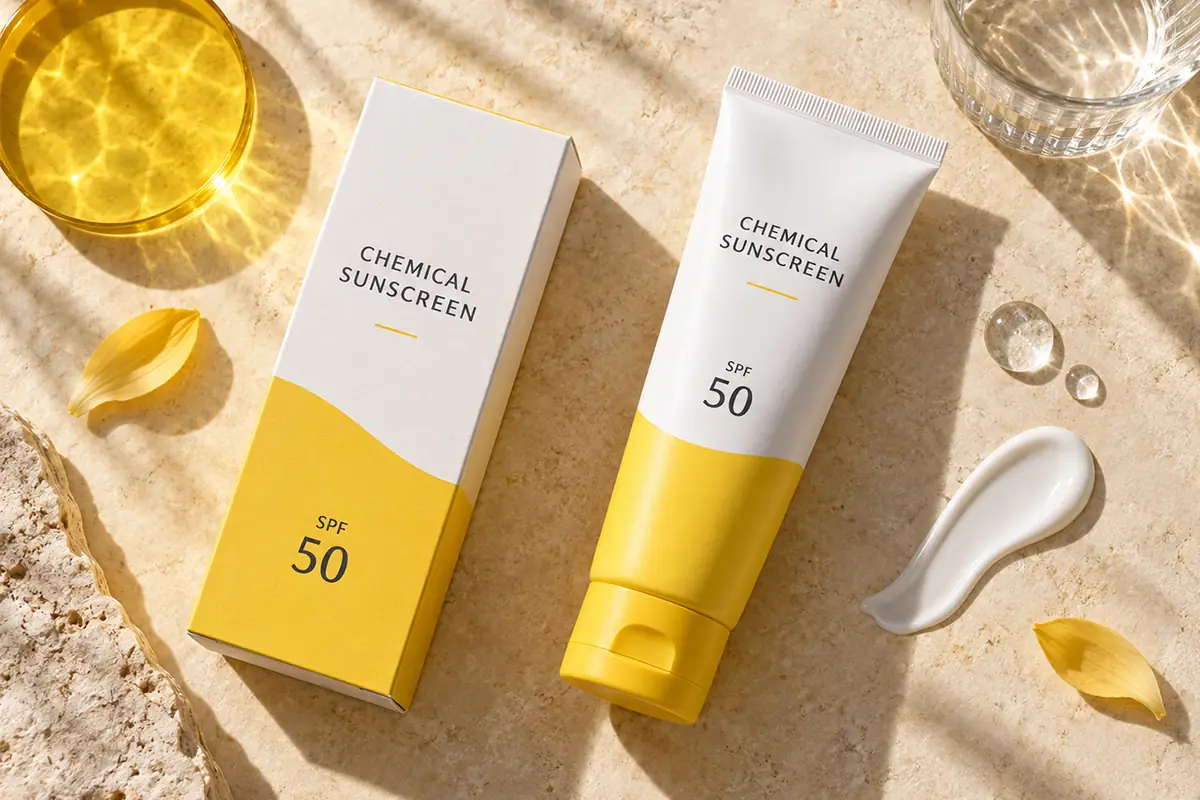
Sourcing Chemical UV Filters
Chemical sunscreen manufacturing is governed by filter solubility, photostability, and regional regulatory boundaries.
- The Solubilization Challenge: Several oil-soluble organic UV filters are crystalline solids at room temperature. They must be dissolved in a compatible ester or oil system and remain soluble after the batch has cooled. If the solvent balance is inadequate, the filter may recrystallize during cold storage or temperature cycling, changing skin feel, filter distribution, and potentially the finished-product performance.
- Photostabilization: Avobenzone provides important UVA coverage but requires a carefully designed supporting system. Depending on the formula and market, compatible UV filters, photostabilizing materials, antioxidants, chelating agents, and film-forming polymers may contribute to stability. The presence of one supporting ingredient does not by itself guarantee photostability; the complete finished formula must be evaluated.
- Regional Regulatory Divergence: A UV filter permitted in one territory may not be available under the regulatory framework of another. Filter selection must therefore begin with the intended sales markets rather than after the formula has already been finalized.
| Regulatory Region | Practical Filter Access | Important Limitations |
|---|---|---|
| United States | Zinc Oxide and Titanium Dioxide are established mineral GRASE actives. In June 2026, FDA added Bemotrizinol at concentrations up to 6% as another GRASE sunscreen active. Legacy filters such as Avobenzone, Homosalate, Octisalate, Octocrylene, and Ensulizole remain relevant to U.S. monograph sunscreen development, subject to current conditions. | DHHB/Uvinul A Plus, Ethylhexyl Triazone/Uvinul T 150, and MBBT/Tinosorb M are not automatically available as U.S. OTC monograph actives. |
| European Union and UK | A broader selection of modern organic UV filters is available, including Bemotrizinol, MBBT, DHHB, and Ethylhexyl Triazone, subject to applicable positive lists and concentration limits. | Nano-related requirements, maximum concentrations, labeling conditions, and authorized material specifications must be reviewed for the intended market. |
| Australia | Therapeutic sunscreen development can access a broad filter toolbox under the applicable TGA framework. | Primary therapeutic sunscreens must comply with Australian ingredient, manufacturing, evidence, labeling, and ARTG requirements. Australia should not be treated as automatically identical to the EU. |
The FDA’s June 2026 addition of Bemotrizinol narrows one part of the historical gap between American and international sun care, but it does not make a European sunscreen formula automatically transferable to the United States.
Brands planning multi-market launches should compare potential partners in our reviews of private label sunscreen manufacturers in the USA and UK private label sunscreen manufacturers.
Factory-Floor Processing and Compounding Engineering
Mineral and chemical sunscreens do not necessarily require completely separate production lines, but they demand different critical controls inside the manufacturing plant.
The Mineral Production Route: Wetting and De-Agglomeration
The fundamental manufacturing challenge with mineral UV filters is dispersion.
Zinc oxide and titanium dioxide particles attract one another and can form microscopic clusters. If these agglomerates remain in the finished emulsion, the product may feel gritty, apply with visible streaks, and create an uneven filter distribution across the skin.
A typical mineral compounding process includes:
- Phase Wetting: The powder is gradually introduced into a compatible oil or ester phase. Proper wetting replaces the air surrounding the particles and creates a workable premix before the material enters the main emulsion.
- Controlled High-Shear Processing: Rotor-stator homogenizers, in-line dispersers, or wet-milling equipment may be used to reduce loose agglomerates and reach a reproducible dispersion state. The objective is not simply to apply maximum shear. Excessive processing can introduce air, increase temperature, or alter the surrounding rheology system.
- Temperature and Phase Control: The water and oil phases should be combined within the manufacturer’s validated temperature range. Large or uncontrolled temperature differences can affect emulsification, viscosity development, and particle distribution, but there is no universal ±2°C requirement for every mineral formula.
- Suspension During Cooling and Filling: Mineral particles are substantially denser than the surrounding emulsion. Controlled sweep mixing may therefore be needed during cooling, holding, and filling so that the beginning and end of a commercial batch remain compositionally consistent.
Mineral formulas can also require longer cleaning and line-turnaround procedures because hydrophobic powder residues may remain on vessel walls, transfer lines, and filling equipment. This operational factor can influence production scheduling and batch pricing.
The Chemical Production Route: Dissolution and Cooling Control
Chemical sunscreen compounding is primarily an exercise in solubility management.
Solid organic filters are heated in compatible emollients until the intended dissolved or dispersed state is achieved. The required temperature depends on the selected filters, solvent system, supplier recommendations, and validated manufacturing process; a universal 75–80°C range should not be applied to every formula.
Once emulsification is complete, the cooling profile becomes important. A filter that remains fully soluble at an elevated temperature may approach its solubility limit as the product cools. If the system becomes supersaturated, microscopic seed crystals may form and grow during later cold storage.
The batch may therefore look smooth immediately after production but develop crystals several days or weeks later.
Where oxidation or air incorporation presents a documented risk, vacuum deaeration, controlled headspace, antioxidant systems, or nitrogen blanketing may be considered. Nitrogen is not an automatic requirement for every chemical sunscreen.
Hybrid Production: Managing Both Behaviors
Hybrid formulas require the manufacturer to suspend insoluble mineral particles while maintaining the solubility and photostability of organic filters.
A change that improves one side of the formula can destabilize the other. Increasing the oil phase may improve organic-filter solubility but reduce the suspension strength needed to control mineral settling. Adding more thickener may slow sedimentation but create drag, pilling, or an uneven film.
For this reason, a hybrid sunscreen is not simply an existing mineral base with several organic filters added. The entire system must be developed and tested as one formula.
Stability Failure Modes: Why Sunscreen Formulas Fail
Sunscreen development commonly includes elevated-temperature, room-temperature, cold-storage, and freeze-thaw evaluations. A 12-week accelerated program is frequently used as a development screen, but the exact conditions and acceptance criteria should be selected according to the formula, package, intended market, and manufacturer’s stability protocol.
Accelerated testing helps reveal likely failure modes; it does not by itself mathematically prove a specific shelf life.
Mineral Sunscreen Failure Mechanisms
- Viscosity Creep: A mineral emulsion may gradually become thicker or thinner during storage. Possible causes include particle-network reorganization, electrolyte interactions, pH movement, polymer sensitivity, and incompatibility between the mineral surface treatment and the rheology system. The release of metal ions and their interaction with certain thickeners is one possible mechanism, but it should not be treated as the universal explanation for every viscosity change.
- Sedimentation and Caking: Zinc oxide and titanium dioxide have much higher densities than a typical emulsion. If the continuous phase does not provide sufficient suspension strength, the particles may settle. A soft sediment that can be redistributed differs from a hard, compacted cake that cannot be restored, but both should be investigated during development.
- Syneresis: When the particle, emulsifier, and rheology networks are poorly balanced, the formula may contract and expel free oil or water. This appears as pooling on the product surface or separation around the container walls.
Chemical Sunscreen Failure Mechanisms
- Filter Recrystallization: Crystals appearing during cold storage or temperature cycling indicate that one or more filters are no longer adequately maintained in the intended phase. Possible causes include insufficient long-term solvency, an unfavorable cooling profile, filter interactions, or changes elsewhere in the oil phase.
- Color and Odor Change: Yellowing or odor shift may result from oxidation, filter degradation, fragrance interaction, botanical ingredients, trace metals, or instability in another part of the emulsion. Visual change alone does not identify the cause; controlled comparison samples and analytical review may be required.
- Packaging Incompatibility: Organic filters, solvents, fragrance materials, and propellants can interact with plastics, seals, gaskets, coatings, or package decoration. Possible outcomes include swelling, leakage, loss of pump performance, decoration damage, or changes in spray rate. The risk depends on the complete formula and package rather than on one filter alone.
SPF Testing, Film Formation, and Change Control
One of the most dangerous commercial assumptions is believing that “SPF is calculated by adding up active ingredient percentages.”
UV-filter percentages are important during formulation screening, but SPF is a performance property of the complete finished product after it has been manufactured and applied to the skin.
[UV Filter System] + [Emulsion Structure] + [Dispersion and Solubility]
                              |
                   [Applied to the Skin]
                              |
              [Uniform Finished Film] → Tested SPF Performance
The Finished-Film Reality
During standardized SPF testing, sunscreen is commonly applied at 2 mg/cm². The formula must spread across the microscopic peaks and valleys of the skin and distribute its filters as evenly as possible.
If mineral particles are agglomerated, some regions may contain excessive powder while others remain under-protected. If an organic filter has recrystallized, it is no longer distributed in the intended state. If the emulsion dries with irregular gaps, the measured SPF can be lower than expected even when the theoretical filter loading appears sufficient.
Film-forming polymers such as VP/Eicosene Copolymer or selected acrylate systems may improve film continuity, rub resistance, or water resistance. They are not universally mandatory, and they do not independently guarantee SPF. Excessive or unsuitable film-former use may create tackiness, pilling, stiffness, or incompatibility with the emulsion.
The Formulation Change-Control Trap
A finished-product SPF result should not automatically be transferred to a modified formula.
- Pigments and Shades: Iron oxides alter total powder loading, viscosity, spreading, visible-light attenuation, and film distribution. Brands should not assume that every additional shade automatically shares the exact SPF result of the originally tested formula. The required verification should be determined through documented technical and regulatory assessment.
- Emulsifiers, Solvents, and Thickeners: These materials may not be classified as UV filters, but they control filter solubility, droplet structure, viscosity, drying, and spreading. A substitution can therefore affect the finished film and should undergo formal change control.
- Fragrance and Botanical Adjustments: A minor fragrance change does not create the same testing obligation in every market. However, certain fragrance materials or essential oils may affect solvent balance, stability, irritation potential, or phototoxicity review. The extent of additional stability, compatibility, safety, or efficacy verification should reflect the actual change.
- Packaging and Dispenser Changes: Moving a sunscreen between an airless pump, mechanical spray, stick, dropper, or pressurized aerosol can alter the amount and pattern of product delivered. If the formula or application behavior changes, the original performance data may need additional verification.
Pressurized Aluminum Aerosols vs. Mechanical Pump Sprays
A pressurized sunscreen spray filled in an aluminum aerosol can is not interchangeable with a non-aerosol plastic pump spray.
When a formula uses hydrocarbon propellants such as butane, propane, or isobutane, the bulk sunscreen, propellant ratio, internal can coating, valve, gasket, actuator, pressure, spray rate, and deposited film must function as one delivery system.
For water-containing formulas, particularly those containing electrolytes such as sodium chloride, the integrity and compatibility of the can’s internal coating should be evaluated. The presence of an electrolyte does not prove that corrosion will occur, but it makes long-term package compatibility especially important.
Mineral or hybrid aerosols also require control of particle settling and valve blockage. Organic-filter systems require confirmation that the filters, solvents, propellant, seals, and internal coating remain compatible throughout storage.
A mechanical pump spray normally contains no liquefied-gas propellant and depends instead on formula viscosity, pump output, dip-tube performance, and nozzle design. Moving the same sunscreen between these two formats can change droplet distribution, application density, and film uniformity, so the change should not be treated as a purely visual packaging substitution.
For brands comparing a pre-tested base with ground-up development, these variables should be considered alongside the broader differences between private label and custom formulation.
Strategic Selection: Which Route Fits Your Brand Roadmap?
                             [Brand Product Brief]
                                      |
              -------------------------------------------------
              |                       |                       |
      [Mineral Route]         [Chemical Route]          [Hybrid Route]
      Mineral-led claim       Transparent texture       Balanced sensory
      Tinted formats          Fluids and sprays         Mixed filter system
      Dispersion control      Solubility control        Combined validation
Choose a Mineral Route When:
- Zinc oxide or titanium dioxide is central to the product concept.
- You are developing a tinted facial sunscreen, solid stick, rich lotion, or complexion-protecting product in which some mineral opacity can be incorporated into the intended finish.
- Your brand accepts the formulation and manufacturing work required to manage powder dispersion, white cast, suspension stability, and packaging compatibility.
- The target market and claim strategy support the selected particle grade and documentation.
Mineral does not automatically mean gentle, natural, reef-safe, or appropriate for every sensitive skin type. Those claims require separate substantiation and regulatory review.
Choose a Chemical Route When:
- Transparent application, low white cast, and a lightweight sensory profile are central to the product brief.
- You are developing a fluid lotion, transparent gel, essence-like sunscreen, mechanical spray, or continuous aerosol format.
- The selected filters are permitted in the intended market.
- The manufacturing partner has a validated approach to filter solubility, crystallization control, photostability, and final-package compatibility.
Chemical sunscreen does not automatically mean unstable or irritating. Performance depends on the selected filters and the complete formula.
Choose a Hybrid Route When:
- You want to retain mineral content while reducing the opacity or heaviness associated with a higher mineral load.
- The product requires a balance among broad-spectrum performance, wearability, and reduced white cast.
- Every filter and concentration has been checked against the intended market.
- The manufacturer can control mineral dispersion and organic-filter solubility within the same system.
The FDA’s 2026 addition of Bemotrizinol may create more flexibility for selected U.S. chemical and hybrid development routes. However, formulas containing other filters outside the applicable U.S. monograph conditions still require reformulation or another valid regulatory pathway.
For product roadmaps targeting Australia, review our guide to Australian sunscreen contract manufacturers.
How Shangpinhui Connects Suncare R&D with Commercial Manufacturing
At Shangpinhui Biotechnology Co., Ltd. (BeautyOEM), sunscreen development begins with the intended market, filter route, product format, and performance target—not with a generic list of available UV filters.
Current Shangpinhui production examples include a multi-filter SPF lotion and a pressurized sunscreen spray filled in an aluminum aerosol can. The lotion requires coordination among filter solubility, titanium dioxide dispersion, emulsion stability, and skin feel. The aerosol spray requires the bulk formula, hydrocarbon propellants, internal coating, valve, actuator, pressure, and deposited spray film to perform as one system.
This practical manufacturing experience supports several development routes:
- Mineral and Hybrid Dispersion: Surface-treated mineral filters can be evaluated with compatible ester, emulsifier, and rheology systems to balance dispersion stability, texture, and visible residue.
- Functional Daily Suncare: Depending on formula compatibility and the intended market, daily sunscreens can be combined with barrier-supporting ingredients such as ceramides, ectoin, or selected soothing ingredients. These additions must not compromise filter stability or finished-product testing. Related technologies are discussed in our guide to barrier-repair formulation systems.
- Formula and Package Compatibility: Lotion, pump-spray, stick, and aerosol formats require different viscosity, filling, compatibility, and delivery controls. The commercial package is evaluated as part of the finished product rather than selected after formula development.
- Technical Documentation: Shangpinhui supports quantitative ingredient disclosures, COA and MSDS documentation, stability and microbiological records, and other technical materials required for the relevant project. Finished-product SPF, UVA, water-resistance, and market-specific evidence should follow the requirements of the intended territory.
Brands can review additional formulation options in the Shangpinhui Product Center or compare the broader global private label sunscreen manufacturing landscape.
Frequently Asked Questions
Why do mineral sunscreens sometimes get thicker inside the bottle?
This behavior is often described as viscosity creep, but it does not have one universal cause.
Possible mechanisms include particle-network reorganization, electrolyte interaction, pH movement, polymer sensitivity, and incompatibility between the mineral surface treatment and the rheology system. In some formulas, released metal ions may interact with selected thickeners, but this should be confirmed rather than assumed.
Corrective action depends on identifying the actual mechanism through controlled stability comparison.
Can my brand use the same sunscreen formula in both the United States and Europe?
Generally, not without a market-specific regulatory review.
The FDA’s June 2026 addition of Bemotrizinol reduces one important difference, but the EU and UK still permit several modern filters that are not available as U.S. OTC monograph actives.
The finished product must also satisfy the applicable requirements for active concentrations, manufacturing, testing, labeling, and market authorization. A European sunscreen should therefore not be assumed to be U.S.-compliant without reviewing the full quantitative formula.
If I change the fragrance or iron oxide tint, must I repeat the SPF test?
Not every change creates the same testing obligation.
Iron oxides can alter powder loading, viscosity, spreading, visible-light attenuation, and film distribution. Fragrance changes can affect solvent balance, stability, and safety assessment depending on their composition and use level.
The manufacturer should document the change, assess its potential effect on the tested product, and determine whether confirmatory stability, compatibility, SPF, UVA, or other testing is required.
What can cause chemical sunscreens to sting the eyes or mark clothing?
Eye stinging can result from multiple factors, including filter migration, volatile carriers, fragrance, alcohol content, film behavior, and individual sensitivity. It should not automatically be attributed to one organic filter.
Yellow or orange marks on light-colored clothing are commonly associated with avobenzone interacting with iron in water during washing, although the finished formula, fabric, detergent, and water chemistry all influence the result.
Film-forming systems, chelating agents, application instructions, and appropriate product positioning may help reduce these problems, but they do not eliminate every possible consumer-use variable.
Secure Your Suncare Formulation with Scientific Precision
Launching a commercially reliable sunscreen requires alignment among filter compatibility, plant-floor processing, stability controls, packaging performance, and finished-product testing.
A mineral formula can fail when particles agglomerate or settle. A chemical formula can fail when filters recrystallize or degrade. A hybrid formula can fail when the dispersion and solvent systems are not compatible. A pressurized aerosol can fail even when the bulk formula looks stable if the propellant, valve, internal coating, or spray pattern is unsuitable.
The most reliable development process treats the formula, manufacturing method, commercial package, and regulatory evidence as one connected system.
Whether your product roadmap requires a mineral lotion, lightweight chemical fluid, hybrid daily sunscreen, or aluminum aerosol spray, clarity on the target market and testing pathway should come before commercial production.
Connect with the Shangpinhui formulation team to discuss your target specifications, UV-filter route, packaging format, and market-specific testing requirements.