When beauty founders and product managers contact a cosmetic OEM/ODM manufacturer, they frequently run into confusing industry terminology: Do you need White Label, Private Label, or Custom Formulation?
To make matters worse, different cosmetic factories use these terms inconsistently. One manufacturer calls their ready-to-ship stock catalog “private label,” while another calls simple fragrance adjustments “custom formulation.”
Choosing the wrong manufacturing pathway can exhaust your startup capital before launch, delay your timeline by six months, or leave you selling an identical formula already saturated across Amazon and TikTok Shop.
Commercial skincare manufacturing is not a binary choice between “buying a generic stock cream” and “inventing an entirely new molecule.” Instead, it operates across three practical development tiers.
This guide strips away industry jargon to clarify how White Label, Private Label (Semi-Custom), and Bespoke Custom Formulation differ in real-world formulation freedom, production minimums (MOQs), development timelines, testing obligations, and proprietary formula ownership.
Quick Answer: Which Manufacturing Route Fits Your Brand?
- Choose White Label if you need to launch quickly, have a limited initial budget, and are comfortable using an unchanged stock formula with available packaging.
- Choose Private Label (Semi-Custom) if you want to start from a validated base but need selected formula adjustments, stronger ingredient positioning, or custom-decorated packaging.
- Choose Custom Formulation if your product strategy depends on a new formulation architecture, specialized delivery technology, distinctive texture, or commercially negotiated formula exclusivity.
In this guide, “white label” refers to an unchanged stock formula, “private label” refers to a validated base with limited customization, and “custom formulation” refers to a formula developed around a new product brief. Manufacturers may use these terms differently, so always compare the actual scope of work rather than the service name alone.
What Is White Label Skincare? (Turnkey Speed)
White label skincare relies on mature, pre-compounded bulk formulas that the manufacturer already produces in ongoing commercial batches.
- The Workflow: You review the factory’s stock catalog, select an approved formula (such as an existing 2% Salicylic Acid Cleanser or a Hyaluronic Acid Serum), pair it with factory-stocked bottles, and apply your custom label.
- The Trade-Off: Speed and simplicity over exclusivity. You cannot alter the ingredient deck, fragrance, or texture. Other brands may sell the identical formula under a different label. However, a new formula-development fee is usually unnecessary, although sampling, packaging, artwork, filling, and setup charges may still apply. Sampling takes just days, and inventory ships quickly.
What Is Private Label Skincare? (Semi-Custom Adaptation)
In professional contract manufacturing, true private label development is semi-custom engineering. You start with a factory’s validated formulation “chassis” (such as a proven lamellar barrier cream base) and modify specific commercial attributes.
- The Workflow: The chemist adjusts the base by dosing your signature hero actives (e.g., adding 2% Ectoin or custom fermented extracts), tweaking the viscosity, adding an allergen-free fragrance, and using custom-decorated packaging.
- The Trade-Off: A balance of brand differentiation and managed risk. You avoid the uncertainty of formulating an emulsion from zero, but still gain a distinct marketing story and packaging profile.
What Is Custom Formulation? (Bespoke Engineering)
Custom formulation is ground-up chemical development designed specifically around your proprietary Product Brief.
- The Workflow: You define the active performance targets, skin-feel benchmarks, lipid-to-water ratios, specific delivery mechanisms (such as liposomes or microencapsulation), and clean-beauty exclusions. The laboratory develops bench prototypes through multiple feedback rounds until the formula matches your exact vision.
- The Trade-Off: Maximum exclusivity and product defensibility, paired with higher capital and time commitments. Bespoke formulas require mandatory 12-week accelerated stability testing, preservative efficacy challenges (PET), and container compatibility evaluations before mass production can begin.

Full Comparison: White Label vs. Private Label vs. Custom Formulation
| Decision Factor | White Label | Private Label / Semi-Custom | Custom Formulation |
|---|---|---|---|
| Formula Origin | Existing factory formula used without ingredient changes | Validated base with approved adjustments | New formula developed around a product brief |
| Formula Exclusivity | Usually non-exclusive | Base normally remains non-exclusive; specific modifications may be protected by agreement | Exclusivity can be negotiated and must be defined in the contract |
| Formula Ownership | Usually retained by the manufacturer | Factory normally retains the base; rights to modifications depend on the agreement | Ownership, licensing, and transfer rights depend on the development agreement |
| Development Timeline | Often 2–4 weeks when formula and packaging are available | Often 6–10 weeks, depending on changes and required checks | Usually several months once formulation, validation, packaging, and documentation are included |
| Development and Testing Cost | Lowest; a new formula-development fee is usually unnecessary | Moderate; sampling and additional checks may be required | Highest; may include R&D, repeated prototypes, testing, and claim substantiation |
| MOQ | Usually the lowest with stock packaging | Commonly moderate and influenced by formula and decorated-packaging requirements | May be higher when special raw materials, custom components, or molds are required |
| Product Differentiation | Mainly through branding and packaging | Through selected ingredients, sensory adjustments, claims, and decoration | Through formula architecture, performance, texture, and delivery technology |
| Packaging Options | Mainly stock containers and labels | Stock packaging with printing, coating, hot stamping, or custom colors | Stock, decorated, or fully customized packaging depending on budget and quantity |
| Technical Documentation | Existing technical documents may be available sooner | Documents may require updates after formula changes | Product-specific safety, testing, and market-entry documents may be required |
These are working ranges rather than fixed industry rules. Formula complexity, testing requirements, packaging availability, destination market, and order quantity can all affect the final cost and schedule.
Formula Ownership, Exclusivity, and Portability
One of the most frequent misunderstandings in contract manufacturing is assuming that paying for an order automatically grants you legal ownership of the formulation.
With white label and semi-custom development, the manufacturer normally retains ownership of the original formula base, ingredient ratios, and production process. Your brand owns its trademarks, packaging artwork, and commercial positioning, but it cannot automatically take the factory’s formula to another supplier. A published INCI list identifies the ingredients but does not reveal their exact percentages, raw-material specifications, or manufacturing process.
Custom formulation provides more room to negotiate ownership and exclusivity, but neither is automatic. Depending on the development agreement, the brand may receive full ownership, exclusive usage rights, or the right to purchase the finished product only. An NDA protects confidential information, but it does not by itself transfer formula ownership or prevent the manufacturer from producing similar formulas.
Before paying a development deposit, make sure the agreement answers three questions:
- Who owns the complete formula and manufacturing process?
- Can the brand transfer the formula to another manufacturer?
- Can the factory produce the same or a substantially similar formula for another customer?
These three answers determine whether you are simply purchasing a custom-manufactured product or investing in a formula that can become a long-term brand asset.
Why Even Small Formula Changes May Require New Checks
Brand founders often ask: “If I start from a proven private label base and only swap one botanical extract or adjust the fragrance, why does the factory require additional testing?”
In cosmetic science, an emulsion functions as an interconnected chemical and physical system. Adjusting a seemingly minor ingredient can affect the stability of the complete formula:
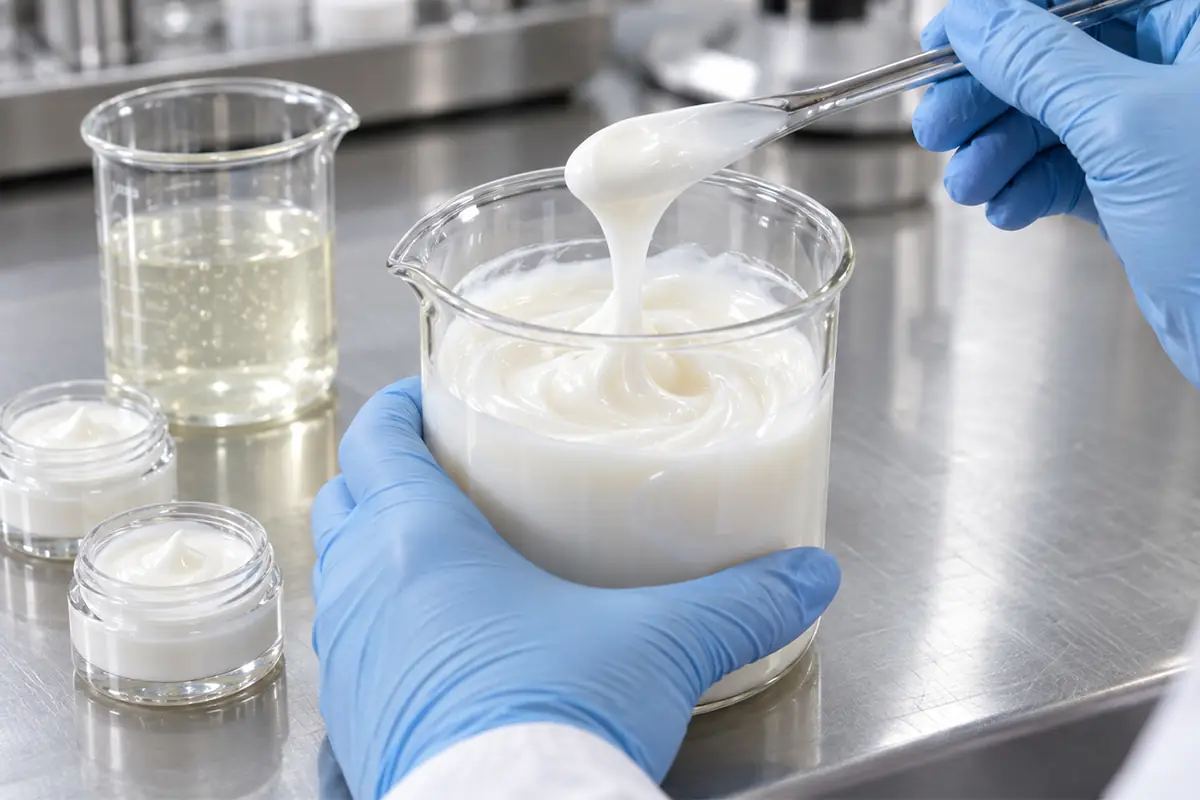
- Preservative Performance: Some botanical extracts can change the formula’s pH, ionic load, or microbial risk. This may reduce the effectiveness of the original preservative system and require additional microbial or preservative-efficacy checks.
- Viscosity and Phase Stability: Replacing an unscented base with a fragrance or essential-oil blend can change solubility and the balance of the emulsion, potentially causing thinning, cloudiness, viscosity loss, or phase separation.
- Packaging Compatibility: Essential oils, solvents, and certain active ingredients may interact with plastics, seals, dip tubes, or pump components. Depending on the formula and package, this can lead to swelling, softening, leakage, dispensing problems, or bottle paneling.
For an itemized breakdown of how compounding minimums, packaging runs, and laboratory testing affect the real project budget, read our practical guide to cosmetics manufacturer MOQ and project costs.
Which Route Fits Your Brand Stage?
Brand stage is a useful starting point, but the final decision should also reflect the role of the product, available capital, required differentiation, and acceptable launch timeline.
1. First Launch or Market Test
- Recommended Route: White Label or Mature Private Label Base.
- Why: When validating product-market fit on Amazon, TikTok Shop, or boutique retail, your primary business risk is customer acquisition rather than formulation complexity. Using a proven catalog formula allows you to test market demand, build cash flow, and collect customer feedback without tying up capital in a lengthy custom-development cycle.
2. Growing Brand with Customer Feedback
- Recommended Route: Semi-Custom Private Label.
- Why: Once you have verified demand and understand what your customers want, you can create stronger differentiation. Starting from a validated base and adding an approved hero active, adjusting the sensory profile, or upgrading the packaging gives the product a clearer brand identity while maintaining a more predictable development process.
3. Established Brand Building a Hero Product
- Recommended Route: Full Custom Formulation.
- Why: When you are preparing for major retail placement, developing a hero product, or positioning the brand around a specific performance claim, custom formulation gives you greater control over product performance, texture, active delivery, testing, and long-term differentiation.
A new brand does not always have to begin with white label, and an established brand does not need to customize every product. The right choice is the least complex manufacturing route that can still deliver the differentiation your product strategy requires.
How Shangpinhui Supports Each Route
Shangpinhui Biotechnology Co., Ltd., the manufacturer behind BeautyOEM.com, supports white label, semi-custom, and full custom development according to the brand’s budget, timeline, and product objectives.
- Flexible Commercial Starting Points: Standard private label and semi-custom projects commonly begin from 1,000 finished units. Selected projects using available formulas and pre-stocked packaging may be discussed from 500 units, subject to the product and component inventory.
- Fast Initial Sampling: Mature-formula samples can normally be prepared in 3–5 business days, while an initial custom-formulation prototype may be prepared in approximately 7 business days when the required raw materials are available. These estimates apply to initial samples, not the complete testing and commercial-production timeline.
- Advanced Formulation Technologies: Our R&D capabilities include botanical fermentation, liposomal delivery, nanoemulsion systems, microencapsulation, and biomimetic barrier-support systems. These technologies can be selected when they improve active stability, delivery, sensory performance, or product differentiation.
- Controlled Formula Customization: For semi-custom projects, our formulators evaluate the compatibility of requested actives, fragrance, texture, packaging, and target-market requirements before confirming the modification plan.
- Clearly Defined Formula Protection: For eligible custom projects, confidentiality, formula usage, ownership, transfer rights, and commercial exclusivity can be defined in the written development agreement. Where exclusivity is agreed, its scope is clearly stated rather than relying on a general NDA alone.
- Manufacturing and Export Support: Operating under ISO 22716 and GMPC standards, Shangpinhui can support stability, microbiological, efficacy, and packaging-compatibility testing according to project needs. Available documentation may include ingredient declarations, COAs, MSDS/SDS, CFS, LOA, stability reports, PIF materials, and other files required for the agreed destination market.
Frequently Asked Questions (FAQ)
Can a private label skincare formula be exclusive to my brand?
Standard white label and private label base formulas are generally non-exclusive, so multiple brands may use the same core formula. A semi-custom or bespoke formula may receive commercial exclusivity only when the development agreement defines what is protected, where the exclusivity applies, and how long it lasts. An NDA protects confidential information but does not by itself grant ownership or exclusivity.
Can a brand start with white label and transition to custom formulation later?
Yes. In fact, this is one of the most commercially disciplined strategies for startup brands. Launching a pre-tested white label or semi-custom formula allows you to validate customer acquisition, build cash flow, and gather real feedback. Once sales volume is predictable, you can invest those profits into engineering a proprietary custom formula.
Does custom formulation always require a higher production MOQ?
Not necessarily for bulk compounding, but packaging minimums often drive the requirement higher. While specialized pilot kettles can compound custom bulk in batches around 1,000 units, custom-printed bottles, unique component colors, and specialized dispensing pumps frequently enforce minimums of 3,000 to 5,000 units from packaging suppliers.
Which manufacturing route is best for a first-time skincare launch?
White label is usually the most practical option when speed, budget control, and market validation come first. Semi-custom private label is a better fit when the brand already has clear positioning and needs moderate formula or packaging differentiation. Full custom development makes sense when product performance is central to the brand and the business can support a longer development and validation cycle.
Build Your Brand on the Right Manufacturing Foundation
Choosing between White Label, Semi-Custom Private Label, and Bespoke Custom Formulation is a strategic decision that aligns your capital, timeline, and competitive moat.
To prepare your project brief before contacting our laboratory, review our checklist on what information to prepare before asking for an OEM quote.
Whether you need rapid market deployment using pre-tested clinical bases or want to engineer proprietary biotechnology powered by custom herbal fermentations, Shangpinhui Biotechnology provides the formulation agility, manufacturing discipline, and strict IP protection your brand needs to scale.
Connect with our formulation engineering team to discuss your product brief, evaluate custom active architectures, or arrange benchtop sample prototypes for your brand.