Launching a private label sunscreen in the United States is fundamentally different from developing a facial serum, moisturizer, or cleanser.
In the U.S., products marketed with an SPF claim are regulated by the Food and Drug Administration as over-the-counter drugs rather than ordinary cosmetics. The finished product must comply with applicable FDA sunscreen monograph conditions, drug cGMP requirements, Drug Facts labeling, establishment registration, product listing, and formulation testing.
This creates an important distinction between general skincare factories and qualified sunscreen manufacturers. A laboratory may be capable of making after-sun gel, tanning oil, or antioxidant moisturizer without having the regulatory systems required to manufacture an OTC sunscreen.
The following comparison focuses on ten U.S. manufacturers with publicly documented sunscreen or OTC manufacturing capabilities. The objective is not to declare one factory universally “best,” but to help brands identify the most suitable partner based on formula type, product format, development route, production scale, and sales channel.
Quick Answer: Which U.S. Sunscreen Manufacturer Is Best for Your Brand?
- For full-service commercial sunscreen production: Pure Source supports mineral, chemical, hybrid, lotion, spray, and bag-on-valve formats.
- For prestige mineral SPF and tinted complexion products: Solésence Beauty Science specializes in proprietary mineral technologies and SPF-infused beauty products.
- For ready-to-market formulas within a broader skincare line: Allure Beauty Concepts offers pre-developed sunscreen programs alongside custom skincare manufacturing.
- For continuous sprays and bag-on-valve packaging: InSpec Solutions has dedicated aerosol and pressurized filling capabilities.
- For sunscreen sticks and hot-pour formats: FP Labs combines SPF formulation with in-house container engineering.
- For broader OTC personal care manufacturing: FillTech USA supports sunscreen, SPF lip care, lotions, creams, and other topical products.
- For professional and clinical skincare channels: CoValence Laboratories and Sarati International offer mineral SPF options suited to spas, clinics, and boutique skincare brands.
- For collaborative custom development: Respect Manufacturing and Pure Velocity Suncare provide private label and custom sunscreen pathways.
Quick Comparison of U.S. Private Label Sunscreen Manufacturers
| Manufacturer | Location | Primary Capability | Development Route | Best Fit |
|---|---|---|---|---|
| Pure Source | Miami, Florida | Mineral, chemical, hybrid and spray sunscreen | Private label and custom | Scaling brands and national retail |
| Solésence Beauty Science | Romeoville, Illinois | Prestige mineral SPF and tinted hybrids | White label, modified and custom | Premium skincare and complexion brands |
| Allure Beauty Concepts | Hayward, CA and Scottsdale, AZ | Ready-to-market SPF and custom skincare | Private label and custom | Multi-category beauty brands |
| InSpec Solutions | Holly Hill, Florida | BOV, aerosol, continuous spray, lotions and sticks | Formula library and custom | Spray-focused and high-volume programs |
| FillTech USA | Rockwell, North Carolina | OTC lotions, sunscreen and SPF lip care | Contract manufacturing | Established personal care brands |
| FP Labs / Federal Package | Chanhassen, Minnesota | Sunscreen sticks and hot-pour SPF | Turnkey and custom | Portable and solid sun protection |
| Pure Velocity Suncare | Chatsworth, California | Mineral, chemical and sport sunscreen | White label and custom | Outdoor, wellness and indie brands |
| CoValence Laboratories | Chandler, Arizona | Professional mineral SPF and clinical skincare | Private label and custom | Medical spas and professional skincare |
| Respect Manufacturing | Denver, Colorado | Mineral and chemical SPF development | Private label and custom | Growing DTC skincare brands |
| Sarati International | Los Fresnos, Texas | Ready-to-label mineral sunscreen and after-sun care | Catalog private label and custom | Spas, salons and boutique brands |
What “FDA Compliant” Means for Private Label Sunscreen
There is no legal credential called an “FDA-certified sunscreen manufacturer.”
A factory may maintain an FDA drug establishment registration, and a finished sunscreen product may be listed and assigned a National Drug Code. Registration, drug listing, and an NDC do not mean that the FDA has approved, certified, or endorsed the manufacturer or product.
Most nonprescription sunscreens enter the U.S. market through the OTC sunscreen monograph pathway. A product that conforms to the applicable monograph conditions may be marketed without a separately approved New Drug Application.
Core requirements include:
- Permitted sunscreen active ingredients within applicable concentration limits
- Drug Facts labeling that complies with federal formatting requirements
- Appropriate SPF and broad-spectrum testing for the intended claims
- Water-resistance testing when making a 40- or 80-minute claim
- Drug cGMP systems covering raw materials, manufacturing controls, batch records, testing and release
- Drug establishment registration and finished-product listing where applicable
Important 2026 Regulatory Updates
In June 2026, the FDA added bemotrizinol to the OTC sunscreen monograph at concentrations up to 6%. This was the first new sunscreen active ingredient added to the U.S. monograph in more than two decades.
In September 2026, the FDA issued a final administrative order removing PABA and trolamine salicylate from the sunscreen monograph after determining that their risk profiles no longer supported continued GRASE status.
Brands should therefore evaluate manufacturers using current FDA administrative orders rather than relying on older sunscreen ingredient summaries.
Detailed Reviews of the Top 10 Manufacturers
1. Pure Source
Pure Source is a Florida-based contract manufacturer specializing in topical pharmaceuticals, cosmetics, and OTC sun care.
Its sunscreen capabilities cover mineral and chemical lotions, creams, gels, manual sprays, continuous sprays, bag-on-valve systems, and tinted SPF products. The company also provides formulation, testing coordination, packaging, manufacturing, and regulatory support.
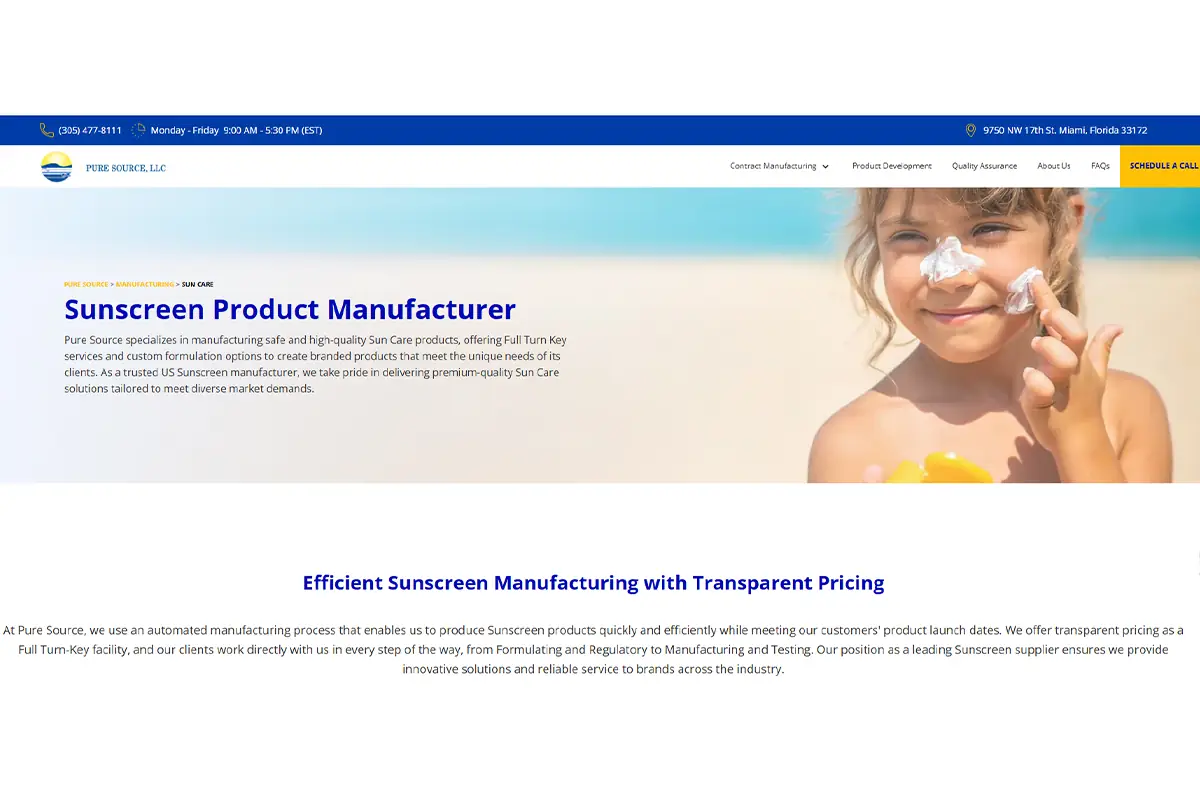
Pure Source publicly states a minimum of approximately 5,000 units per sunscreen product, making it more suitable for brands that have moved beyond small-scale market testing.
Best fit: Scaling brands, national retail programs, sport sunscreen lines, and companies requiring multiple sunscreen formats from one manufacturing partner.
2. Solésence Beauty Science
Solésence Beauty Science develops and manufactures mineral-based skincare, complexion products, and SPF-infused beauty formulations from Illinois.
Its main differentiator is proprietary mineral technology designed to improve zinc oxide dispersion, sensory feel, and transparency across different skin tones. Its product formats include tinted sunscreen, SPF primer, complexion products, lip oil, face oil, and lightweight daily sun protection.
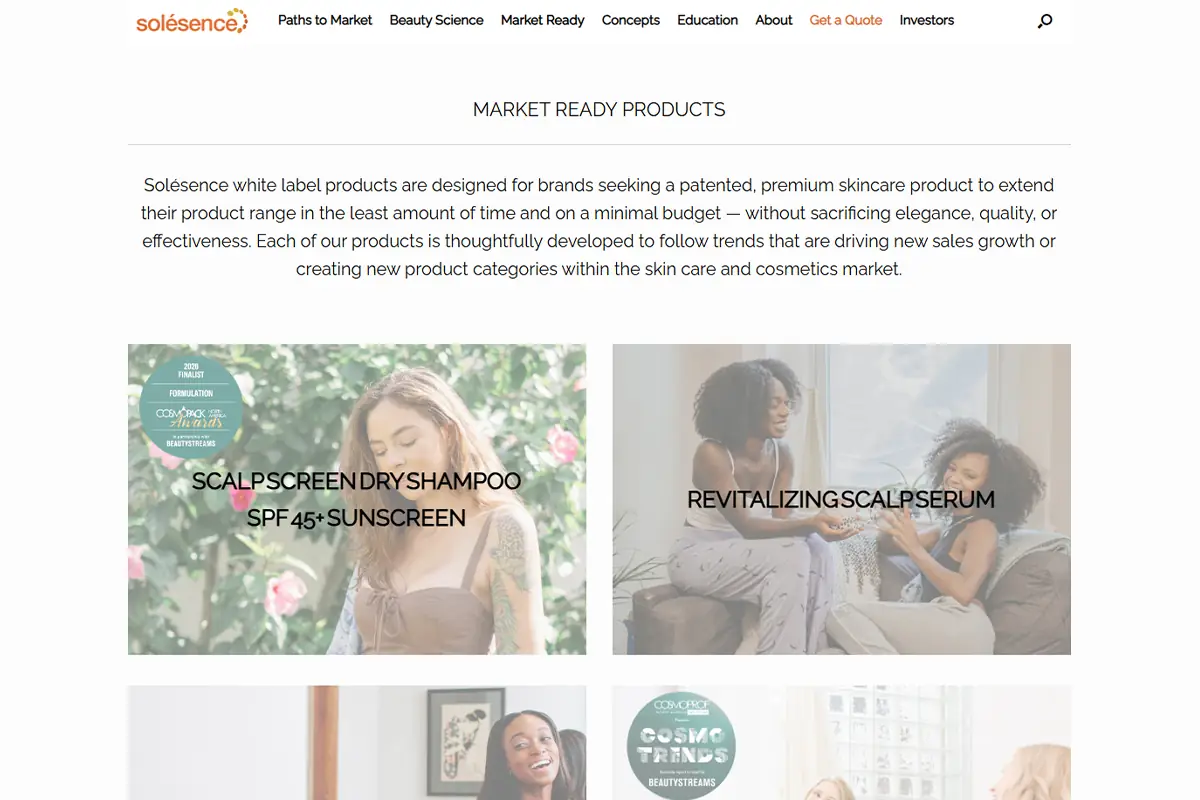
Brands can choose from market-ready formulations, modified platforms, or full custom development.
Best fit: Prestige skincare brands, mineral sunscreen specialists, clinical brands, and companies developing tinted or makeup-skincare SPF hybrids.
3. Allure Beauty Concepts
Allure Beauty Concepts operates manufacturing facilities in California and Arizona and supports skincare, personal care, and FDA-regulated OTC products.
Its ready-to-go sunscreen program allows brands to begin with tested SPF platforms and approved packaging combinations. It also supports custom formulation for companies building sunscreen alongside cleansers, serums, moisturizers, and other skincare products.
Brands should confirm which facility will manufacture the sunscreen and verify the current drug establishment status of that location.
Best fit: Beauty companies seeking a U.S. partner capable of supporting both sunscreen and a wider skincare portfolio.
4. InSpec Solutions
InSpec Solutions operates an FDA-registered facility in Holly Hill, Florida, with a strong focus on sunscreen, OTC topicals, aerosols, and specialized filling.
Its production capabilities include lotions, tubes, hot-fill sticks, bag-on-valve systems, aerosols, and continuous-spray SPF. This makes it particularly relevant to brands requiring formats not supported by conventional skincare filling lines.
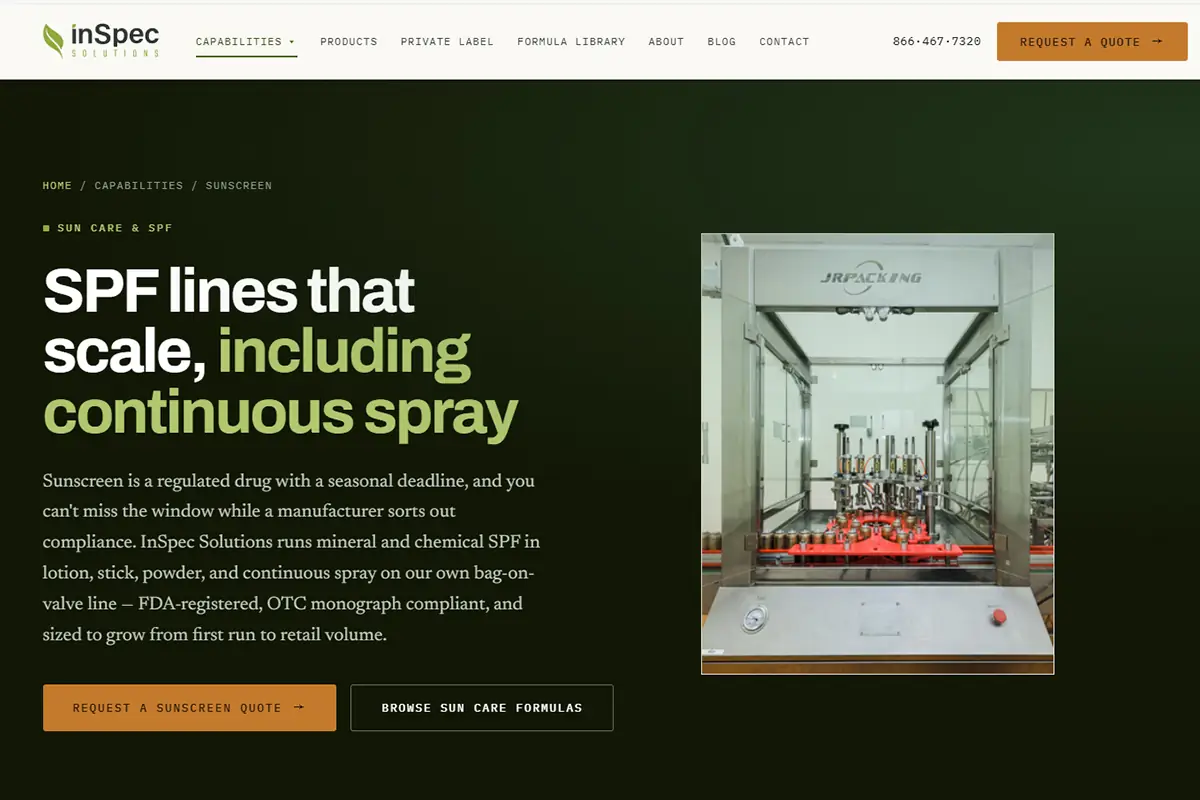
Pressurized sunscreen projects require additional evaluation of propellant compatibility, flammability, fill tolerances, transportation classification, and packaging performance.
Best fit: Established brands developing sunscreen sprays, BOV products, sticks, or multi-format sun-care collections.
5. FillTech USA
FillTech USA has provided contract manufacturing and filling services for OTC personal care products since 1995.
Its capabilities include sunscreen, SPF lip balm, topical ointments, lotions, gels, creams, and other personal care products. The company is better aligned with commercial production programs than very small experimental launches.
Minimums may vary considerably between bottle, tube, hot-pour, and lip-care filling lines, so brands should request format-specific requirements.
Best fit: Established personal care companies expanding into sunscreen, SPF lip care, or broader OTC topical categories.
6. FP Labs / Federal Package
FP Labs is the formulation and contract manufacturing division associated with Federal Package.
The company specializes in hot-pour products and propel-repel packaging, including sunscreen sticks, SPF lip balms, solid balms, and portable sun-protection formats. Container injection molding and automated assembly are handled within the same manufacturing network.
Its vertically integrated structure can reduce coordination between formula development, stick compatibility, container production, and filling.
Best fit: Brands developing sunscreen sticks, SPF lip products, solid mineral sunscreen, or custom twist-up packaging.
7. Pure Velocity Suncare
Pure Velocity Suncare focuses specifically on sunscreen and outdoor skin protection.
Its publicly presented capabilities include mineral and chemical sunscreen, lotions, sprays, sticks, water-resistant sport formulations, and ready-to-brand sunscreen platforms. Stock and custom development pathways are available.
Brands should request the legal name and address of the manufacturing establishment, current FDA registration status, applicable testing reports, and drug-listing responsibilities before paying a production deposit.
Best fit: Outdoor lifestyle brands, wellness companies, e-commerce brands, and founders seeking a sunscreen-focused development partner.
8. CoValence Laboratories
CoValence Laboratories operates from Chandler, Arizona, and specializes in professional skincare, private label products, custom formulation, and OTC topical products.
Its sunscreen portfolio includes mineral SPF products designed to complement professional skincare and post-treatment regimens. One example is its broad-spectrum SPF 30 mineral sunscreen using zinc oxide and titanium dioxide.
Its professional positioning makes it particularly relevant to physician-dispensed skincare, medical spas, licensed estheticians, and clinical treatment lines.
Best fit: Medical spas, dermatology clinics, professional skincare brands, and businesses combining mineral SPF with corrective facial treatments.
9. Respect Manufacturing
Respect Manufacturing operates from Denver, Colorado, and provides private label and contract development across skincare, personal care, and sunscreen.
Its publicly described services include mineral and chemical SPF formulation, testing coordination, stability work, packaging, and cGMP manufacturing. The company emphasizes collaborative development for brands requiring more support than a basic stock-formula supplier provides.
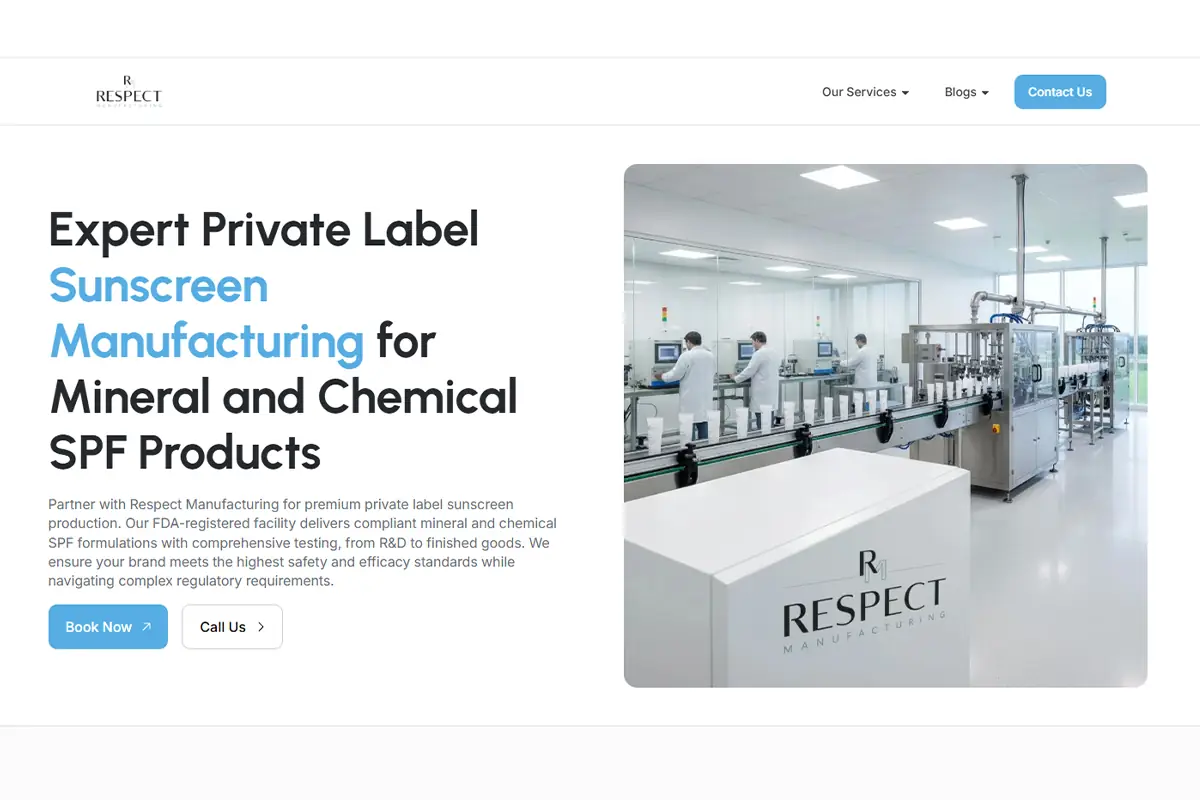
Before proceeding, brands should confirm the specific facility registration, testing responsibilities, available SPF formulas, and packaging formats included in the quotation.
Best fit: Growing DTC brands and founders looking for hands-on custom development and domestic production support.
10. Sarati International
Sarati International is based in Los Fresnos, Texas, and serves salons, spas, medical clinics, and independent skincare brands.
Its private label catalog includes broad-spectrum mineral sunscreen, daily moisturizers, and post-sun skincare. This catalog-based pathway can be more approachable for brands that do not require an exclusive formula at launch.
Brands should confirm whether the selected sunscreen is sold as a finished, tested private label product and whether its minimum differs from Sarati’s standard cosmetic products.
Best fit: Spas, salons, aesthetic clinics, boutique skincare brands, and companies beginning with a ready-to-label mineral SPF product.
White Label vs. Modified Private Label vs. Custom Sunscreen
| Parameter | White Label | Modified Private Label | Full Custom |
|---|---|---|---|
| Formula | Existing validated platform | Existing platform with limited changes | Developed from the ground up |
| Speed | Fastest | Moderate | Longest |
| Testing | Usually based on an existing formula and approved package | Additional testing may be required | Full validation program normally required |
| Exclusivity | Usually shared | Limited differentiation | Depends on the development agreement |
| Packaging | Usually restricted to validated options | Some flexibility | Greater flexibility, subject to compatibility testing |
| Best For | Faster market entry | Controlled differentiation | Brands with sufficient budget and a clear technical brief |
A white label sunscreen is normally the lowest-risk route because the formula and selected packaging system may already have supporting testing.
Modified private label development can involve adding a botanical, changing a tint, adjusting fragrance, or selecting a different package. Even small changes may affect UV-filter dispersion, film formation, stability, and finished SPF performance.
A full custom sunscreen offers greater differentiation but requires a longer development process and more extensive validation. Before selecting this route, review the differences between private label and custom formulation and understand how packaging minimums and batch sizes influence the true cost of cosmetic manufacturing.
Mineral, Chemical, or Tinted Sunscreen?
Mineral Sunscreen
Mineral sunscreen relies primarily on zinc oxide, titanium dioxide, or a combination of the two.
Its main formulation challenge is achieving uniform particle dispersion without excessive whitening, graininess, poor spreadability, or emulsion separation. High-shear processing, dispersion quality, particle treatment, and packaging compatibility all influence the finished result.
Mineral positioning is often selected for sensitive-skin, post-procedure, clean-beauty, and professional skincare concepts. “Reef-safe” is not a standardized FDA claim and should be used carefully.
Chemical Sunscreen
Chemical or organic sunscreen filters can support lightweight, transparent textures with less visible residue across different skin tones.
Permitted U.S. filters include established monograph ingredients such as avobenzone, octisalate, octocrylene, and homosalate. Bemotrizinol was added to the U.S. sunscreen monograph in 2026 at concentrations up to 6%.
The final filter system must be evaluated for photostability, compatibility, eye-sting potential, active concentration, and the intended SPF and water-resistance claims.
Tinted Sunscreen
Tinted sunscreen combines an SPF base with iron oxide pigments to create sheer coverage and improve the visible appearance of mineral sunscreen on different skin tones.
Pigment dispersion can affect shade consistency, application, film formation, and SPF performance. Any visible-light or blue-light positioning should be supported by appropriate formulation evidence and claim substantiation.
How an International Skincare CDMO Can Complement a Sunscreen Program
An international skincare CDMO should not be presented as a shortcut around U.S. OTC sunscreen requirements.
A sunscreen manufactured outside the United States must still satisfy applicable FDA establishment registration, U.S. agent, drug cGMP, monograph, testing, product-listing, and labeling requirements before entering the U.S. market.
A practical model is to manufacture the regulated sunscreen through a qualified OTC facility while using a specialized skincare CDMO to develop complementary non-SPF products, including:
- Antioxidant facial serums
- Barrier-support creams
- Gentle cleansers
- After-sun gels and moisturizers
- Ectoin, ceramide, fermented-active, and peptide treatments
Shangpinhui Biotechnology Co., Ltd. supports the development and manufacture of these complementary skincare products through liposomal delivery, microencapsulation, bio-fermentation, nanoemulsion, stability testing, packaging integration, and export-ready technical documentation.
Brands developing a broader sun-care regimen can review our custom facial care manufacturing capabilities and available formulations in the Shangpinhui Product Center.
Frequently Asked Questions
Are private label sunscreen manufacturers FDA certified?
No. The FDA does not issue an “FDA-certified manufacturer” credential. Drug establishments register with the FDA and products are listed, but registration and listing do not mean that the agency has approved or endorsed the manufacturer or product.
Can European or Asian UV filters be used in a U.S. sunscreen?
Only filters permitted through the FDA OTC sunscreen monograph or another applicable drug approval pathway may be used in products marketed as sunscreens in the United States.
Bemotrizinol, commonly associated with the trade name Tinosorb S, was added to the OTC sunscreen monograph in 2026 at concentrations up to 6%. Other filters used outside the U.S., including bisoctrizole and diethylamino hydroxybenzoyl hexyl benzoate, are not currently permitted through the U.S. OTC monograph pathway.
Can sunscreen be manufactured overseas for sale in the United States?
Yes, provided that the foreign establishment and finished product comply with all applicable U.S. OTC drug requirements. These may include foreign establishment registration, a designated U.S. agent, drug cGMP compliance, monograph-conforming ingredients, product testing, drug listing, and compliant Drug Facts labeling.
Overseas manufacturing does not remove or reduce the U.S. regulatory requirements.
Why is sunscreen MOQ usually higher than standard skincare MOQ?
Sunscreen requires controlled UV-filter dispersion, validated processing, regulated batch documentation, analytical release procedures, and packaging compatibility. Packaging components and specialized filling formats can also have minimums that exceed the bulk formula requirement.
Brands should request separate minimums for formula production, packaging procurement, decoration, and finished filling rather than relying on a single advertised MOQ.
Recommended Reading
- Compare manufacturing options across different markets in our global private label sunscreen manufacturers guide.
- Review another regulated market in our guide to UK private label sunscreen manufacturers.
- Understand how formula batches, packaging runs, and testing affect your cosmetics manufacturing MOQ and project cost.
Build Your Suncare Portfolio with Clear Regulatory Boundaries
Selecting a sunscreen manufacturer requires more than comparing product samples and unit prices. Brands must confirm the actual manufacturing establishment, development pathway, testing package, product-listing responsibilities, packaging compatibility, and formula ownership before placing an order.
Shangpinhui Biotechnology Co., Ltd. supports brands developing the non-SPF skincare products surrounding a complete sun-care portfolio, including cleansers, antioxidant serums, barrier creams, after-sun care, and advanced facial treatments.
Connect with our formulation team to discuss complementary skincare development, packaging requirements, technical documentation, or sample prototypes for your brand.