Eye creams may use smaller containers than standard facial moisturizers, but they are not necessarily simpler products to manufacture.
The eye area is highly visible and is often less tolerant of heavy, strongly fragranced, or poorly balanced formulas. A successful eye cream needs the right texture, spreadability, absorption speed, active concentration, and sensory experience without migrating too easily toward the eyes.
Packaging also plays a larger role than many first-time brands expect. A rich eye cream may work well in an airless pump but struggle inside a narrow massage-tip tube. A lightweight caffeine gel may flow smoothly through a rollerball, while a thicker peptide formula could block the same applicator.
That is why selecting an eye cream manufacturer should involve more than comparing ingredient lists. Brands should also evaluate the manufacturer’s formulation model, minimum order quantity, applicator experience, testing support, documentation, and ability to scale future orders.
This guide compares ten private label eye cream manufacturers serving different types of skincare brands, from low-MOQ startups and med spas to established retailers and global beauty companies.
Quick Answer: Which Eye Cream Manufacturer Is Best for Your Brand?
There is no single best manufacturer for every eye care project. The right choice depends on your order quantity, formulation requirements, target market, packaging, budget, and brand positioning.
- Shangpinhui Biotechnology is suitable for brands seeking custom eye creams, peptide systems, PDRN concepts, advanced delivery technologies, specialized applicators, or freeze-dried eye treatments.
- Pravada Private Label is suitable for startups that want ready-made US private label eye products from a low entry quantity.
- Trilogy Laboratories is a practical option for med spas, estheticians, and professional skincare brands.
- RainShadow Labs is suitable for natural, botanical, and environmentally conscious eye care brands.
- Made By Nature Labs is suitable for European brands seeking natural private label products manufactured in the EU.
- Blackbird Skincare supports full-service custom eye care development and packaging sourcing in China.
- Pure Source is designed for established brands that need US manufacturing at 5,000 units or more.
- Ausmetics is better suited to higher-volume vegan, natural, and export-oriented skincare projects.
- Kolmar Korea is a strong option for established brands seeking large-scale K-beauty ODM research and development.
- COSMAX is suited to global beauty companies requiring advanced R&D, international production facilities, and high-volume ODM support.
Published minimum order quantities and service models may change. Brands should confirm current requirements directly with each manufacturer before making a supplier decision.
How We Selected These Private Label Eye Cream Manufacturers
The companies in this guide were evaluated according to the following factors:
- Verified eye care or facial skincare manufacturing capabilities
- Availability of private label, OEM, ODM, or custom formulation services
- Published minimum order information where available
- Experience with eye creams, gels, serums, masks, and targeted treatments
- Packaging and applicator support
- Quality control and regulatory documentation
- Suitability for different brand sizes and sales channels
- Information available through official company sources
Comparison of the Top 10 Private Label Eye Cream Manufacturers
| Manufacturer | Location | Best For | Published Entry Point |
|---|---|---|---|
| Shangpinhui Biotechnology | Guangzhou, China | Custom biotech eye care and specialized formats | Commonly 1,000 units |
| Pravada Private Label | Florida, USA | Low-MOQ ready-to-market eye care | From 50 units |
| Trilogy Laboratories | Florida, USA | Med spas and professional skincare brands | From 25 units |
| RainShadow Labs | Oregon, USA | Natural and botanical eye care | Depends on service model |
| Made By Nature Labs | Bulgaria, EU | EU natural private label skincare | From 500 units |
| Blackbird Skincare | Foshan, China | Full-service custom OEM/ODM | Contact manufacturer |
| Pure Source | Miami, Florida, USA | Established US brands and larger orders | From 5,000 units |
| Ausmetics | Guangzhou, China | Higher-volume vegan and natural skincare | Usually 5,000–10,000 units |
| Kolmar Korea | South Korea | Large-scale K-beauty ODM development | Project-dependent |
| COSMAX | South Korea and global facilities | Global scientific ODM programs | Project-dependent |
1. Shangpinhui Biotechnology Co., Ltd.
Headquarters: Guangzhou, China
Best for: Custom eye cream formulation, peptide systems, PDRN concepts, specialized applicators, and differentiated eye care formats
Typical MOQ: Commonly 1,000 units
Shangpinhui Biotechnology Co., Ltd. is an OEM/ODM cosmetics manufacturer supporting eye creams, eye serums, eye gels, eye masks, and other targeted eye care products.
Its main advantage is not simply the availability of standard moisturizing eye cream bases. The company can combine custom formulation with liposome delivery, nanoemulsion, microencapsulation, fermentation, and freeze-drying technologies to create more differentiated eye care concepts.
Possible formula directions include caffeine eye gels for the visible appearance of puffiness, multi-peptide eye creams for fine lines and firmness, ceramide-rich barrier eye creams, retinol or bakuchiol eye treatments, PDRN cosmetic concepts, and hydrating eye serums with hyaluronic acid and soothing ingredients.
For PDRN or exosome-related projects, the development discussion should cover more than a marketable ingredient story. In PDRN vs. exosome skincare manufacturing, ingredient source, identity, available safety data, labeling name, stability, regulatory suitability, and finished-product claims all need to be considered before formula approval.
Shangpinhui can also coordinate packaging such as metal massage-tip tubes, ceramic applicators, airless pumps, rollerball bottles, jars, and dual-component systems. Formula viscosity and packaging should be evaluated together because an attractive applicator is not useful if it leaks, blocks, releases an inconsistent dose, or reacts with the formula.
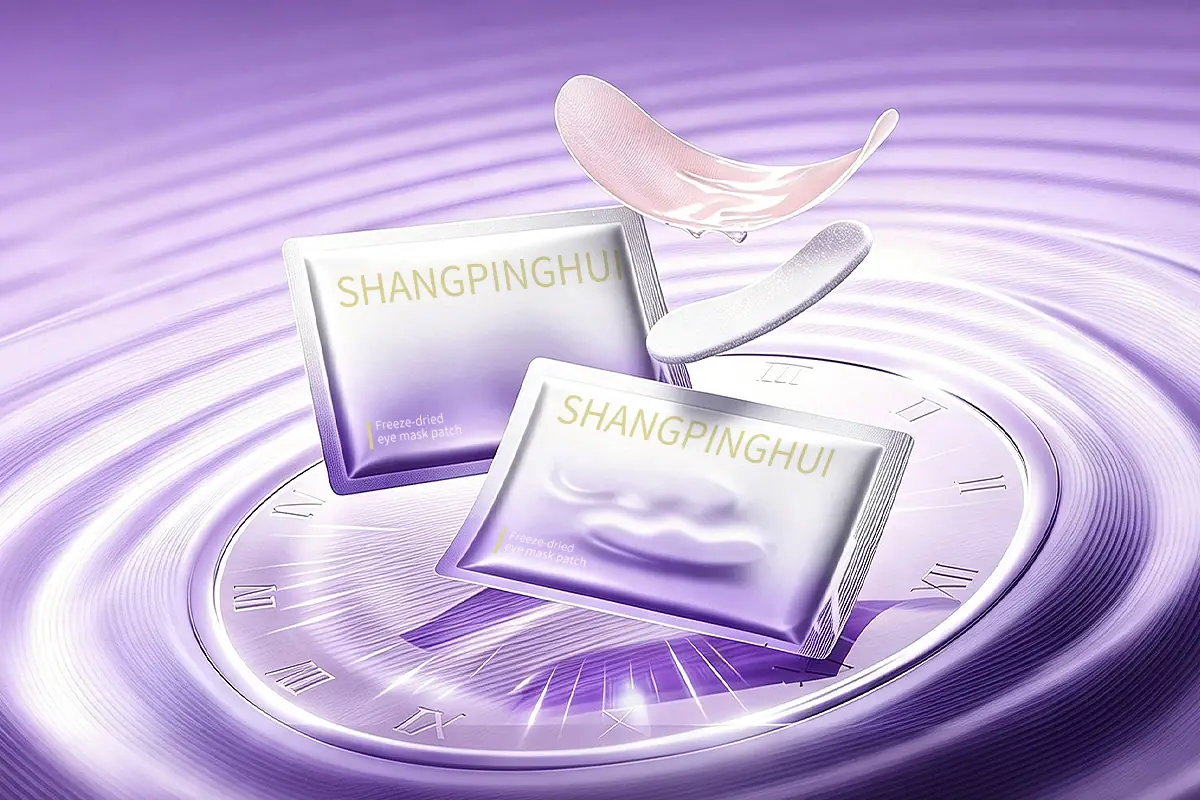
Beyond conventional creams and serums, the company supports freeze-dried eye patches and dual-component eye treatments in which a dry component is activated with a separate essence. These formats require additional evaluation of residual moisture, reconstitution performance, packaging integrity, microbiological quality, and complete-system stability.
Suitable for: Independent skincare brands, premium facial care lines, clinic and spa brands, and companies developing peptide, PDRN, retinol, or biotechnology-positioned eye care.
Potential limitation: Brands seeking only 25 or 50 ready-labeled units may find a US stock-formula supplier more suitable for an initial market test.
2. Pravada Private Label
Headquarters: Naples, Florida, USA
Best for: Low-MOQ ready-made eye creams and eye serums
Published MOQ: From 50 units for selected ready-to-market products
Pravada Private Label is a practical option for new skincare brands that want to launch without funding a fully custom formulation.
Its eye treatment range includes ready-made eye creams and eye serums that can be branded using the customer’s labels and available packaging options. The company publicly lists a low entry quantity for selected ready-to-market products, while semi-custom projects generally require a higher order quantity.
This model allows a small brand to test an eye care concept before investing in custom ingredients, specialized applicators, exclusive formulation work, or larger packaging minimums.
Pravada is particularly suitable for ecommerce founders, salons, estheticians, and small beauty businesses that prioritize speed and lower inventory risk over complete formula exclusivity.
Suitable for: New US skincare brands, salons, estheticians, small ecommerce launches, and businesses testing one initial eye care SKU.
Potential limitation: A ready-made low-MOQ product may offer less formula differentiation than a fully custom OEM project.
3. Trilogy Laboratories
Headquarters: Fort Myers, Florida, USA
Best for: Med spas, estheticians, professional skincare, and low-MOQ eye care
Published MOQ: From 25 units for selected products
Trilogy Laboratories manufactures private label eye creams, eye serums, and targeted treatments for professional skincare businesses.
The company positions its product range toward dermatology-focused businesses, med spas, estheticians, and clinical-style skincare brands. Its eye care products address concerns such as fine lines, puffiness, dark circles, dryness, and reduced firmness.
One of Trilogy’s most notable advantages is its low entry point. Selected eye creams and eye serums are available in small quantities, allowing a professional practice to add an eye product without taking on a large amount of inventory.
This can be particularly useful for a clinic or esthetician that already has a customer base but does not need the volume required by a larger custom manufacturer.
Suitable for: Med spas, dermatology and aesthetic clinics, estheticians, and small professional skincare brands.
Potential limitation: Brands requiring a proprietary formula, exclusive ingredient system, or heavily customized packaging should confirm what can be changed beyond the standard private label range.
4. RainShadow Labs
Headquarters: St. Helens, Oregon, USA
Best for: Botanical, natural, and environmentally conscious eye care
MOQ: Depends on whether the project uses stock bulk, filling, or custom formulation
RainShadow Labs is a US skincare manufacturer with a strong focus on natural ingredients, botanical formulas, and environmentally conscious production.
Its eye care capabilities include eye creams, eye gels, moisturizing treatments, antioxidant products, and anti-aging eye care formulas. Brands may choose an existing private label formula or discuss a more customized development project.
RainShadow may be particularly relevant to businesses that want an eye care product built around botanical oils, antioxidants, hydration, and barrier support rather than a highly clinical or biotechnology-led concept.
Buyers should pay attention to the service model because stock bulk, stock filling, and fully custom development may have different minimums, development costs, and production timelines.
Suitable for: Natural skincare brands, botanical product lines, spa and wellness businesses, and companies that prefer US manufacturing.
Potential limitation: Fully custom development may require a larger investment and longer timeline than purchasing an existing bulk or private label formula.
5. Made By Nature Labs
Headquarters: Bulgaria, European Union
Best for: Natural, organic-positioned, and EU-manufactured private label skincare
Published MOQ: From approximately 500 units
Made By Nature Labs is a European private label manufacturer specializing in natural skincare, hair care, body care, and personal care products.
The company offers eye contour serums, eye creams, and other targeted facial care formulas within a large library of ready-to-market private label products. Existing products can be customized with the brand’s labels and packaging, while custom formulation services are also available.
Made By Nature Labs can be a practical option for European beauty brands that want natural formulation positioning, EU manufacturing, vegan or cruelty-free options, and a lower entry point than many large European contract manufacturers.
It may also appeal to international brands that prefer to source an EU-manufactured eye product rather than import the finished cosmetic from outside Europe.
Suitable for: European skincare startups, natural and organic-positioned brands, vegan beauty lines, and companies starting at approximately 500 units.
Potential limitation: Ready-made natural formulas may not provide the same level of differentiation as a proprietary peptide, retinoid, or advanced delivery-system project.
6. Blackbird Skincare
Headquarters: Foshan, Guangdong, China
Best for: Full-service eye care OEM/ODM and packaging coordination
MOQ: Contact the manufacturer for project-specific requirements
Blackbird Skincare provides private label and custom OEM/ODM services for eye creams, eye balms, eye serums, and broader eye care collections.
The company offers support across formulation, packaging, labeling, production, and shipment. Its eye cream development service covers different positioning directions, including lightweight hydration, brightening, anti-aging, and mature-skin products.
Blackbird may be a useful option for brands that want to source both the formula and packaging through one Chinese supplier. It also promotes PDRN and exosome-related skincare concepts, although buyers should still verify ingredient identity, source, supporting documentation, and acceptable cosmetic claims.
Public MOQ information is limited, so brands should request current details covering formula ownership, sample charges, testing, packaging minimums, decoration requirements, and export documentation.
Suitable for: International private label brands, companies sourcing from China, ecommerce businesses, and brands requiring packaging coordination.
Potential limitation: Buyers need a project-specific quotation before determining whether the supplier fits a smaller initial launch.
7. Pure Source
Headquarters: Miami, Florida, USA
Best for: Established brands requiring US manufacturing and larger production runs
Published MOQ: From 5,000 units per SKU
Pure Source is a US contract manufacturer producing eye creams, eye gels, creams, liquids, and other skincare products.
Its eye cream service includes custom formulation, packaging selection, label support, and assistance with US cosmetic compliance requirements. The company can develop rich creams, lightweight gels, fragrance-free concepts, and formulas positioned for sensitive skin.
Pure Source publicly states that eye cream projects require a minimum of 5,000 units per SKU. This makes the company more appropriate for established skincare brands, retailers, pharmacy-oriented businesses, and companies with proven sales volume.
It is less likely to be the right supplier for a founder who only wants a few hundred units to test a new eye product.
Suitable for: Established US skincare brands, retail companies, businesses ordering at least 5,000 units, and brands seeking domestic manufacturing.
Potential limitation: The 5,000-unit minimum creates a higher initial inventory commitment than low-MOQ private label suppliers.
8. Ausmetics
Headquarters: Guangzhou, China
Best for: Higher-volume vegan, natural, and internationally distributed skincare
Typical MOQ: Approximately 5,000–10,000 units, depending on packaging
Ausmetics is an established cosmetics contract manufacturer offering private label, OEM, ODM, custom formulation, and packaging support.
Its manufacturing range includes facial care, body care, baby care, hair care, and other personal care products. The company emphasizes natural, organic-positioned, vegan-friendly, and cruelty-free formulation options.
Ausmetics states that minimum quantities depend on the formula and packaging. Standard packaging projects commonly fall around 5,000 to 10,000 units per SKU, while some tube packaging projects may require approximately 10,000 units.
Because many eye creams are packed in small tubes, massage-tip containers, or airless systems, brands should confirm the packaging minimum separately from the bulk formula minimum.
Suitable for: Established international brands, vegan and natural skincare lines, and companies requiring higher-volume export-oriented production.
Potential limitation: Formula and packaging minimums may be too high for an early-stage brand launching its first eye care product.
9. Kolmar Korea
Headquarters: South Korea
Best for: Advanced K-beauty ODM, high-performance skincare, and large brand programs
MOQ: Project-dependent
Kolmar Korea is one of South Korea’s most established cosmetics ODM manufacturers.
The company provides support from product planning and formulation development to design, production, quality management, and finished-product shipment. Its manufacturing scope includes creams, essences, masks, cleansers, brightening products, anti-wrinkle products, and other functional skincare categories.
Kolmar has developed technologies related to eye creams, wrinkle-improvement cosmetics, peptide design, lipid-based delivery systems, and nanoemulsion technologies. These capabilities make it relevant to established brands seeking sophisticated eye treatments rather than simple stock formulas.
Its technical scale and research resources are major advantages, but large global ODM companies do not always operate like low-MOQ private label suppliers. Development costs, project acceptance, communication structure, intellectual property arrangements, and order quantities generally need to be discussed directly.
Suitable for: Established K-beauty brands, international beauty companies, retail programs with meaningful volume, and businesses requiring advanced R&D.
Potential limitation: Very small startups may receive more flexible service from a smaller or mid-sized manufacturer.
10. COSMAX
Headquarters: South Korea, with global operations
Best for: Global beauty companies, scientific ODM, and international production networks
MOQ: Project-dependent
COSMAX is a global cosmetics ODM group with research and manufacturing facilities in markets including South Korea, China, the United States, Indonesia, and Thailand.
The company supports product development using proprietary formulations, ingredients, carrier systems, research resources, quality management, and international manufacturing capabilities. Its skincare range covers creams, essences, oils, sun care, and other facial care formats that can be applied to broader eye care development programs.
COSMAX is most relevant to established brands that need substantial R&D support, regional manufacturing options, large-scale production, or a long-term global supply relationship.
Its size is an advantage for multinational projects, but it may not be the most accessible route for a founder looking for a straightforward 500-unit eye cream launch.
Suitable for: Multinational beauty brands, established K-beauty companies, large retail distribution, and high-volume ODM projects.
Potential limitation: The company’s scale and project structure may be less suitable for small brands needing low minimums and highly flexible startup support.
Eye Cream Packaging Must Be Developed with the Formula
Packaging should not be left until after the eye cream formula has been finalized.
The selected container affects dosage, application, product protection, consumer experience, and sometimes formula stability. A manufacturer should therefore evaluate the formula and primary packaging as one complete finished system.
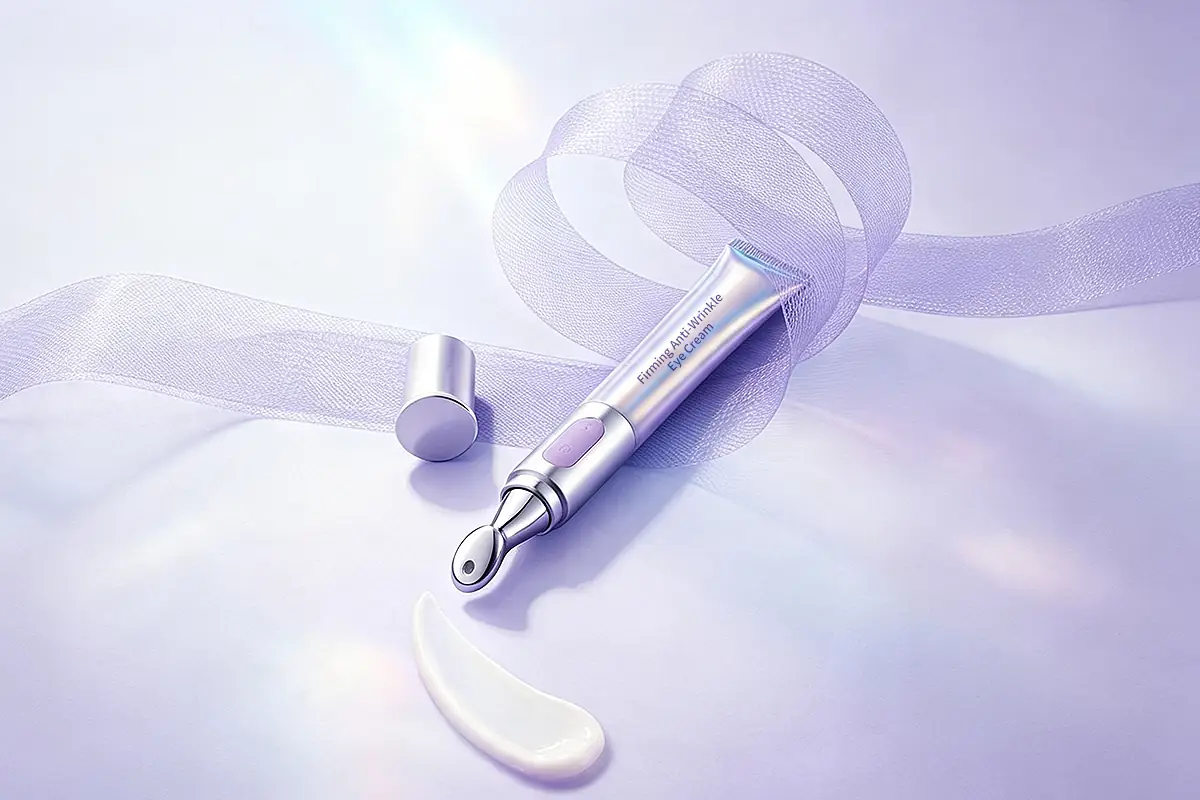
Metal and Ceramic Massage Tips
Metal and ceramic tips create a cooling sensory effect and make the product feel more premium during application. They are commonly used for peptide eye creams, caffeine gels, and products positioned for the visible appearance of puffiness.
Formula contact with the applicator surface, coating durability, corrosion resistance, product flow, leakage during storage, cleaning during use, and dose consistency should all be considered during packaging compatibility testing.
A cooling tip can improve the application experience, but it does not automatically prove a long-term reduction in puffiness.
Rollerballs
Rollerballs are more suitable for lightweight eye serums and fluid gels.
The formula must be thin enough to move around the roller but not so thin that it leaks. The roller should also continue turning after repeated use without becoming blocked by dried product.
A rich or high-viscosity eye cream is usually not suitable for this packaging format.
Airless Pumps
Airless pumps are often selected for eye creams containing oxidation-sensitive or contamination-sensitive ingredients.
They can reduce repeated exposure to air and direct consumer contact while delivering a more controlled dose than an open jar. However, airless packaging alone does not guarantee active stability. The complete formula still requires suitable stability and packaging compatibility evaluation.
Massage-Tip Tubes
Massage-tip tubes combine direct dispensing with a built-in applicator. They are popular for 10 ml, 15 ml, and 20 ml eye treatments.
Formula blockage, separation near the outlet, excessive product release, leakage beneath the applicator, and incompatibility between the formula and internal components are the main issues that should be checked during development.
Tube packaging may also have a higher supplier minimum than standard bottles or jars.
Jars
Jars remain common for richer eye creams and luxury textures. They provide easy access to high-viscosity formulas and allow brands to create a premium visual presentation.
However, repeated finger contact may increase contamination risk. Brands using jars may consider including a small spatula and clear directions for hygienic use.
Eye Cream Packaging Compatibility Overview
| Eye Care Format | Common Packaging | Main Formula Requirement | Main Risk |
|---|---|---|---|
| Lightweight caffeine gel | Rollerball or metal-tip tube | Low-to-medium viscosity | Leakage or roller blockage |
| Peptide eye cream | Airless pump or massage-tip tube | Smooth and stable emulsion | Poor dose control |
| Retinol eye treatment | Opaque airless pump | Light and oxidation protection | Active degradation |
| Rich barrier eye cream | Jar or airless jar | Higher viscosity | Consumer contamination |
| Lightweight eye serum | Airless pump or rollerball | Controlled fluidity | Migration toward the eyes |
| Dual-component treatment | Vial plus activator | Predictable reconstitution | Incorrect consumer mixing |
The manufacturer should perform appropriate compatibility testing using the actual production formula, applicator, closure, decoration, and container—not only a visually similar packaging sample.
How to Choose the Right Private Label Eye Cream Manufacturer
The manufacturer at the top of a general ranking is not automatically the right supplier for every brand.
Your final choice should depend on the product concept, available budget, target market, order quantity, packaging, and degree of customization.
1. Decide Between Private Label and Custom Formulation
A ready-made private label eye cream is usually faster and requires less initial investment. It is suitable for brands that want to test demand or add an eye product to an existing range.
A custom formula provides more control over texture, active ingredients, claims, sensory experience, and brand differentiation. However, it generally requires more sampling, testing, development time, and production volume.
Brands that are still comparing these models can review our guide to private label vs. custom formulation skincare.
2. Match the MOQ to Realistic Sales Volume
An extremely low MOQ reduces inventory risk, but it may come with limited formula and packaging customization.
A higher MOQ may reduce the unit cost and provide more room for custom decoration and packaging, but it also increases the brand’s initial cash and inventory commitment.
- 25–50 units: Suitable for a med spa, salon, or initial online test
- 500–1,000 units: Suitable for many growing independent skincare brands
- 5,000 units or more: More appropriate for established ecommerce, retail, or distribution channels
- Large ODM programs: Better suited to brands with proven demand and long-term sales forecasts
The best MOQ is not always the lowest one. It is the quantity the brand can realistically sell without compromising formula quality, packaging, or cash flow.
3. Evaluate the Manufacturer’s Real Eye Care Experience
A factory that manufactures standard facial moisturizers does not automatically have strong experience with targeted eye products.
Brands should check whether the manufacturer has previously developed eye creams, eye gels, eye serums, eye masks, massage-tip products, rollerball products, airless eye treatments, and retinol, peptide, caffeine, or brightening eye formulas.
A relevant eye care sample is more useful than a long list of unrelated facial skincare products.
4. Confirm the Formula and Packaging Requirements
Before comparing final quotations, confirm four practical points:
- Whether the project uses an existing private label formula or a newly developed custom formula
- The separate minimums for the formula, primary packaging, decoration, and printed cartons
- Whether the selected applicator will be tested with the actual finished formula
- Which stability, microbial, safety, and regulatory documents are included
These four points are usually enough to make quotations easier to compare without shifting the entire sourcing process into a long supplier questionnaire.
Brands can prepare their core project information using our guide on what to provide before requesting an OEM quotation.
5. Review Claims Before Finalizing the Formula
Ingredient popularity does not automatically support every marketing claim.
For example, peptides may support anti-aging, smoothing, firming, and anti-wrinkle positioning, but the finished product’s wording should reflect the complete formula, active level, available supplier data, testing, and target-market requirements.
Our guide to peptides in anti-aging skincare formulation explains how different peptide systems can be used within a broader anti-aging product strategy.
Claims such as treating eye bags, regenerating cells, repairing tissue, healing skin, or permanently removing dark circles may create regulatory and substantiation risks.
Cosmetic claims should generally focus on hydration, smoothness, radiance, comfort, firmness, barrier support, and the visible appearance of fine lines, puffiness, or dark circles unless stronger evidence and a suitable regulatory route are available.
Popular Eye Cream Formula Directions for Private Label Brands
Choosing an active ingredient should follow the intended consumer, texture, price point, and product positioning rather than simply copying a market trend.
Caffeine Eye Gel
A lightweight caffeine eye gel is commonly positioned for tired-looking eyes and the visible appearance of puffiness.
It works well in rollerball bottles, metal-tip tubes, or small airless pumps. The formula should absorb quickly and avoid leaving a sticky film beneath makeup.
Multi-Peptide Eye Cream
A multi-peptide eye cream is suitable for anti-wrinkle, smoothing, and firming positioning.
Peptides are often combined with moisturizers, antioxidants, ceramides, or film-forming ingredients rather than being used as the only formula story. Packaging should protect the formula while delivering a controlled amount.
Ceramide Barrier Eye Cream
A ceramide-rich formula can target dryness, discomfort, and a weakened-looking eye-area barrier.
This direction may be particularly relevant for mature skin and sensitive-skin product lines. The texture should provide nourishment without feeling excessively greasy, heavy, or prone to migration.
Retinol or Encapsulated Retinol Eye Treatment
Retinol eye products are designed for more intensive anti-aging and anti-wrinkle positioning.
The formula requires careful attention to concentration, irritation potential, packaging, stability, and usage instructions. An opaque airless package is often preferable to a transparent jar.
Bakuchiol Eye Cream
Bakuchiol is frequently selected by brands seeking a plant-derived alternative to conventional retinol positioning.
It can be combined with peptides, antioxidants, squalane, or barrier-support ingredients. Brands should still avoid presenting bakuchiol as automatically irritation-free for every consumer.
Brightening Eye Serum
Brightening eye products may use ingredients such as niacinamide, vitamin C derivatives, licorice-derived ingredients, caffeine, peptides, or selected botanical extracts.
The formula should distinguish between the visible appearance of pigmentation, dullness, shadowing, puffiness, and structural hollowness. One eye cream cannot realistically correct every cause of dark-looking under-eyes.
PDRN or Biotechnology-Positioned Eye Care
PDRN, plant-derived extracellular-vesicle ingredients, fermented extracts, and biotechnology-inspired complexes can support a premium eye care story.
However, brands should avoid turning an ingredient trend into unsubstantiated medical or regenerative claims. Ingredient documentation, target market, formula stability, packaging, and final marketing language should be reviewed as one complete product system.
Frequently Asked Questions
How is an eye cream different from a face cream?
An eye cream is normally designed around the sensory needs, dosage, and application pattern of the eye area.
Compared with a standard face cream, it may use more controlled levels of potentially irritating ingredients, a smoother texture with less dragging, lower fragrance or a fragrance-free formula, reduced migration, more precise dosage, and packaging designed for targeted application.
This does not mean every eye cream is automatically gentler or more effective than every facial moisturizer. The finished formula still needs to be evaluated on its own merits.
What ingredients are popular in private label eye creams in 2026?
Common eye care ingredients and formula directions include caffeine, multi-peptide complexes, ceramides, hyaluronic acid, niacinamide, vitamin C derivatives, encapsulated retinol, bakuchiol, ectoin, panthenol, allantoin, licorice-derived ingredients, PDRN cosmetic ingredients, fermented extracts, and selected extracellular-vesicle or exosome-inspired concepts.
The right combination depends on whether the product targets dryness, fine lines, puffiness, dullness, firmness, sensitive skin, or premium biotechnology positioning.
Can a private label eye cream be fragrance-free?
Yes. Eye creams can be developed without added fragrance, and fragrance-free positioning is common for sensitive-skin and professional eye care products.
However, fragrance-free does not always mean that the product has no natural raw-material odor. The manufacturer should also review whether botanical extracts, essential oils, masking ingredients, or aromatic raw materials affect the intended claim.
How long does private label eye cream development take?
A ready-made private label formula can be faster because the base product has already been developed.
A custom eye cream takes longer because the process may involve concept development, sample adjustments, formula approval, packaging sourcing, compatibility testing, artwork, production, and final inspection.
The total timeline may range from several weeks for a straightforward stock formula to several months for a custom product with specialized packaging and extended testing.
For a broader overview, see our guide to the custom skincare development timeline.
Should a new brand launch an eye cream or an eye serum first?
An eye cream is usually easier to position around nourishment, dryness, fine lines, and barrier support. An eye serum may be more suitable for lightweight hydration, caffeine, brightening, or layered skincare routines.
The decision should depend on the target consumer, climate, texture preference, price point, packaging, and the rest of the brand’s product range.
A brand that already sells a facial serum and moisturizer may choose an eye cream to make the routine feel more complete. A brand focused on lightweight, active-led products may prefer an eye serum.
Bring Your Private Label Eye Care Product to Market
The right private label eye cream manufacturer should match more than an ingredient list.
It should match the brand’s quantity, formulation model, product positioning, applicator, testing requirements, target market, documentation needs, and future sales plan.
A startup testing its first eye product may benefit from a ready-made formula at 25 or 50 units. A growing independent brand may need a 500- or 1,000-unit custom project. An established retailer may be better served by a manufacturer designed for 5,000 units or more.
Shangpinhui Biotechnology Co., Ltd. supports custom eye creams, eye gels, eye serums, peptide formulas, PDRN cosmetic concepts, specialized applicator packaging, and differentiated eye care formats for international beauty brands.
Brands can begin with an established formula or develop a more customized product based on the intended consumer, texture, active ingredients, packaging, claims, target price, and sales market.
Develop Your Private Label Eye Cream with BeautyOEM
Tell us your target consumer, desired texture, key ingredients, packaging format, target quantity, and sales market. Our team can recommend suitable mature formulas or develop a more customized eye care solution for your brand.