Launching a commercially successful hair care line requires more than finding a contract facility with competitive pricing. Hair conditioners present unique technical challenges—from rheology and viscosity control to cationic emulsification, active ingredient deposition, and silicone-free system engineering.
Most rinse-off conditioners and hair masks are typical cationic emulsion systems, except for formats such as leave-in sprays, conditioning waters, and oil-based products.
Whether you are developing a daily rinse-out conditioner, a high-intensity repair hair mask, or a multi-functional leave-in detangling spray, selecting the right OEM/ODM partner affects product performance, shelf-life stability, production consistency, and regulatory preparation.
This B2B sourcing guide evaluates ten global private label conditioner manufacturers, explains formulation requirements by product type, compares manufacturing regions, and outlines essential quality testing before mass production.
Brands planning a broader shampoo, mask, styling, scalp-care, or treatment range can also review our guide to private label hair care manufacturers.
Quick Comparison: Top Global Private Label Conditioner Manufacturers
| Manufacturer | Primary Location | Core Expertise & Specialty | Entry Level / MOQ | Target Brand Profile |
|---|---|---|---|---|
| Shangpinhui Biotechnology Co., Ltd. | Guangzhou, China | Cationic conditioning systems, repair formulation, rheology control, packaging compatibility, and scalable hair care manufacturing | Project-dependent | International brands, distributors, salons, ecommerce companies, and established hair care businesses |
| HSA Cosmetics | Varese, Italy | Professional salon heritage, hair color maintenance, and customized hair care systems | Contact manufacturer | Professional salon brands and premium European hair care lines |
| Pravada Private Label | United States | Ready-developed conditioner formulas and faster domestic launches | Published stock options available | US startups, salons, and rapid-launch indie brands |
| RainShadow Labs | Oregon, USA | Natural, botanical, and clean-positioned conditioning systems | Published stock and bulk options | Natural beauty brands and eco-conscious personal care lines |
| Nutrix | Utah, USA | Turnkey contract manufacturing and scalable US production | Contact manufacturer | Growing US retail and ecommerce brands |
| Apollo Health & Beauty Care | Ontario, Canada | Retail, control-label, and commercial-scale personal care manufacturing | Contact manufacturer | Retailers, distributors, and larger North American programs |
| Hera Beauty | Peterborough, UK | Natural positioning and silicone-alternative conditioning systems | Contact manufacturer | UK and European indie brands, salons, and natural hair care |
| Orean Personal Care | UK and USA | Premium bespoke development and dual-market manufacturing | Contact manufacturer | Premium hair care brands and long-term custom projects |
| Saehan Cosmetics | Incheon, South Korea | Professional treatments, post-color care, and Korean hair care ODM | Project-dependent | K-beauty brands and salon distributors |
| Epilab | Melbourne, Australia | Australian-made rinse-out, leave-in, co-wash, and treatment formulas | Project-dependent | Australian and Oceania brands scaling from indie to retail |
Published minimums and service models may change. Formula, filling, packaging, decoration, and carton requirements should be confirmed separately with each manufacturer.
Technical Considerations Before Choosing a Conditioner OEM
Before requesting factory quotations or requesting lab samples, brand owners should understand the technical parameters that differentiate hair conditioner manufacturing from standard lotion or body wash production:
1. Stock Formulation vs. Custom R&D
- Stock (White Label) Formulas: Pre-tested, shelf-stable formulas that allow rapid market entry with lower minimum order quantities (MOQs). Ideal for testing market response or launching basic complementary conditioners.
- Custom (ODM/OEM) Formulation: Bespoke development tailored to specific marketing claims (e.g., silicone-free, vegan keratin, scalp-soothing exosomes, or botanical oils). Requires dedicated stability testing, higher minimums, and longer development lead times.
2. Viscosity and Rheology Control
Conditioners must deliver a consistent user experience. If a formula is too thin, it runs off wet hair before depositing active ingredients; if it is too thick, pump packaging will clog or fail. Your manufacturer must demonstrate precise control over fatty alcohol matrices, emulsifiers, and thickening polymers across varying storage temperatures.
3. Cationic Conditioning Systems & Silicone Alternatives
Effective conditioning relies on positively charged (cationic) ingredients—such as Behentrimonium Chloride or Cetrimonium Chloride—that bind to negatively charged, damaged hair fibers. Brands moving away from traditional silicones (like Dimethicone) need manufacturers experienced with plant-derived silicone alternatives (e.g., isoamyl laurate, natural ester blends) that provide slip and detangling without heavy buildup.
Brands comparing proteins, botanical oils, conditioning agents, repair ingredients, and silicone alternatives can also review our guide to hair care ingredients for private label brands.
Detailed Factory Profiles: Top 10 Conditioner Manufacturers
1. Shangpinhui Biotechnology Co., Ltd.
Location: Guangzhou, China
Best For: Custom conditioner systems, repair-focused formulation, packaging integration, and scalable hair care manufacturing
MOQ: Project-dependent
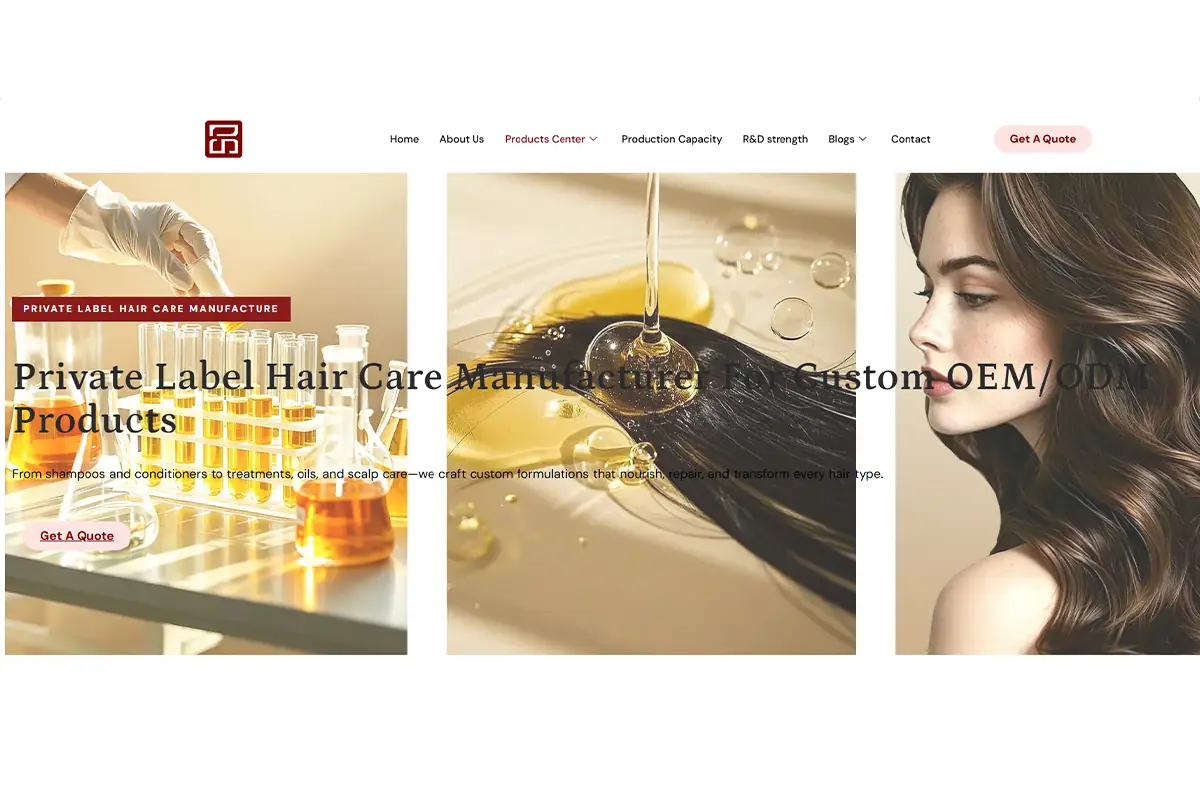
Shangpinhui Biotechnology Co., Ltd. is a cosmetics OEM/ODM manufacturer with in-house R&D for rinse-off conditioners, deep-repair hair masks, leave-in products, co-washes, silicone-free systems, color care, and complete shampoo-and-conditioner ranges. Its technical capabilities include cationic emulsion design, viscosity and rheology control, repair conditioning systems, botanical and fermentation-led formula directions, and nanoemulsion support for lightweight leave-in formats.
The company coordinates formulation, repeated sample adjustment, stability and microbiological testing, packaging sourcing, compatibility review, filling, and export documentation within one manufacturing system. Six emulsification vessels and 46 automated production lines support high-viscosity masks, pumps, squeeze bottles, tubes, jars, salon-size packaging, and stable repeat production for international brands.
Learn more about Shangpinhui’s private label hair care manufacturing capabilities.
2. HSA Cosmetics
Location: Varese, Italy
Best For: European salon heritage, professional hair care, and custom formulations
MOQ: Contact manufacturer
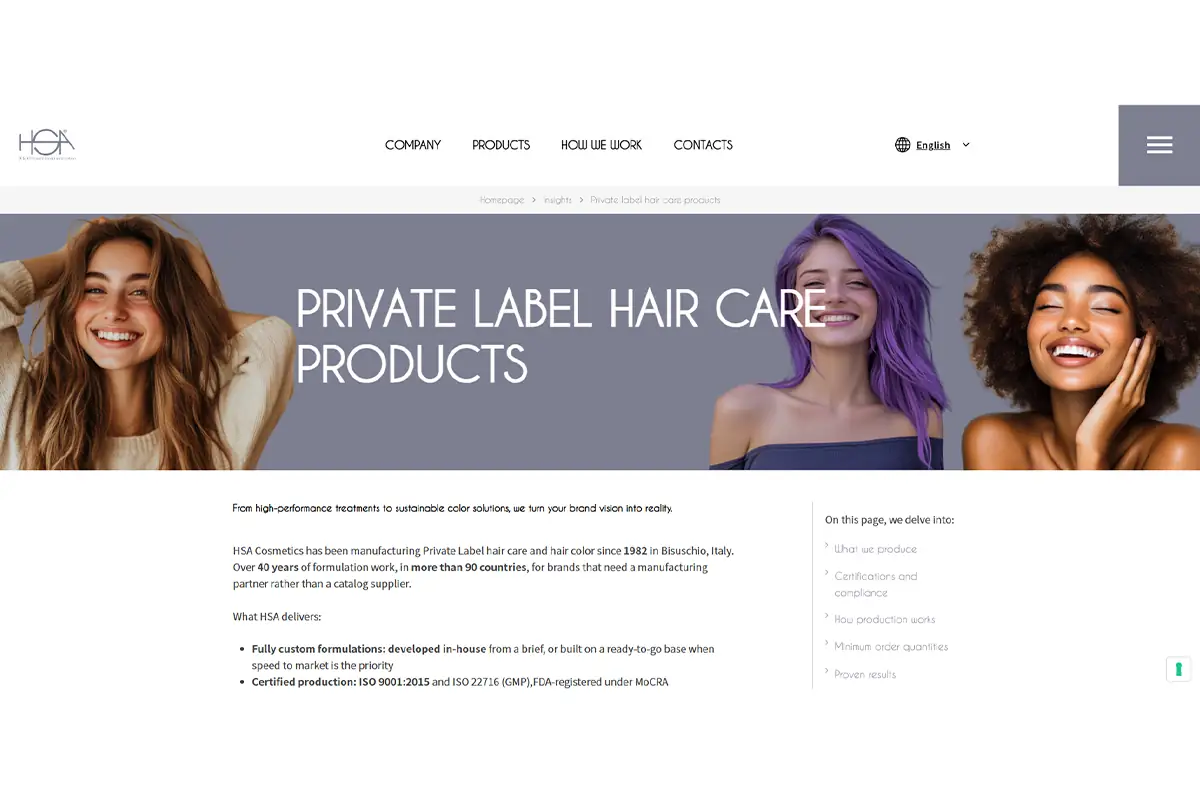
HSA Cosmetics is an Italian private label manufacturer specializing in professional hair care, treatments, styling products, and hair color systems. Its portfolio includes conditioners, repair masks, leave-in treatments, oils, scalp products, and color-maintenance systems.
HSA is particularly suitable for salon brands and distributors developing a coordinated professional collection rather than one isolated conditioner. Shampoo, conditioner, treatment, and styling products can be developed with a consistent fragrance and salon positioning.
3. Pravada Private Label
Location: United States
Best For: Rapid domestic launches and ready-developed conditioner formulas
MOQ: Published stock options available
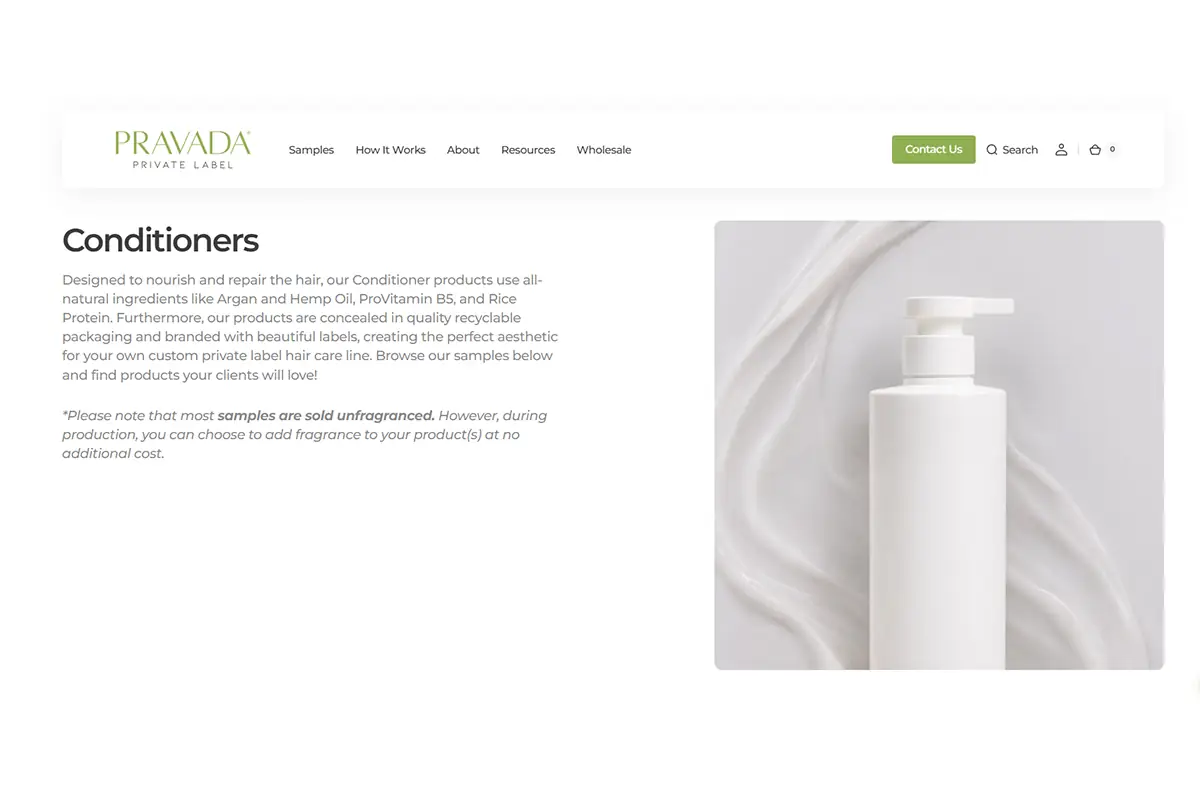
Pravada Private Label provides a streamlined route for boutique brands, salons, and ecommerce companies launching conditioner products in North America.
Its conditioner catalog covers hydration, strengthening, lightweight care, curl products, color care, volumizing, and damaged-hair positioning. Matching shampoos and treatments allow brands to build coordinated sets without developing each formula from the beginning.
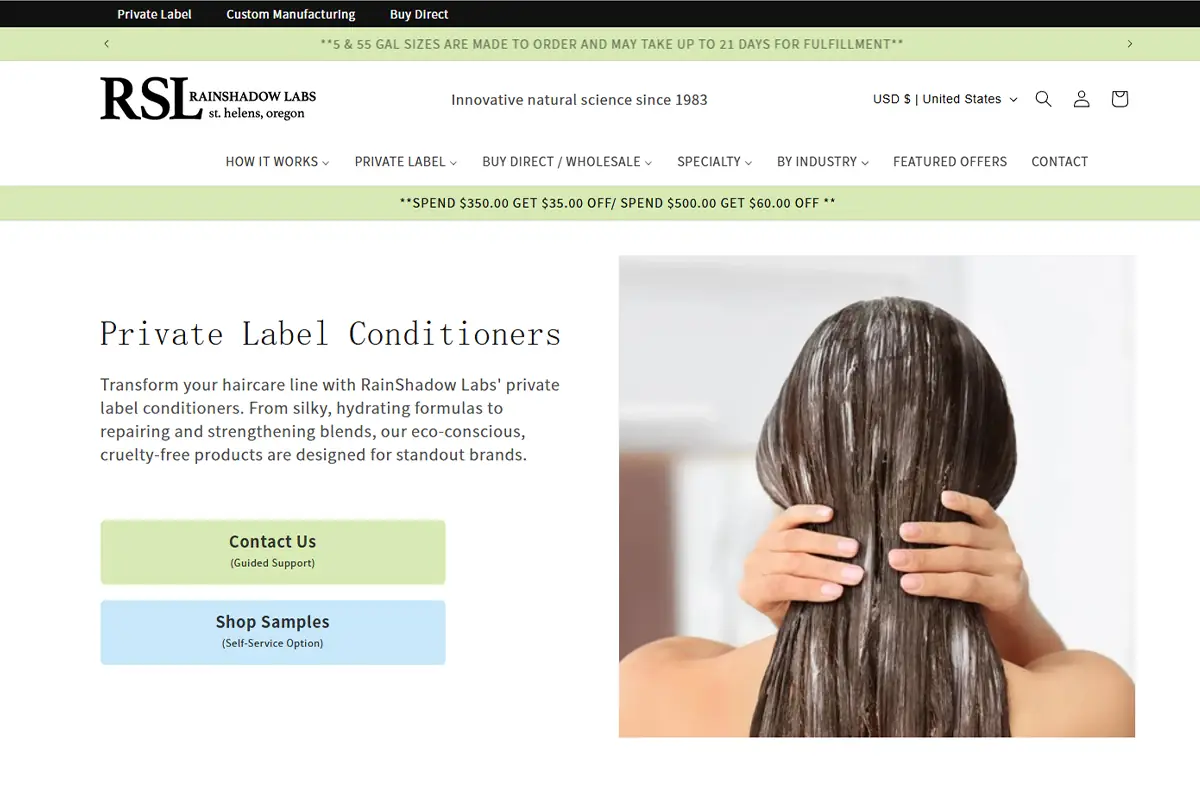
4. RainShadow Labs
Location: Oregon, USA
Best For: Natural, botanical, and clean-positioned conditioner formulas
MOQ: Published stock and bulk options
RainShadow Labs is a private label and contract manufacturer focused on botanical and naturally positioned personal-care products.
Its conditioner capabilities include moisturizing formulas, lightweight conditioners, repair products, botanical systems, amino-acid formulas, and treatment oils. Brands can select stock products, modify existing formulas, or move into custom development.
5. Nutrix
Location: Utah, USA
Best For: Turnkey contract manufacturing and scalable US production
MOQ: Contact manufacturer
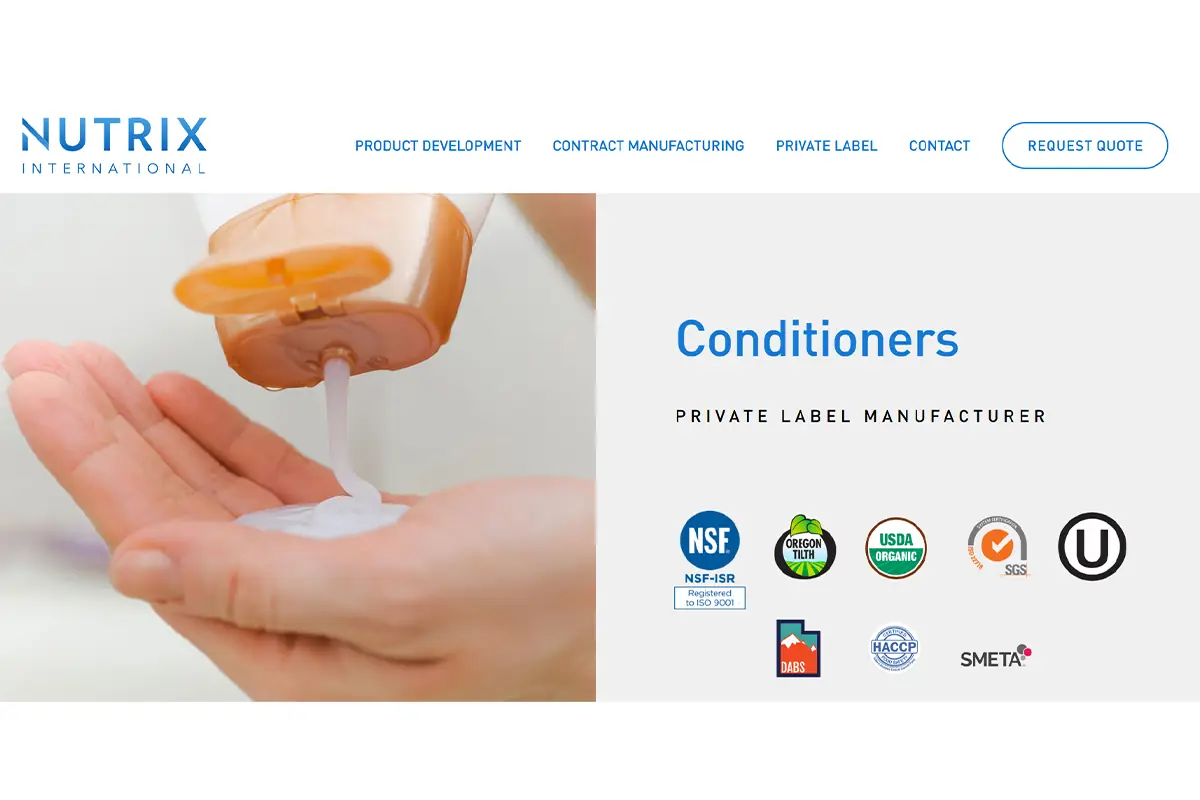
Nutrix provides private label and contract manufacturing for hair care, skincare, body care, and other personal-care categories.
Its services cover formulation, compounding, filling, packaging, quality assurance, and production scaling. Nutrix may suit growing brands seeking domestic US manufacturing and a broader turnkey solution rather than coordinating multiple suppliers.
6. Apollo Health & Beauty Care
Location: Ontario, Canada
Best For: Retail private label, control-label programs, and commercial-scale production
MOQ: Contact manufacturer
Apollo Health & Beauty Care manufactures shampoos, conditioners, body washes, lotions, baby care, hygiene products, and other personal-care categories.
Its industrial model is most relevant to established retailers, distributors, pharmacy channels, and larger North American brands that prioritize supply continuity, category breadth, and long-term output.
7. Hera Beauty
Location: Peterborough, England
Best For: Natural-positioned conditioners and silicone-alternative systems
MOQ: Contact manufacturer
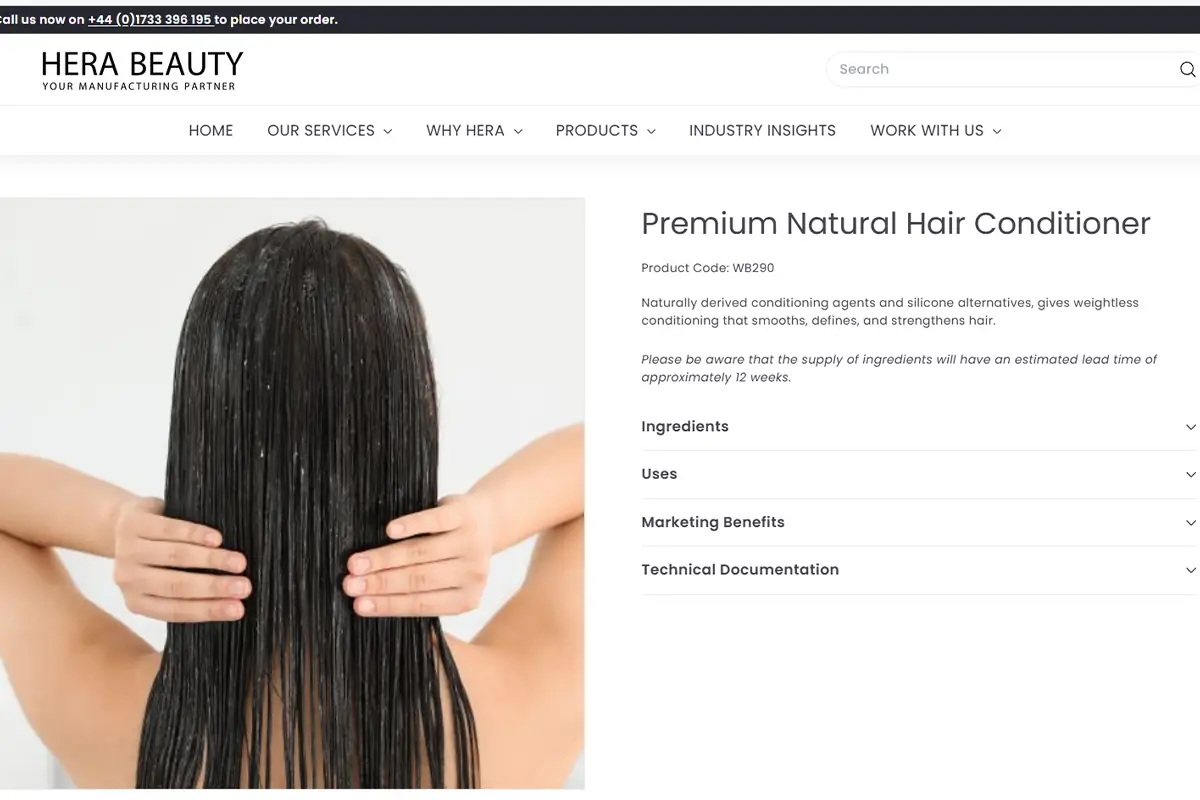
Hera Beauty develops private label and bespoke skincare, hair care, and wellness products.
Its published conditioner directions include naturally derived conditioning agents, cationic guar polymers, jojoba oil, glycerin, panthenol, and silicone-alternative systems. Hera may suit UK and European brands seeking natural positioning with practical detangling and sensory performance.
8. Orean Personal Care
Location: United Kingdom and United States
Best For: Premium bespoke hair care and dual-market production
MOQ: Contact manufacturer
Orean Personal Care develops and manufactures premium hair care, skincare, body care, and other personal-care products from operations in the UK and USA.
Rather than focusing primarily on stock catalogs, Orean emphasizes bespoke formulation, packaging coordination, manufacturing, and long-term supplier partnerships for premium brands and coordinated product ranges.
9. Saehan Cosmetics
Location: Incheon, South Korea
Best For: K-beauty treatments, professional salon products, and post-color maintenance
MOQ: Project-dependent
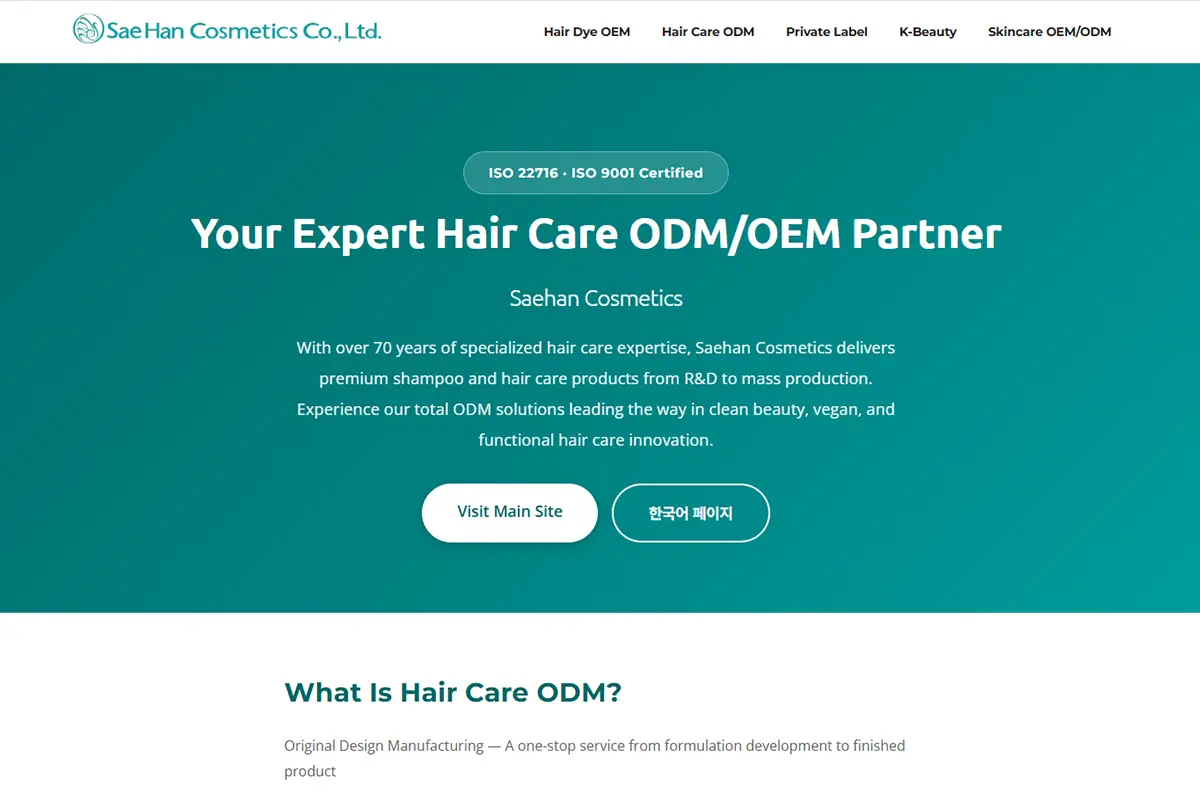
Saehan Cosmetics is a South Korean OEM/ODM manufacturer specializing in hair color, perms, intensive treatments, hair care, and styling products.
Its scope includes conditioners, rinse-off treatments, masks, tonics, lotions, oils, and leave-in products developed for repair, hydration, shine, and post-chemical care.
10. Epilab
Location: Melbourne, Australia
Best For: Australian-made conditioners and indie-to-retail development
MOQ: Project-dependent
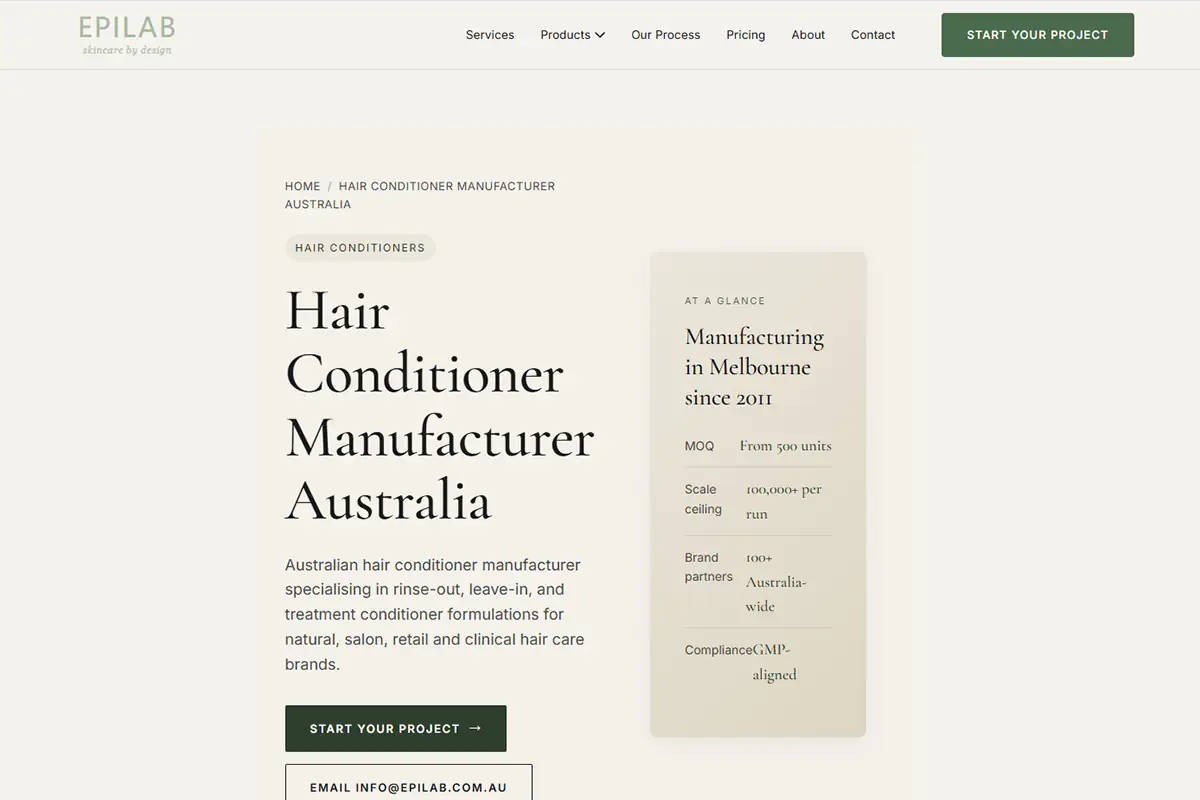
Epilab supports rinse-out conditioners, leave-in products, co-washes, and deep-treatment formulas from its Melbourne manufacturing facility.
Conditioning weight can be adjusted for fine hair, damaged hair, curls, coarse textures, or chemically processed hair. Epilab is particularly relevant to Australian and New Zealand brands seeking local manufacturing and custom development.
Key Types of Conditioners You Can Private Label
Expanding your hair care catalog requires choosing the right product format for your target consumer:
Daily Rinse-Off Conditioner
Designed to soften, detangle, and restore manageability immediately after shampooing without weighing down the hair.
- Formulation Focus: Balanced fatty alcohol matrices, lightweight cationic agents, and quick-rinsing emulsifiers.
- Target Audience: General daily care, fine to oily hair types, or classic two-step shampoo-and-conditioner systems.
Deep-Repair Conditioner or Hair Mask
Intensive treatments aimed at severely dry, bleached, heat-damaged, or chemically processed hair.
- Formulation Focus: Richer textures featuring hydrolyzed proteins, amino acids, ceramides, botanical oils, plant butters, and film-forming actives.
- Packaging Requirement: Typically requires wide-mouth jars or thick squeeze tubes rather than standard pump bottles.
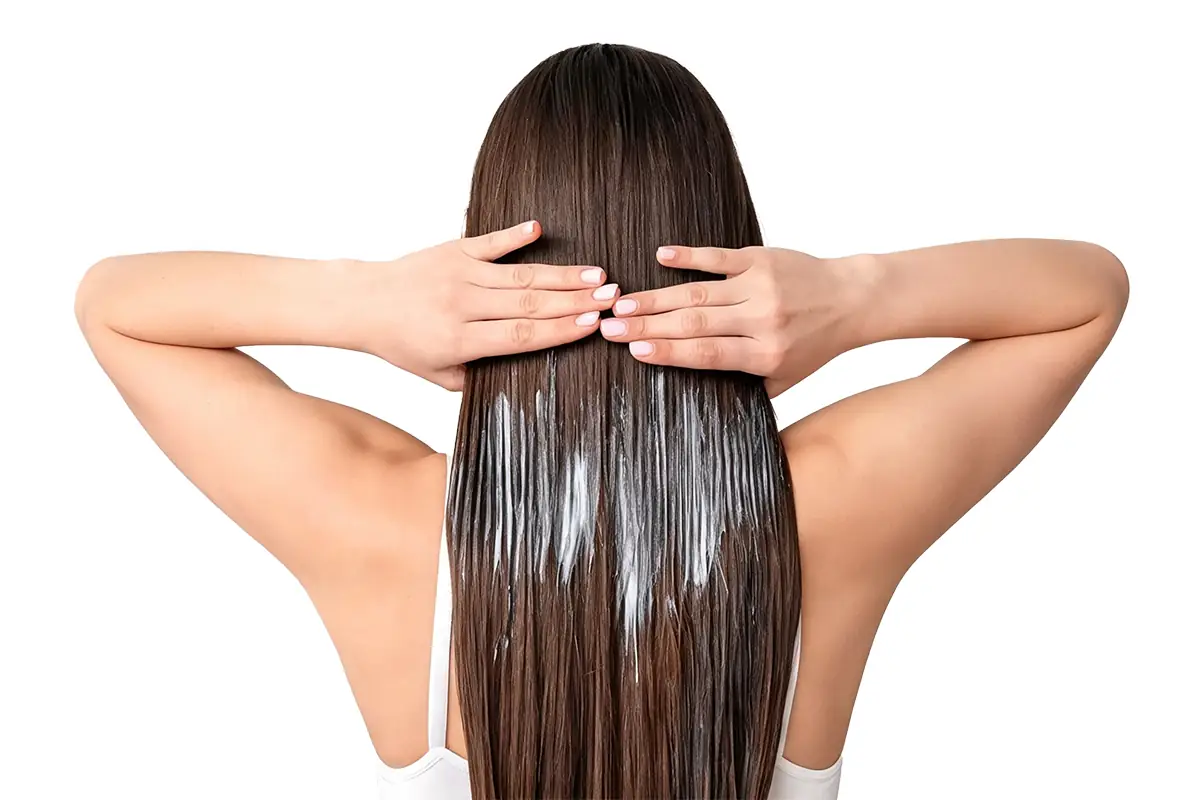
Leave-In Conditioner, Milk, or Detangling Spray
Formulas left on the hair to provide continuous hydration, heat protection, and environmental defense.
- Formulation Focus: Must remain lightweight and non-sticky. Requires careful evaluation of spray-pump atomization if presented as a liquid mist or spray.
- Product Formats: Detangling sprays, lightweight milks, anti-frizz lotions, and curl-refreshing fluids.
Curl-Defining and Textured-Hair Conditioner
Formulations engineered specifically for wavy, curly, coily, or textured hair patterns (Types 2–4).
- Formulation Focus: High-slip properties, intense moisture retention, and curl separation without leaving waxy buildup or stifling natural movement.
- Key Formats: Co-washes, deep treatments, leave-in curl creams, and rich butter conditioners.
Color-Protecting Conditioner
Formulated to prevent premature pigment fading on dyed, bleached, or highlighted hair.
- Formulation Focus: Low pH levels to seal the hair cuticle, UV filters, antioxidants, and smooth anti-static agents.
- Specialty Variants: Toning or purple conditioners, which require precise pigment dispersion and staining evaluations.
Regional Comparison: Choosing the Right Manufacturing Location
| Manufacturing Region | Regional Advantages | Best Fit For |
|---|---|---|
| USA & Canada | Domestic logistics, established stock formulas, and access to North American retail | North American startups, salon chains, retailers, and control-label programs |
| China | Integrated R&D, broad packaging resources, complete product-line development, and scalable production | International brands, distributors, ecommerce companies, and multi-SKU hair care ranges |
| UK & Europe | Premium salon positioning, regional manufacturing, and proximity to European markets | European brands, upscale salon ranges, and premium hair care concepts |
| South Korea | K-beauty concepts, technical treatments, and post-perm or post-color expertise | Trend-driven brands and professional salon lines |
| Australia | Local provenance, natural positioning, and access to Oceania markets | Australian and New Zealand brands |
For buyers prioritizing North American production, our guide to private label hair care manufacturers in the USA provides a more detailed comparison of US suppliers.
Brands evaluating European production can also compare private label hair care manufacturers in Europe.
The best manufacturing region is not automatically the closest or least expensive. The complete comparison should include formula expertise, production scale, packaging, testing, freight, import costs, communication, and long-term supply requirements.
Buyer’s Evaluation Guide: Key Quality & Compatibility Tests
Before approving a final lab sample for mass production, complete these three core evaluation steps to prevent costly commercial issues:
1. Match Conditioning Weight to Target Hair Type
Never request a single formula “suitable for all hair types.” A formula that works for thick, coarse curls will leave fine hair greasy and flat.
- Fine or Oily Hair: Test for volume retention, clean rinse feel, and lack of heavy residue.
- Dry, Coarse, or Damaged Hair: Verify deep moisture retention, cuticle smoothing, and long-lasting softness.
2. Compare Wet and Dry Hair Performance
Evaluate samples using standardized hair swatches or controlled washing tests under identical conditions:
- Wet Evaluation: Application slip, wet detangling ease, wet combing resistance, and rinse speed.
- Dry Evaluation: Dry combability, static reduction, softness, volume, fragrance retention, and buildup after multiple consecutive washes.
3. Test Formula Compatibility with Final Packaging
A successful lab sample can fail in production if packaging compatibility is overlooked. Always test the final production formula inside the exact target container:
- Dispensing Function: Ensure pumps dispense thick formulas smoothly without clogging or priming failure.
- Container Integrity: Test squeeze force on tubes, inverted bottle leak resistance, and seal cleanliness around the opening.
- Thermal Viscosity Stability: Expose packaged samples to elevated and freezing temperatures to ensure the emulsion does not separate or drastically change thickness.
Before requesting a quotation, prepare the target hair type, desired formula format, texture, fragrance, ingredients, claims, packaging capacity, estimated quantity, price positioning, and intended sales market. Review the information to prepare before requesting an OEM quote.
Conclusion & Next Steps
Finding the right private label hair conditioner manufacturer comes down to balancing the brand’s technical requirements, packaging plan, expected production scale, target market, and desired level of formulation ownership.
Pravada and RainShadow offer established-formula routes for US brands. Apollo is more strongly aligned with larger retail and control-label programs, while HSA and Orean serve premium or professional hair care projects. Saehan is relevant to Korean salon treatments, and Epilab provides an Australian manufacturing route.
For brands seeking custom cationic conditioner systems, repair-focused formulation, high-viscosity manufacturing, packaging integration, and coordinated development across shampoo, conditioner, masks, and leave-in care, Shangpinhui Biotechnology Co., Ltd. provides end-to-end OEM/ODM support from formulation and testing through filling and scalable repeat production.
Ready to Develop Your Private Label Conditioner?
Tell us your target hair type, desired conditioning weight, formula texture, fragrance, ingredients, packaging, production requirements, and intended sales market.
Shangpinhui Biotechnology Co., Ltd. can support rinse-off conditioners, deep-repair treatments, hair masks, leave-in products, and coordinated shampoo-and-conditioner systems.