
Why ingredient strength alone rarely determines long-term whitening performance
Introduction|Why Ingredient Strength Alone Is Not Enough
In many whitening projects, formulation decisions begin with a simple assumption:
stronger ingredients lead to faster and more visible results.
However, real-world OEM experience often tells a different story.
Brands frequently encounter whitening products that perform well initially, only to plateau, fade, or become unstable over time. In most cases, this inconsistency is not caused by ineffective ingredients, but by how those ingredients are delivered, retained, and maintained within the skin.
Whitening performance is not determined by ingredient strength alone.
It is shaped by how efficiently actives reach their target, remain stable within the formulation, and sustain activity over repeated use.
Section 1|Why Mild Whitening Actives Often Underperform
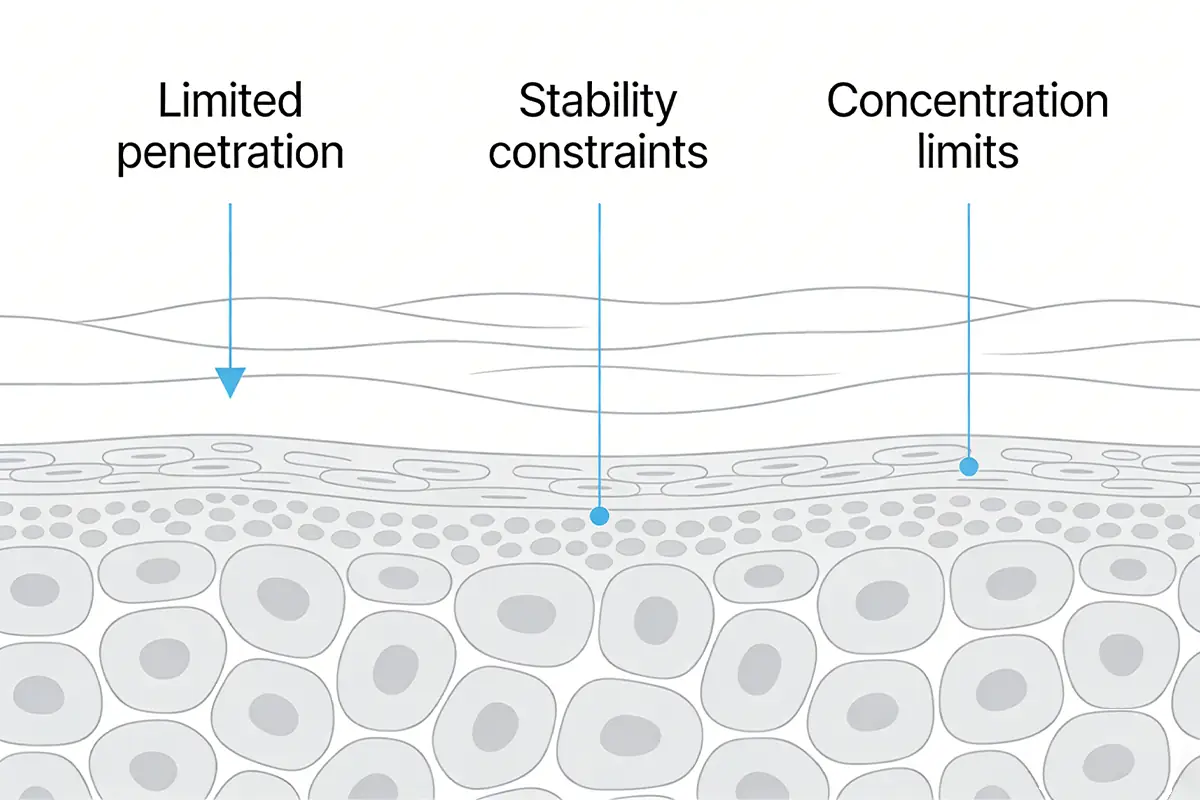
Mild whitening actives are widely favored in modern skincare for their safety and tolerability. Yet in conventional formulations, they often fail to meet performance expectations. This underperformance typically stems from three structural limitations.
First, penetration is limited.
Many mild actives struggle to pass through the stratum corneum in sufficient amounts to influence deeper pigmentation pathways. Without effective delivery, activity remains superficial and transient.
Second, stability is constrained.
Sensitive actives can degrade, oxidize, or lose efficacy when exposed to incompatible formulation environments, light, or temperature fluctuations.
Third, concentration is capped.
Unlike aggressive actives, mild ingredients cannot simply be “dosed higher” to compensate. Safety thresholds, irritation risks, and regulatory limits often restrict usable concentrations.
These constraints explain why mild whitening actives frequently appear promising on paper, but deliver inconsistent real-world results.
Section 2|What Delivery Technology Actually Solves
Delivery technology does not change what an ingredient does.
It changes how efficiently the ingredient can do it.
In whitening formulations, delivery systems are designed to improve three critical factors: availability, stability, and targeting.
Common delivery approaches include lipid-based carriers, microencapsulation, nano-emulsions, and targeted release systems. While their structures differ, their functional goal is consistent: to increase the proportion of active ingredients that reach the intended site of action in a usable form.
Effective delivery systems can:
-
Improve penetration without increasing irritation
-
Protect sensitive actives from premature degradation
-
Enable controlled or sustained release over time
Rather than amplifying ingredient strength, delivery technology amplifies delivery efficiency—allowing mild actives to perform closer to their theoretical potential.
This distinction is critical in OEM formulation design, where safety, reproducibility, and long-term stability matter as much as visible efficacy.
Section 3|Where Delivery Has Clear Limits
Despite its advantages, delivery technology is not a universal solution.
There are two situations where improved delivery alone cannot compensate for poor formulation outcomes.
The first is incorrect target selection.
If the whitening strategy addresses the wrong biological pathway, no delivery system can correct that mismatch — particularly when melanin regulation pathways are misunderstood.
The second is unmanaged skin environment factors.
Inflammation, barrier disruption, and skin stress can override delivery gains by continuously reactivating pigmentation pathways. In such cases, even well-delivered actives struggle to sustain visible improvement.
Recognizing these limits is essential. Delivery systems enhance efficiency, but they cannot replace correct mechanism selection or holistic formulation strategy.
Section 4|OEM Application Strategies
In OEM practice, delivery technology is most effective when applied strategically rather than universally.
Three application approaches are commonly used:
1. Mild actives with enhanced delivery for long-term use
This strategy prioritizes safety, tolerance, and consistency, making it suitable for daily-use whitening products.
2. Controlled-release systems for stability-sensitive actives
Here, delivery focuses on preserving activity and reducing formulation stress rather than increasing intensity.
3. Delivery as part of a multi-target system
Delivery technologies can support broader formulation strategies by improving the coordination between multiple whitening pathways.
In all cases, delivery is treated as a supporting system—integrated into formulation design rather than positioned as the primary driver of efficacy.
Conclusion|Delivery Is an Efficiency Multiplier, Not a Substitute
Whitening outcomes are rarely determined by a single ingredient or technology.
Delivery systems play a critical role in improving how effectively whitening actives perform, particularly when working with mild, skin-friendly ingredients. However, they do not replace the need for correct mechanism selection, formulation balance, or realistic performance expectations.
In OEM formulation design, delivery should be viewed as an efficiency multiplier—one that helps well-chosen ingredients perform more consistently, safely, and predictably over time.
When used with restraint and strategy, delivery technology becomes a powerful tool.
When relied upon as a shortcut, it quickly reaches its limits.
To address some of the most common formulation questions OEM clients often raise, the following FAQs provide additional clarification.
Q1: Do delivery systems make whitening ingredients stronger?
A:No. Delivery systems improve efficiency, not intrinsic ingredient strength. They help actives reach and maintain effectiveness closer to their theoretical potential.
Q2: Can delivery technology replace high concentrations in whitening formulas?
A:Not entirely. Delivery can reduce reliance on higher concentrations, but formulation balance and mechanism selection remain critical.
Q3: Are delivery systems necessary for all whitening products?
A:No. Delivery systems are most valuable for mild, stability-sensitive actives and long-term use products, not every formulation.

 Uzbek
Uzbek  English
  Kazakh
  Turkish
  Russian
  Arabic
  Spanish
  Portuguese
  French
  German
  Japanese
  Korean