
How Inflammation Undermines Dark Spot and Acne Mark Correction in OEM Formulation
Introduction|Why Many Whitening Formulas Fail Before Results Can Even Begin
In OEM whitening projects, disappointing results are often blamed on familiar reasons: insufficient active strength, weak delivery systems, or unrealistic consumer expectations.
However, many formulas fail even when actives are well-chosen and the system is stable—especially for dark spots and acne marks, where real-world feedback often shows slow response or rapid plateau.
A frequently overlooked driver is inflammation.
Inflammation whitening failure is not simply about irritation or redness. It is about a persistent skin state that keeps pigmentation behavior “switched on,” reducing how predictably whitening actives can perform over time.
This article explains inflammation as an OEM-side failure factor—and what it changes in formulation logic.
Section 1|Inflammation Is Not a Side Effect—It Is a Functional Skin State
In formulation discussions, inflammation is often treated as a side effect to minimize: redness, burning, or discomfort.
But in skin biology, inflammation is a functional state that can reshape pigmentation behavior. When skin remains under repeated stress (acne activity, barrier disruption, friction, over-exfoliation, post-procedure recovery), inflammatory signaling may stay active even without obvious redness.
Under these conditions:
-
Pigmentation signals become more easily triggered
-
Barrier recovery slows, increasing sensitivity cycles
-
Oxidative stress rises, accelerating active degradation risk
-
Tone improvement becomes less stable and more inconsistent
This is why some whitening products look strong “on paper,” but fail to deliver repeatable results across users.
Section 2|Why Traditional Whitening Logic Breaks Down for Dark Spots and Acne Marks
Most whitening formulas assume a relatively stable baseline: predictable melanin regulation, controlled permeability, and consistent tolerance.
But dark spots and acne marks often involve post-inflammatory behavior rather than purely UV-driven tanning.
When inflammation is present:
-
Melanocyte activity can remain reactive
-
Pigment distribution may become deeper or more uneven
-
Barrier disruption increases the chance of stop-and-go usage (which reduces consistency)
So simply increasing concentration or switching to a “stronger active” does not guarantee better outcomes. In some cases it increases sensitivity events, creating a loop that reinforces pigmentation recurrence.
Section 3|Inflammation Is a Primary Driver of “Stubborn Pigmentation” in OEM Feedback
From an OEM perspective, many “whitening failures” are not caused by weak actives. They are caused by the skin environment making the results harder to stabilize.
A common pattern in market feedback is:
-
Early brightness appears
-
Dark spots improve partially
-
Results plateau or become unstable
-
Complaints rise among acne-prone / sensitive users
This pattern is consistent with inflammation-driven pigmentation, where pigment activity behaves like a defensive response instead of a simple “enzyme problem.”
To better understand where pigmentation control can break down across different stages, it helps to revisit melanin regulation pathways.
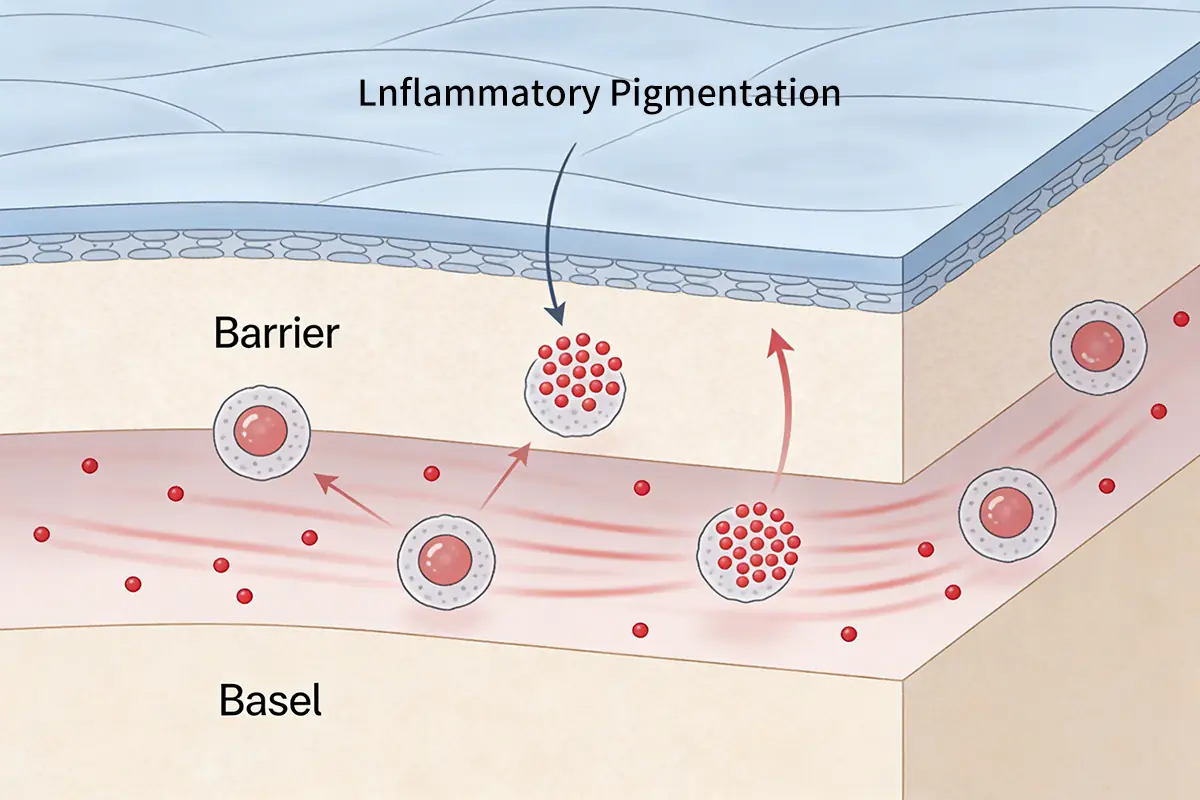
The following diagram illustrates how inflammatory activity alters pigmentation behavior at deeper skin layers, even when surface irritation is minimal.
Section 4|Why Delivery and “Stronger Actives” Cannot Replace Skin-State Management
Delivery can improve efficiency, but it does not automatically reset inflammation signaling.
Poorly controlled penetration may even create localized stress—especially in compromised barriers—leading to more reactivity over time.
This is why delivery systems in whitening formulations should be treated as an engineering tool, not a shortcut for biological mismatch.
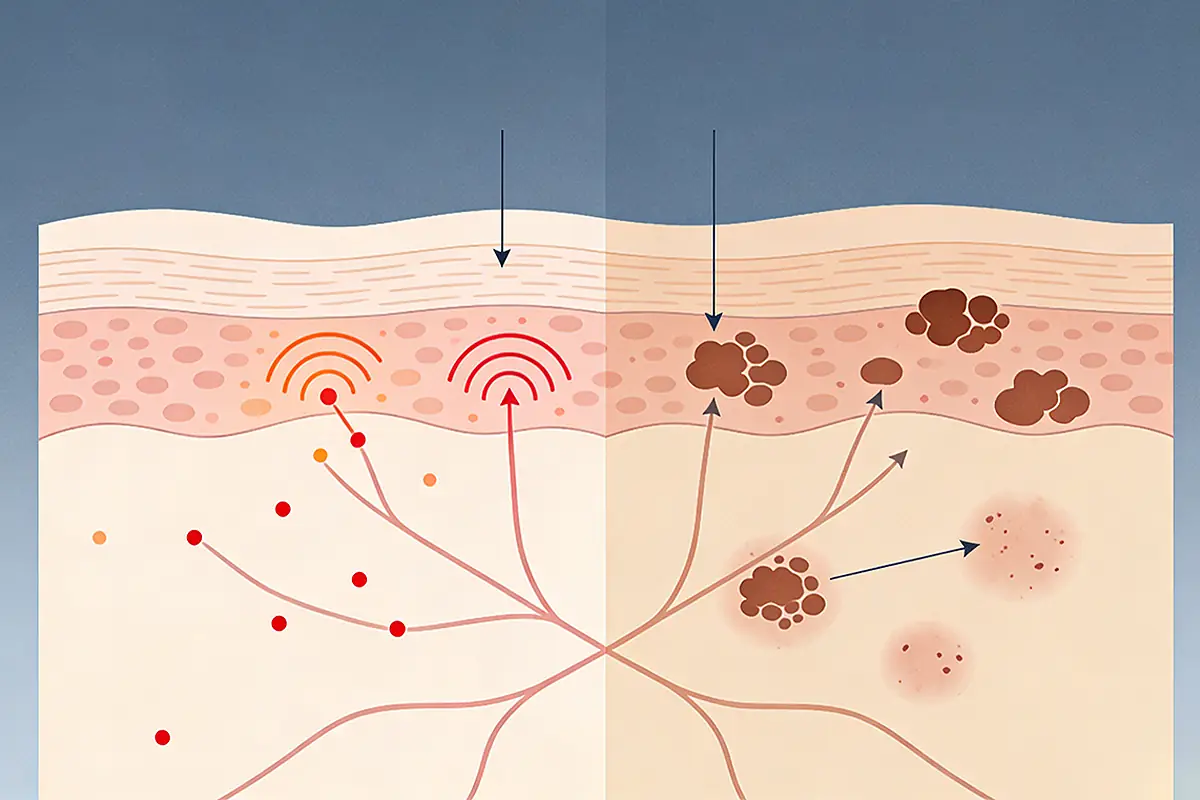
The following diagram illustrates how inflammatory signaling interferes with pigmentation pathways, reducing long-term whitening stability.
Section 5|OEM Implications: Reformulating Whitening as “Skin-State First”
For many brands, the real decision is not “Which whitening active is strongest?” but “Can the formula keep skin stable long enough to respond?”
In OEM development, this often translates into a layered logic:
-
reduce inflammatory triggers and skin stress
-
support barrier recovery and tolerance
-
reduce oxidative load
-
then run targeted pigment modulation
This is also why setting realistic testing logic and timelines matters early — especially when defining first whitening batch expectations.
Conclusion|Whitening Fails When Inflammation Sets the Rules
Whitening outcomes are rarely determined by a single ingredient.
In OEM practice, many failures happen because formulas are designed for idealized skin conditions—while real users often have ongoing inflammation, barrier stress, or acne-related activity.
When inflammation remains active, pigmentation becomes harder to regulate, results become less predictable, and even well-constructed systems may plateau.
For OEM whitening formulation, controlling the skin environment is not a “nice-to-have.” It is often the difference between a formula that works in theory and one that performs consistently in the market.
Before closing, here are the most common OEM-side questions brands ask when they realize inflammation can reshape whitening performance.
FAQ 1|Can whitening formulas work well on acne-prone or sensitive skin?
A:Yes, but they require stronger tolerance logic—barrier support and reduced skin stress must be built into the system so actives can perform consistently.
FAQ 2|Is increasing active concentration the fastest way to improve results?
A:Not always. Higher intensity can increase irritation events, which may reinforce pigmentation recurrence and reduce long-term stability.
FAQ 3|Do delivery systems solve inflammation-driven performance problems?
A:Delivery improves efficiency, but it cannot replace skin-state management. If inflammatory signaling remains active, performance gains may be limited or unstable.

 English
  Uzbek
Uzbek  Kazakh
  Turkish
  Russian
  Arabic
  Spanish
  Portuguese
  French
  German
  Japanese
  Korean