
A Practical Guide to Retinol Positioning, Tolerance, and OEM Formulation Strategy
Введение
In anti-aging skincare, few ingredients have the same level of market recognition as retinol.
For many brands, retinol is one of the first ingredients that comes to mind when planning a new anti-aging serum, cream, or night treatment. It is widely associated with wrinkle reduction, smoother texture, and long-term skin renewal.
But strong recognition does not automatically mean universal fit.
As discussed in our guide on how to choose anti-aging ingredients for OEM development, ingredient popularity alone is not enough to define a strong anti-aging product line. The more important question is whether the ingredient path actually matches the product’s positioning, skin tolerance profile, and long-term formulation logic.
This is exactly where retinol becomes a strategic ingredient rather than just a famous one.
Retinol can be highly valuable in anti-aging skincare OEM development, but it is not the right answer for every brand, every market, or every user group. To use it well, brands need to understand not only where it works, but also where its limits begin.
What Retinol Actually Does in Anti-Aging Formulation
Retinol is best understood as a renewal-focused anti-aging ingredient.
Its value comes largely from how it helps improve the visible condition of the skin over time. In practical formulation terms, retinol is most often associated with three major areas of performance.
First, it supports surface renewal. This is why retinol is often linked to smoother-looking skin, improved texture, and a more refined surface appearance.
Second, it is commonly used to address early visible signs of aging, especially when brands want to target fine lines, roughness, and dullness in one direction.
Third, it has strong commercial relevance because it sits at the intersection of scientific credibility and consumer awareness. Even users who do not fully understand anti-aging mechanisms often recognize retinol as a serious ingredient.
This is one reason why retinol remains such a strong entry point in anti-aging skincare.
At the same time, its role is more specific than many marketing claims suggest. Retinol is especially relevant in formulations built around renewal, surface smoothing, and visible texture improvement. It is not a complete anti-aging strategy on its own.
Why Retinol Matters — But Does Not Solve Everything
One of the biggest formulation mistakes brands make is assuming that a powerful ingredient can function as a complete anti-aging answer.
Retinol is important, but anti-aging is still a multi-mechanism problem.
Earlier in this series, we discussed how oxidative stress contributes to skin aging, how glycation affects wrinkles and skin quality, and how chronic inflammation accelerates long-term aging. These pathways help explain why visible aging is not driven by only one process.
Retinol can contribute strongly to renewal-oriented positioning, but it does not automatically resolve oxidative pressure, barrier fragility, chronic inflammation, or every form of structural decline.
This distinction matters in OEM development.
If a brand defines anti-aging too narrowly, it may overbuild around a single famous ingredient while underbuilding around the broader formulation system needed for long-term results. That often leads to products that sound strong in concept, but feel incomplete in real market positioning.
For this reason, retinol should be treated as one strategic path within anti-aging development, not as the entire map.
The Real Challenge: Stability, Tolerance, and Product Positioning
Retinol is not difficult only because it is active. It is difficult because it creates formulation pressure on multiple levels at the same time.
In OEM development, the real challenge is not only ingredient recognition, but also how the formula addresses stability pressure, oxidation risk, and long-term tolerance.
Retinol is sensitive to light, air exposure, and formulation environment. At the same time, higher-performance retinol positioning often increases the risk of redness, peeling, or low long-term compatibility if the surrounding system is not carefully designed.
This is why retinol products can look attractive on paper, but still struggle in real market performance.
A formula that sounds strong but leads to low repeat use, weak user adaptation, or inconsistent experience may be less commercially sustainable than a slightly gentler formula with stronger real-world retention.
That is where OEM judgment becomes critical.
In practice, retinol projects often depend less on ingredient recognition alone and more on whether the formulation can balance renewal performance with long-term skin compatibility. This becomes especially important when brands want to support an active anti-aging image without pushing the formula beyond the tolerance of the target user.
For some brands, retinol makes sense in performance-driven night treatments, texture-focused serums, or more experienced skincare markets where users already understand active ingredient routines.
For other brands, especially those targeting sensitive-aging users, lower-tolerance skin, or gentler long-term positioning, retinol may create too much formulation pressure unless the system is very carefully designed.
How Strong OEM Development Improves Retinol Performance
A strong retinol formula is not built by “adding retinol” alone.
Its real strength often depends on how the surrounding formulation system is designed to protect the ingredient, reduce unnecessary stress, and improve the user’s long-term experience.
In practical OEM development, this may involve several technical directions.
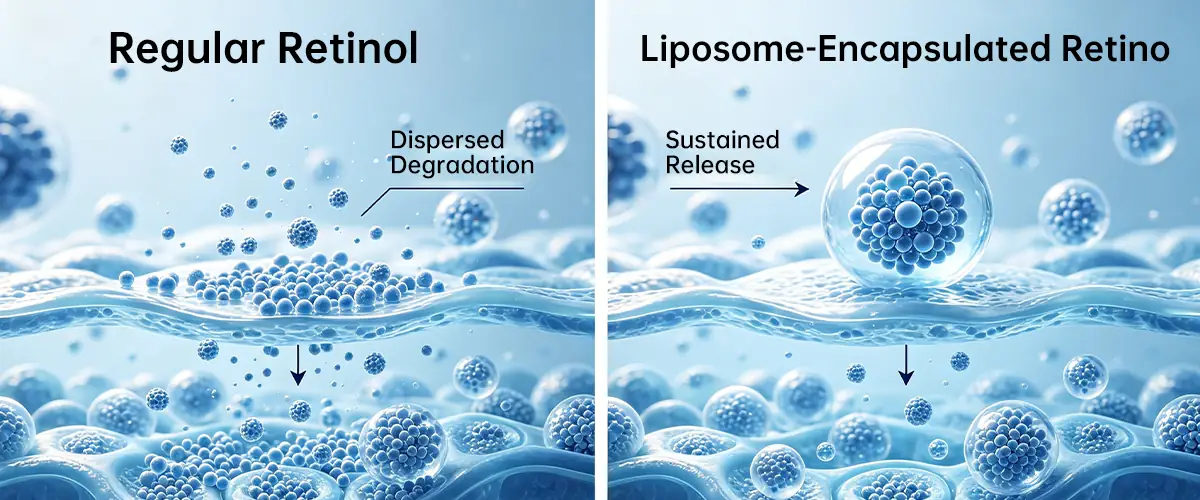
One important direction is stabilization logic. Retinol-based formulas often benefit from production and formulation strategies that reduce oxidation exposure and help preserve activity during processing and storage.
Another is controlled delivery or protective structuring. In some projects, encapsulation-related approaches or other protective formulation systems can help improve ingredient handling, reduce harshness, and support more stable real-world use.
Packaging strategy also matters. In retinol development, formula design and packaging design should not be treated as separate decisions. A better-protected system often depends on how the product is filled, stored, and dispensed over time.
These details matter because a retinol project usually succeeds or fails less on the fame of the ingredient itself and more on whether the full formulation system is built to support stable performance.

When Retinol Works Best in OEM Development
Retinol tends to perform best when the product direction is already clear.
In practical terms, it is most suitable when brands want to build around one or more of the following goals:
- visible renewal and smoother texture
- early wrinkle-focused anti-aging
- night repair or resurfacing positioning
- higher-performance anti-aging concepts with a more active image
In these cases, retinol can give the line a recognizable anchor ingredient and help support a stronger premium or science-driven identity.
It is also particularly useful when the target market already understands active skincare routines and is willing to accept a more performance-oriented formulation style.
For these projects, retinol is not just a formulation ingredient. It also acts as a communication shortcut. It helps define the product as serious, active, and anti-aging focused.
That said, OEM development still needs to support this direction with the right texture, stability logic, usage context, and compatibility design. Without that support, the ingredient may generate more concept value than true product strength.
When Brands Should Consider Alternatives or Synergy Routes
Retinol is powerful, but it is not the only route to renewal-oriented anti-aging.
For some anti-aging lines, the better question is not whether retinol is effective, but whether a gentler or more balanced renewal strategy would be more commercially sustainable.
This becomes especially relevant when the product line is designed for:
- sensitive-aging users
- long-term daily use positioning
- recovery-first anti-aging concepts
- users with weaker tolerance or barrier fragility
- markets that prefer lower-irritation claims
In these cases, brands may need to look at gentler alternatives, softer renewal systems, or more balanced combinations that deliver anti-aging value without making retinol the entire center of the formula.
This is also where synergy logic becomes important. In some OEM projects, renewal-focused ingredients may need to be supported by barrier-conscious systems, recovery-oriented actives, fermentation-based soothing logic, or peptide-related support pathways rather than standing alone.
The important point here is not to reject retinol. It is to understand that retinol is one route, not the only route.
That distinction becomes commercially important when brands want to build anti-aging lines that are not only effective in theory, but more adaptable across real user needs.
How OEM Development Should Evaluate a Retinol Project
In OEM development, retinol should never be evaluated as an isolated ingredient decision.
It should be assessed as part of a broader formulation and positioning system.
Before deciding whether retinol should become a hero ingredient, brands should evaluate at least four questions.
First, what is the expected tolerance level of the target user?
A formula for experienced active-skincare users will require different design logic than a formula intended for sensitive-aging or low-tolerance skin.
Second, what is the real product positioning?
Is the product built around visible renewal, overnight improvement, premium anti-aging, gentle long-term repair, or early prevention? Retinol does not play the same role in each case.
Third, what format will support the strategy best?
A serum, cream, night concentrate, or paired system may all require different formulation choices and communication strategies.
Fourth, what support system needs to surround the ingredient?
Retinol often becomes stronger commercially when supported by texture logic, barrier-conscious design, and a formulation system that improves long-term usability rather than relying only on ingredient fame.
This is where a strong OEM partner adds real value.
For retinol-based projects, technical value often lies in how the formula is structured around tolerance, texture, stability, and long-term usability rather than in the ingredient claim alone. In many cases, the real difference is not whether retinol is included, but whether the surrounding system is built to support stable performance and better real-world use.
The question is not simply whether retinol can be added. The question is whether retinol can be translated into a product that fits the right skin type, user expectation, and market role.
Retinol as an Entry Point, Not a Universal Answer
Retinol deserves its place as one of the most recognized anti-aging ingredients in skincare.
It can support visible renewal, smoother texture, and a stronger active-positioning story. For many OEM projects, it is a valid and commercially useful direction.
But retinol should not be treated as a universal answer.
The strongest anti-aging lines are not built by asking only whether a famous ingredient can be included. They are built by asking whether that ingredient fits the mechanism, tolerance level, positioning, and long-term logic of the line itself.
That is the real difference between trend-following formulation and strategic anti-aging OEM development.
Conclusion
Retinol remains one of the most important ingredients in anti-aging skincare, but its value depends on where and how it is used.
For some brands, it is an excellent fit for renewal-focused, high-recognition anti-aging products. For others, especially those building gentler or more tolerance-sensitive lines, it may not be the most suitable central path.
In OEM development, the goal is not to treat retinol as mandatory. The goal is to understand when retinol truly fits the product line, and when a different route may create a better long-term result.
Brands that make this distinction clearly are far more likely to build anti-aging products that are not only marketable, but coherent, differentiated, and commercially sustainable.
Before moving into the FAQ section, here are a few practical questions brands often ask when evaluating retinol for anti-aging OEM development.
FAQ
Q1: Is retinol the best anti-aging ingredient for every brand?
No. Retinol is one of the most recognized anti-aging ingredients, but it is not automatically the best fit for every brand, market, or user group. Its relevance depends on positioning, tolerance level, and the overall formulation strategy.
Q2: What are the main challenges of retinol in OEM formulation?
The main challenges usually involve stability, oxidation exposure, tolerance, and long-term usability. In anti-aging OEM development, retinol needs stronger strategic evaluation than many brands initially expect.
Q3: When should brands consider gentler alternatives to retinol?
Brands should consider gentler alternatives when targeting sensitive-aging users, lower-tolerance skin, long-term daily use, or recovery-focused anti-aging positioning. In these cases, a softer renewal route may be more commercially sustainable.

 Russian
  English
  Uzbek
Uzbek  Kazakh
  Turkish
  Arabic
  Spanish
  Portuguese
  French
  German
  Japanese
  Korean