
Polypeptide cream is popular for one simple reason: it gives customers a promise they can understand.
Firmer-looking skin. Smoother texture. Better elasticity.
A cream that feels advanced, but not aggressive.
That is why peptide creams keep showing up in anti-aging routines, sensitive-skin lines, and premium private label skincare. The category is growing, and it is not slowing down.
But here is the part many brands miss: a peptide cream does not work just because the word “peptide” appears on the label. The results depend almost entirely on how the formula is built — the peptide system chosen, the supporting actives around it, the texture, the stability, and the delivery.
The short answer: Polypeptide cream helps support firmer-looking skin, improve the appearance of fine lines, and strengthen skin’s resilience over time — when the formula is built properly.
This article explains what polypeptide cream actually does, where its real limits are, and what brands need to think about when developing one.
What Does Polypeptide Cream Actually Do?
Polypeptide cream works by delivering peptide actives to the skin in a form it can respond to. The results are not dramatic or immediate. They are cumulative, gradual, and most visible over consistent use across several weeks.
When a polypeptide cream is well formulated, it can:
- Support firmer-looking skin — by influencing the skin’s own signaling pathways that relate to elasticity and structural support
- Improve the appearance of fine lines and expression lines — particularly surface-level dryness lines and early aging signs
- Support skin elasticity and bounce — making skin feel more resilient to the touch over time
- Strengthen barrier comfort — especially when peptides are combined with ceramides, panthenol, or beta-glucan
- Enable a gentle anti-aging positioning — without the redness, peeling, or adjustment period associated with harsher actives
For brands, polypeptide cream is not just a functional product. It is a positioning product. It allows a brand to communicate “advanced anti-aging” without the clinical aggression that makes customers nervous — and without the complaint rate that often follows.
How Do Peptides Work in Skin?
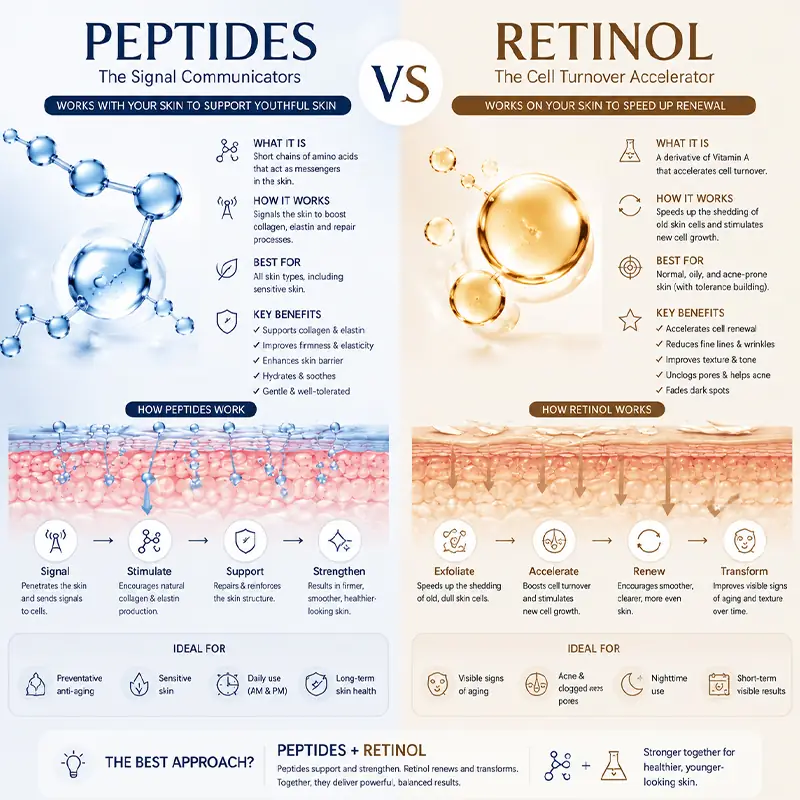
Think of peptides as messengers, not builders.
They do not directly construct collagen or physically fill in wrinkles. Instead, they send signals to skin cells suggesting that repair or maintenance is needed. The skin, in turn, responds by supporting its own natural processes — including collagen synthesis, barrier repair, and moisture retention.
This is why peptide creams feel gentle. There is no forced cell turnover, no surface disruption, no mandatory purging phase. Just a quiet signal, delivered consistently.
But signals only work if they reach the right place. A peptide molecule that sits on the surface of the skin without penetrating does very little. Peptide molecules tend to be relatively large — too large, in some cases, to pass through the skin barrier on their own. This is where formulation design, not the ingredient itself, becomes the deciding factor.
The delivery system, the base formula pH, the texture, the emulsification approach — all of these affect whether the peptide actually reaches where it needs to go.
For OEM development, this means the peptide you choose matters less than the system you build around it.

Does Polypeptide Cream Really Work?
Yes — but only when the formula is built with the right system.
This is not a vague disclaimer. It is the most practical thing to understand about peptide cream, whether you are a consumer evaluating a product or a brand developer planning a launch.
Here are the five factors that determine whether a polypeptide cream performs or just promises:
Peptide type matters. Signal peptides, copper peptides, expression-line peptides, and collagen-support peptides all work through different mechanisms. Matching the peptide system to the target claim is the first formulation decision, not an afterthought.
Concentration and supporting actives matter. A peptide at too low a concentration, surrounded by no meaningful supporting ingredients, will underperform regardless of the peptide’s quality. Supplier clinical data — from companies like Sederma and Lipotec — is typically generated at specific concentrations in controlled formulation environments. Those conditions matter.
Stability matters. Some peptide complexes degrade at the wrong pH, or when combined with incompatible actives. Stability testing is not optional for a credible commercial formula.
Delivery matters. If a peptide molecule cannot reach the skin layer where it is meant to work, the formula is not delivering on its label. Delivery system design — including liposome encapsulation — can make a meaningful difference for premium-positioned products.
Texture and sensory experience matter. A peptide cream that feels wrong will not be used consistently. And a product that is not used consistently does not work. Texture is a functional variable, not a cosmetic detail.
If your brand wants to turn peptide benefits into a real commercial product, the next step is understanding what goes into building one. Our polypeptide cream OEM development guide covers the full formulation and production process.
Main Benefits of Polypeptide Cream
Firmer-Looking Skin and Fine-Line Support
Signal peptides like palmitoyl tripeptide-1 and palmitoyl tetrapeptide-7 support the skin’s collagen-related signaling pathways. Expression-line peptides like Argireline work on dynamic line appearance by influencing muscle contraction signaling. Over consistent use, the result is skin that looks firmer and feels more resilient — without the aggressive turnover mechanism of retinol.*
For brands, “firmer-looking skin” and “fine-line appearance support” are among the easiest claims to communicate. They are visual, tangible, and understood across age groups.
Barrier Comfort and Gentle Anti-Aging
When peptides are paired with ceramides, panthenol, beta-glucan, or ectoin, the formula supports both skin structure and daily comfort. This combination works for sensitive skin, dry skin, and anyone who cannot tolerate more aggressive actives.
People still want anti-aging results. They just do not want their face to feel punished for wanting them. Peptide cream solves this. No adjustment period, no peeling story, no restriction on daily use.
Premium Positioning Without Clinical Risk
Peptide cream occupies a strong position in the premium skincare market. The word “peptide” communicates science and precision without triggering the anxiety that medical-adjacent language sometimes creates. This supports higher price positioning, works across multiple formats — serum, cream, eye cream, neck cream — and elevates a brand’s product line without a complete repositioning.
For brands moving upmarket, a well-formulated polypeptide cream is one of the lowest-risk, highest-credibility ways to do it.
What Polypeptide Cream Cannot Do
A peptide cream is not magic.
And honestly, that is a good thing. Brands that understand the limits usually build better products — and have lower return and complaint rates — than brands that chase exaggerated claims.
Here is what polypeptide cream cannot do:
It cannot produce overnight results. Peptide actives work through gradual cellular signaling. Most consumers see meaningful improvement after 4 to 8 weeks of consistent use.
It cannot replace medical aesthetic treatments. Deep structural wrinkles, significant volume loss, and advanced photodamage are beyond what any topical cosmetic product can address.
It cannot solve multi-dimensional aging with a single ingredient. Skin aging involves collagen loss, barrier dysfunction, oxidative stress, glycation, and inflammation. A well-designed formula addresses several of these pathways — but no single cream addresses all of them.
It cannot compensate for a weak base formula. A high-quality peptide active in a poorly designed base will not deliver the results on the label. The peptide is only as effective as the system around it.
One question that comes up often at this stage: if synthetic peptide creams have these limits, is there a formulation route that can go further? There is. Fermentation-derived peptide actives work through a different mechanism — and they carry different strengths and positioning advantages. We will cover that comparison in a dedicated article coming soon.
For brands already thinking about premium anti-aging positioning, our article on fermented peptide actives in anti-aging skincare OEM explores the technical logic behind higher-tier formulation approaches.
How to Build a Better Polypeptide Cream
Understanding what polypeptide cream does is useful. Knowing how to build one that actually delivers is what separates a credible product from a trend-chasing label claim. This is where most OEM conversations need to start — not with “which peptide is trending” but with “what is this product trying to do, for whom, and in what format.”
Step 1: Define the Product Brief Before Choosing the Peptide
The most common mistake brands make is choosing a peptide first and building a brief around it. The correct sequence is the opposite.
Start with three questions: Who is the target consumer? What is the primary claim? What is the product format?
A lightweight daily moisturizer for consumers in their late 20s has a different peptide brief than a rich night repair cream for mature skin. A brand building a sensitive-skin line has different compatibility requirements than a brand positioning in the performance anti-aging space. The answers to these questions determine which peptide system, which supporting actives, which texture direction, and which delivery approach are appropriate.
Skipping this step leads to generic formulas — products that are technically correct but commercially undifferentiated.
Step 2: Choose the Right Peptide System for the Claim
Different peptide actives work in different directions. Matching the system to the claim is a formulation decision with commercial consequences.
Signal peptides — such as Matrixyl 3000 (palmitoyl tripeptide-1 and palmitoyl tetrapeptide-7) — are among the most studied peptide actives for firming and collagen-support claims. They are a strong default for broad anti-aging positioning.
Copper peptides (GHK-Cu) support skin repair and regeneration, with barrier-support and antioxidant properties. They work well in recovery-focused and barrier-repair positioned products.
Expression-line peptides — such as Argireline (acetyl hexapeptide-3) — address dynamic line appearance. They are particularly effective in eye cream and expression-area targeting formats.
Multi-peptide complexes combine several mechanisms, supporting broader claims with a single ingredient addition. They are a practical choice when a brand wants a comprehensive anti-aging story without managing multiple single-peptide actives.
Supplier clinical data from companies like Sederma and Lipotec provides the evidence base for these claims — but only when the actives are used at the validated concentrations in a compatible formulation environment.
Step 3: Build the Supporting Formula System
A peptide active in isolation is unlikely to perform at its best. The formula around it determines how much of the active reaches where it needs to go, and how the skin receives it.
Strong supporting actives for a polypeptide cream include ceramides for barrier lipid restoration, panthenol for barrier repair and anti-inflammatory support, beta-glucan for soothing and skin resilience, hyaluronic acid for surface hydration and plumping, and ectoin for environmental stress protection.
These ingredients do two things simultaneously: they create the skin environment in which the peptide actives are most likely to function well, and they broaden the product’s positioning from single-benefit anti-aging to multi-benefit skin health — a more defensible market position with a wider consumer appeal.
Step 4: Match Texture to the Use Occasion
Texture is not a secondary consideration. For a leave-on product like a cream, texture determines repurchase behavior more reliably than the formula’s technical quality.
A lightweight gel-cream is appropriate for morning use, younger demographics, combination and oily skin types, and layering under SPF. A richer cream supports mature skin, dry skin, and night repair positioning. An eye cream has specific requirements — light enough to avoid milia, stable enough for repeated daily use, and designed to absorb without migration.
The right texture also depends on the target market. Consumers in humid climates tend to prefer lighter textures than those in dry or cold climates. For export-oriented brands, getting texture right for the primary market is as important as getting the actives right.
Step 5: Validate Stability and Compatibility
A peptide formula that looks good at launch but degrades within six months on shelf is not a commercial product. Stability testing — including accelerated aging, freeze-thaw cycles, and compatibility testing with packaging materials — is the step that confirms a formula is ready for market.
Compatibility testing also matters at the product-line level. If a brand is launching a peptide serum alongside a peptide cream, the interactions between those two products — including pH alignment, active compatibility, and layering behavior — should be confirmed before the line goes to market.
This is the step that most early-stage brands underestimate. It is also the step that most experienced OEM manufacturers treat as non-negotiable.
Who It Is For and When to Use It
Polypeptide cream is one of the most broadly applicable anti-aging formats available. A quick reference for brands thinking about target consumer and product positioning:
Who it works for:
- Mature skin seeking daily firming and fine-line support
- Dry or sensitive skin that cannot tolerate retinol or acid-based actives
- Retinol-sensitive users who want anti-aging results without the reaction risk
- Consumers in their late 20s and early 30s starting their first real anti-aging routine
When to use it:
- Morning: after serum, before SPF — formula should be lightweight enough to layer
- Evening: as the final step in a repair-focused routine — can be richer and more nourishing
For brands, daytime and night-cream briefs produce two different formulas, two different textures, and two different marketing stories. That is two product opportunities from one ingredient direction.
What Should You Not Layer with Peptides?
The honest answer is that it depends on the specific peptide system and the full formula context.
As a general direction: avoid layering high-concentration AHA or BHA exfoliants in the same routine step as peptide actives. Some peptide complexes are sensitive to low-pH environments, which can affect their stability and performance. Overloading a routine with multiple strong actives — strong retinol, low-pH vitamin C, aggressive exfoliants — alongside a peptide cream increases irritation potential without proportionally increasing benefit.
For OEM projects, layering compatibility between products in a routine should be validated at the formulation stage, not discovered by customers after purchase. This applies especially to brands launching a serum-plus-cream system where the two products are designed to be used together.
Conclusão
Polypeptide cream works best when it is not treated as a trend ingredient.
It should be treated as a product system.
The right peptide type. The right supporting actives. A texture that drives repurchase. Delivery design that protects active stability. Claims that match the target market and the regulatory environment.
These are the decisions that separate a polypeptide cream that performs from one that only promises. And they are the decisions that determine whether a brand builds customer loyalty or manages customer complaints.
For brands ready to move from research to development, the next step is working with a manufacturer who can translate these decisions into a stable, scalable, commercially viable formula.
Talk to our OEM team about building your polypeptide cream product line →

 Portuguese
  English
  Uzbek
Uzbek  Kazakh
  Turkish
  Russian
  Arabic
  Spanish
  French
  German
  Japanese
  Korean