
Why First-Batch Whitening Products Often Underperform — and How OEM Strategy Fixes It
Introduction:
Many whitening products underperform not because the ingredients are ineffective,
but because performance expectations are defined incorrectly from the very beginning.
For private label brands, e-commerce sellers, and professional skincare businesses,
a first whitening product is rarely—and should not be—designed to address every pigmentation pathway at once.
In real OEM development, early-stage whitening projects must balance:
-
Clear and realistic product positioning
-
Formula stability and safety
-
Cost–performance feasibility
-
Speed of market validation
This article explains how to set the right performance expectations for first-batch whitening products,
and why this decision has a long-term impact on brand success.
Section 1|Why First-Batch Whitening Formulas Focus on a Clear Core Direction
In OEM manufacturing, most first-batch whitening formulas are designed around one clear core direction,
supported by synergistic actives rather than isolated single ingredients.
This is not a technical limitation, but a strategic decision.
Early-stage brands typically prioritize:
-
Stable and controllable formulations
-
Predictable testing and compliance pathways
-
Clear communication of what the product is designed to do
-
Sustainable cost–performance balance
The key is not how many whitening ingredients are included,
but whether the product’s intended role and performance scope are clearly defined.
Section 2|Whitening, Lightening, and Brightening Are Not the Same Thing
Before discussing results, it is important to clarify terminology.
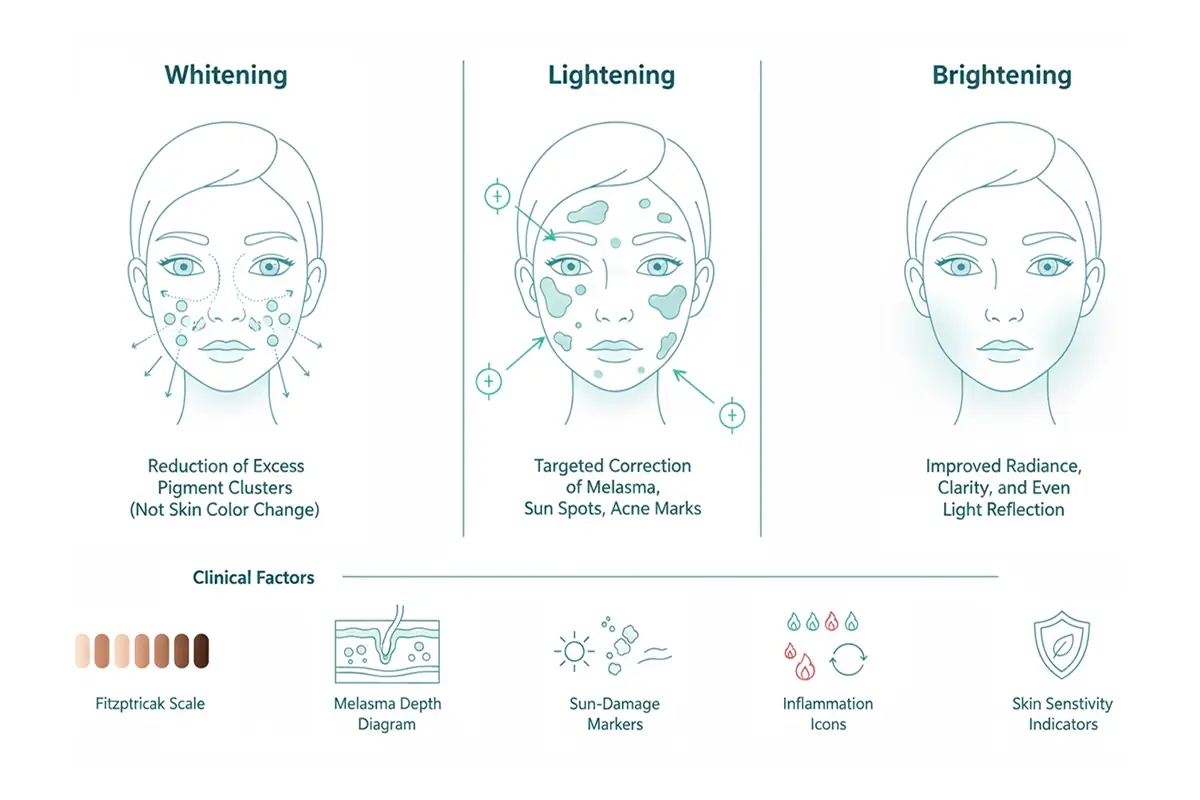
Whitening, lightening, and brightening describe different layers of skin tone improvement — not interchangeable claims.
-
Whitening focuses on regulating melanin-related mechanisms
-
Lightening targets localized pigmentation concerns such as spots or marks
-
Brightening improves visual radiance and even light reflection
Understanding this distinction helps brands avoid overpromising results their first product is not designed to deliver.
Section 3|Instant Brightening vs Long-Term Whitening Performance
Many whitening products deliver visible improvement within minutes or days.
These effects often result from:
-
Enhanced light reflection on the skin surface
-
Improved hydration and smoothness
-
Temporary tone uniformity
Such instant brightening effects are valid and valuable, especially for early user experience.
Instant perception plays a key role in:
-
First-use satisfaction
-
User confidence
-
Encouraging consistent use
However, instant brightening should not be confused with long-term pigmentation regulation,
which requires time, routine compatibility, and good skin tolerance.
Clear positioning allows users to understand:
-
What the product can deliver immediately
-
What improvements require sustained use
Foundational Whitening Strategy Series
Basics on melanin pathways: 효과적인 피부 미백을 위해서는 다음 3가지 멜라닌 경로를 해결해야 합니다.
Comparison of active ingredients: Niacinamide, Vitamin C, or Glabridin?
Section 4|Cost–Performance Logic in OEM Whitening Development
Raw material price alone does not determine final product cost.
Usage level, formulation complexity, stability requirements, testing scope,
and market positioning all influence the overall cost–performance balance.
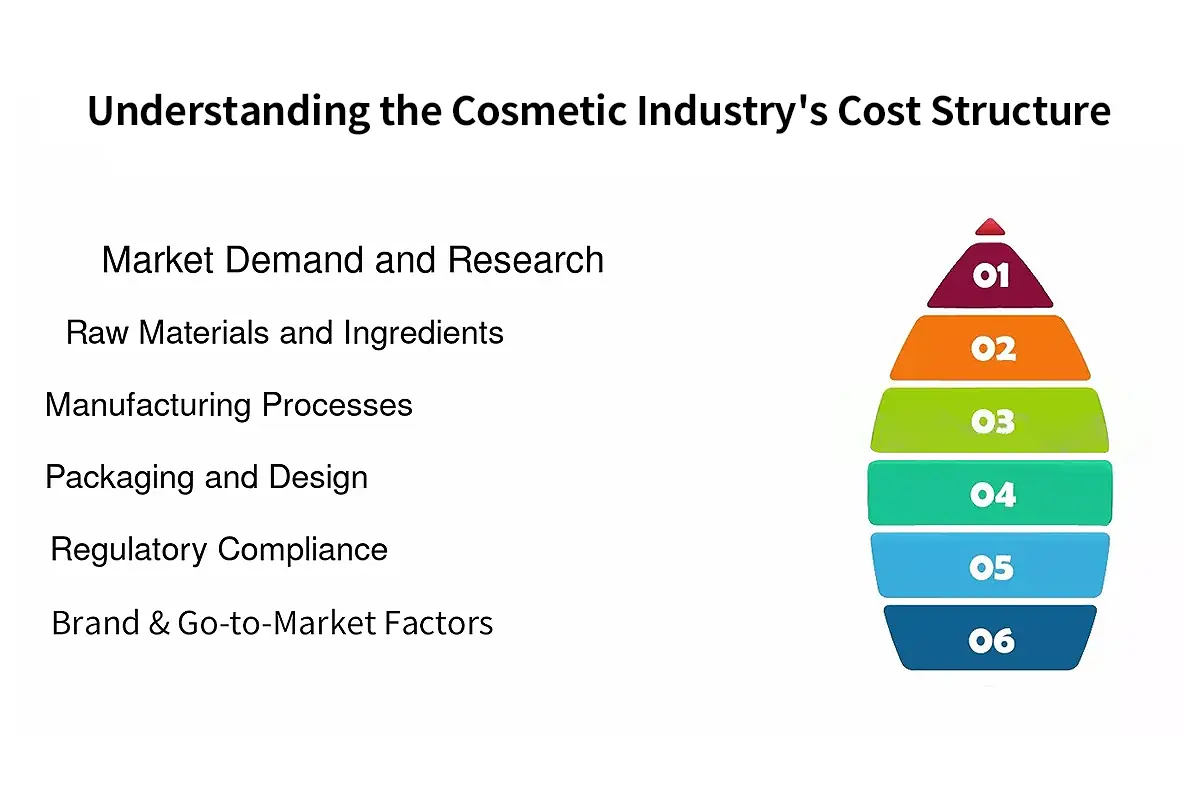
A good whitening formula is not the one with the most expensive ingredient,
but the one that delivers predictable results within a viable cost structure.
This perspective helps brands avoid over-engineering first-batch products
and supports sustainable pricing and margin planning.
Section 5|Whitening Performance Is a Design Decision, Not a Fixed Timeline
Whitening performance should not be viewed as a single timeline.
In OEM development, performance is a design variable influenced by:
-
Target consumer profile
-
Usage scenario (daily care vs professional treatment)
-
Skin tolerance expectations
-
Cost and formulation stability considerations
OEM formulations can be designed for:
-
Instant visual improvement
-
Short-term visible refinement
-
Gradual long-term tone regulation
without relying on non-compliant or high-risk ingredients.
Defining this direction early prevents misaligned expectations later.
Section 6|Why Sun Protection Still Matters
All pigmentation-regulating products perform best
when paired with appropriate UV protection.
This does not mean whitening products are unsafe under sunlight.
Rather, UV exposure remains one of the strongest triggers of melanin activity,
and unmanaged exposure can offset whitening progress.
Clear routine guidance improves real-world results and brand credibility.
Conclusion|Successful Whitening Starts with Honest Positioning
The success of a private label whitening product
depends less on ingredient strength
and more on how clearly its performance role is defined.
First-batch whitening products do not need to do everything.
They need to:
-
Deliver what they promise
-
실제 사용 루틴에 맞추기
-
일관성을 통한 신뢰 구축
For brands and OEM partners alike,
long-term whitening success starts with realistic expectations and strategic formulation design.
For brands planning their first whitening product, clarifying formulation direction early often saves time, cost, and unnecessary trial-and-error.
This clarity becomes especially important when planning the next stage of product development.
FAQs on Performance Expectations for Private Label Whitening Products
Q1: How quickly can results be expected from a first batch of private-label whitening products?
A:Result timelines depend on formulation strategy, ingredient systems, and delivery design.
Some first-batch whitening products are formulated to deliver immediate or short-term visible brightening, while others focus on progressive tone regulation over several weeks.
Importantly, faster visible results do not automatically imply higher irritation.
When advanced delivery technologies and well-balanced formulations are used, performance can be achieved through improved targeting and utilization of actives, rather than simply increasing concentration or aggressiveness.
In OEM development, performance expectations should therefore be aligned with the chosen mechanism and formulation approach, not with a single fixed timeline.
Q2: How do formulation choices affect first-batch performance expectations?
A: Active selection, delivery systems, and base texture all influence visible outcomes. Even with the same ingredient, different formulation strategies can produce different real-world results.
Q3: How should performance be validated before scaling production?
A: Early validation typically includes stability testing, compatibility checks, and small-scale evaluation rather than large clinical trials.
Q4: How should whitening performance claims be communicated safely?
A: Claims should reflect actual test data, clearly state usage conditions and timelines, and avoid absolute or unrealistic promises.

 Korean
  English
  Uzbek
Uzbek  Kazakh
  Turkish
  Russian
  Arabic
  Spanish
  Portuguese
  French
  German
  Japanese