
A Step-by-Step Guide for Brands Working with a Cosmetic OEM Manufacturer
Introduction
Developing a whitening serum through an OEM manufacturer can be an exciting opportunity for skincare brands, but many first-time founders are often unsure about how the process actually works.
Questions such as how long development takes, what steps are involved, and what brands need to prepare are very common during the early stages of product planning.
In our previous guide, we explored what differentiates advanced whitening serum OEM manufacturers and why technological capability plays a critical role in product performance.
Once the right manufacturing partner has been identified, the next step is understanding how a whitening serum project moves from concept to full-scale production.
The process typically involves several coordinated stages, including product positioning, formulation development, testing, packaging preparation, and final manufacturing.
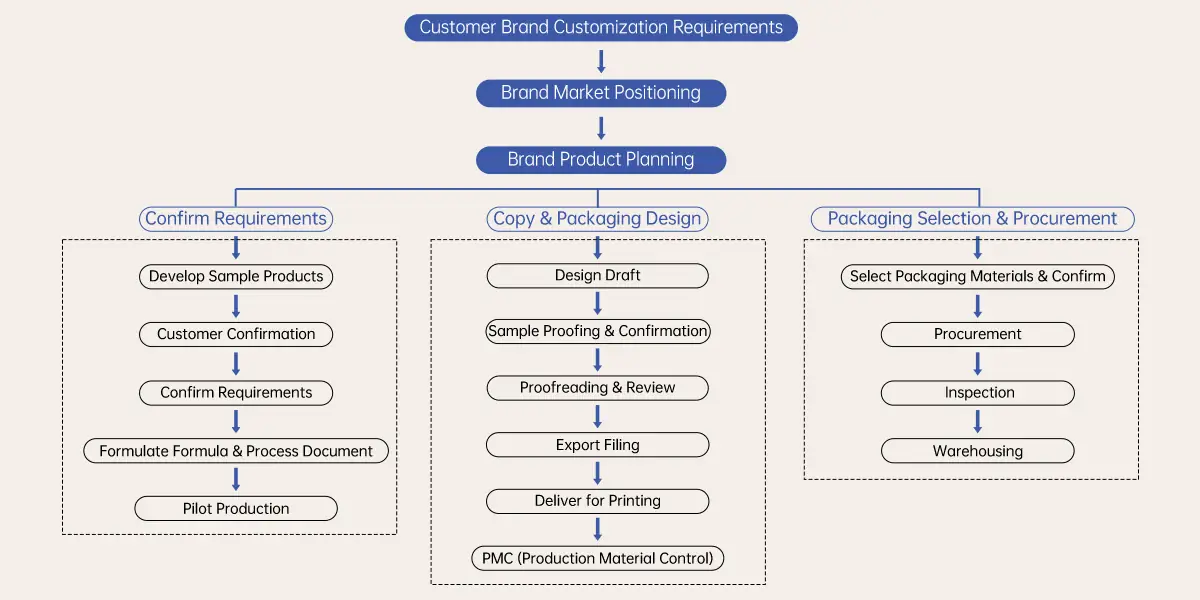
Step 1. Product Concept and Market Positioning
Every successful skincare product begins with a clear concept and market positioning.
At this stage, brands usually define several key elements of the product, including:
• Target skin concerns (such as dullness, uneven tone, or dark spots)
• Intended market or region
• Product texture and sensory preferences
• Ingredient philosophy (for example botanical, fermentation-based, or dermatology-inspired)
Clear positioning helps the OEM manufacturer understand the brand’s expectations and allows the formulation team to design a whitening serum that aligns with the product strategy.
Step 2. Whitening Formula Design and Ingredient Selection
Once the product concept is defined, the next stage involves formulation development.
During this step, the OEM R&D team evaluates potential ingredients, delivery systems, and compatibility considerations in order to create a stable whitening formulation.
Effective whitening products often require carefully balanced combinations of active ingredients targeting different pigmentation pathways.
Brands interested in understanding these mechanisms can explore our guide on:
Effective Skin Brightening Requires Solving These 3 Melanin Pathways
Formulation design may also involve evaluating ingredient stability, delivery technologies, and skin tolerance to ensure the final product performs consistently in real-world conditions.
Step 3. Laboratory Testing and Sample Development
After the initial formulation is designed, the next phase is laboratory testing and prototype development.
The OEM laboratory will typically produce sample batches so the brand can evaluate factors such as:
• texture and skin feel
• absorption speed
• fragrance profile
• overall performance expectations
It is common for whitening serum projects to go through several sample iterations before the final formula is confirmed.
During this stage, stability testing and compatibility assessments are also conducted to ensure the formulation maintains performance throughout its intended shelf life.
Step 4. Packaging Preparation and Compliance
While formulation testing is taking place, packaging preparation usually happens in parallel.
This stage may include:
• bottle and pump selection
• packaging design and artwork
• label compliance review
• regulatory documentation preparation
For brands selling in different markets, packaging and labeling requirements may vary depending on the target region.
Coordinating packaging and regulatory preparation early in the development process helps avoid delays before production.
Step 5. Pilot Production and Quality Control
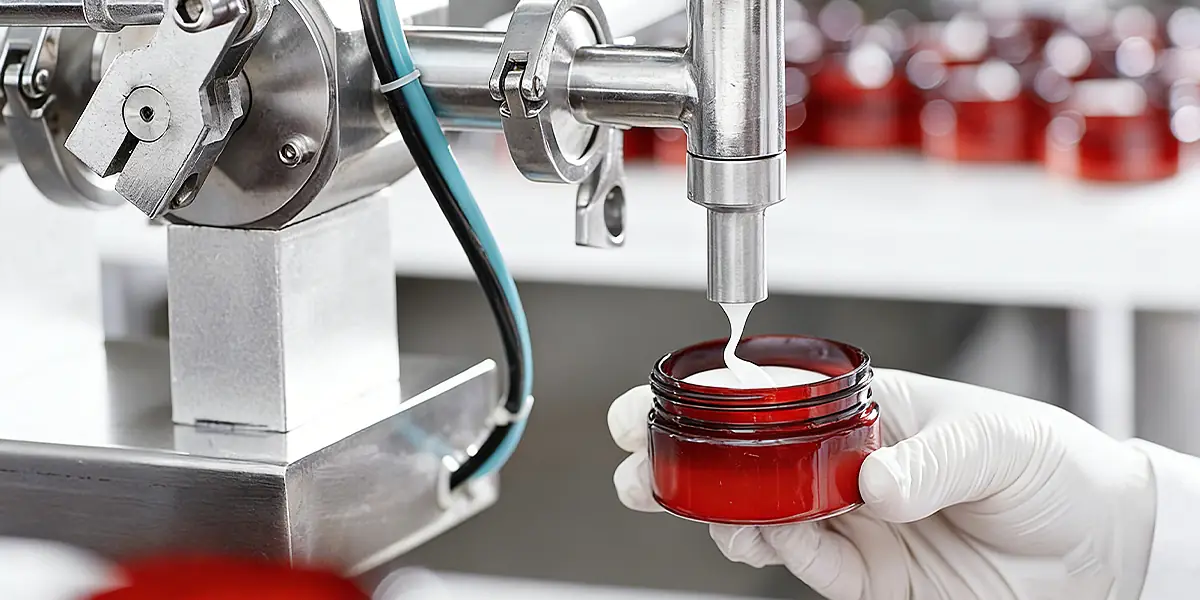
Before large-scale manufacturing begins, OEM manufacturers typically conduct a pilot production stage.
Pilot production allows the factory to verify that the whitening serum formulation performs consistently when scaled from laboratory batches to manufacturing equipment.
During this stage, quality control teams evaluate factors such as:
• formulation stability during mixing
• filling accuracy
• packaging compatibility
• overall production consistency
This step helps ensure the product maintains the same quality during full production runs.
Step 6. Full-Scale Manufacturing and Delivery
Once pilot testing confirms that the formulation and packaging are stable, the project moves into full-scale production.
This stage generally includes:
• bulk formulation production
• product filling
• packaging assembly
• final quality inspection
• shipment preparation
Experienced OEM manufacturers use standardized production workflows to ensure consistent quality across every batch.
How Long Does the Whitening Serum OEM Process Take?
The timeline for developing a whitening serum can vary depending on several factors, including formulation complexity, packaging preparation, and regulatory requirements.
In many cases, development and production can be completed within several weeks when product specifications are clearly defined and communication between the brand and manufacturer is efficient.
For first-time collaborations, the process may involve additional formulation adjustments, testing cycles, and coordination between both teams.
Once a formula has been finalized and the workflow is established, repeat production cycles are typically much faster.
Clear project planning and early alignment on product requirements often help accelerate the development process.
Conclusion
Understanding the OEM development workflow
Launching a successful whitening serum requires coordination between product strategy, formulation science, packaging preparation, and manufacturing execution.
Understanding how these stages work together helps brands plan product launches more effectively and avoid common development challenges.
Working with the right OEM partner
Choosing an experienced OEM manufacturer can significantly simplify the development process.
Technology-driven OEM partners with strong R&D capabilities and well-established production systems are better equipped to guide brands from concept to launch while maintaining product quality and stability.
Recommended Reading
How to Choose a Whitening Serum OEM Manufacturer

 Kazakh
  English
  Uzbek
Uzbek  Turkish
  Russian
  Arabic
  Spanish
  Portuguese
  French
  German
  Japanese
  Korean