
A Practical First-Batch Development Roadmap for Private Label Brands
Introduction|Why Most Whitening Projects Fail Before Production Begins
Many private label whitening projects do not fail because the ingredients are ineffective.
They fail because the first step is taken in the wrong order.
After learning about melanin mechanisms, ingredient logic, and performance expectations, most brand owners eventually reach the same point:
“I understand the theory — but how do I actually start working with an OEM?”
From a factory perspective, the success of a first whitening batch depends far less on how advanced the formula sounds, and far more on whether the project is structured clearly from the very beginning.
This article provides a practical, OEM-side roadmap for launching a first whitening serum project — helping brands move from idea to execution with fewer missteps in their first batch.
Section 1|Define Your Whitening Goal Before Choosing Ingredients
One of the most common early mistakes is starting with ingredient names:
-
“Should we use niacinamide or vitamin C?”
-
“Do we need tranexamic acid?”
In real OEM development, ingredients come after goals — not before.
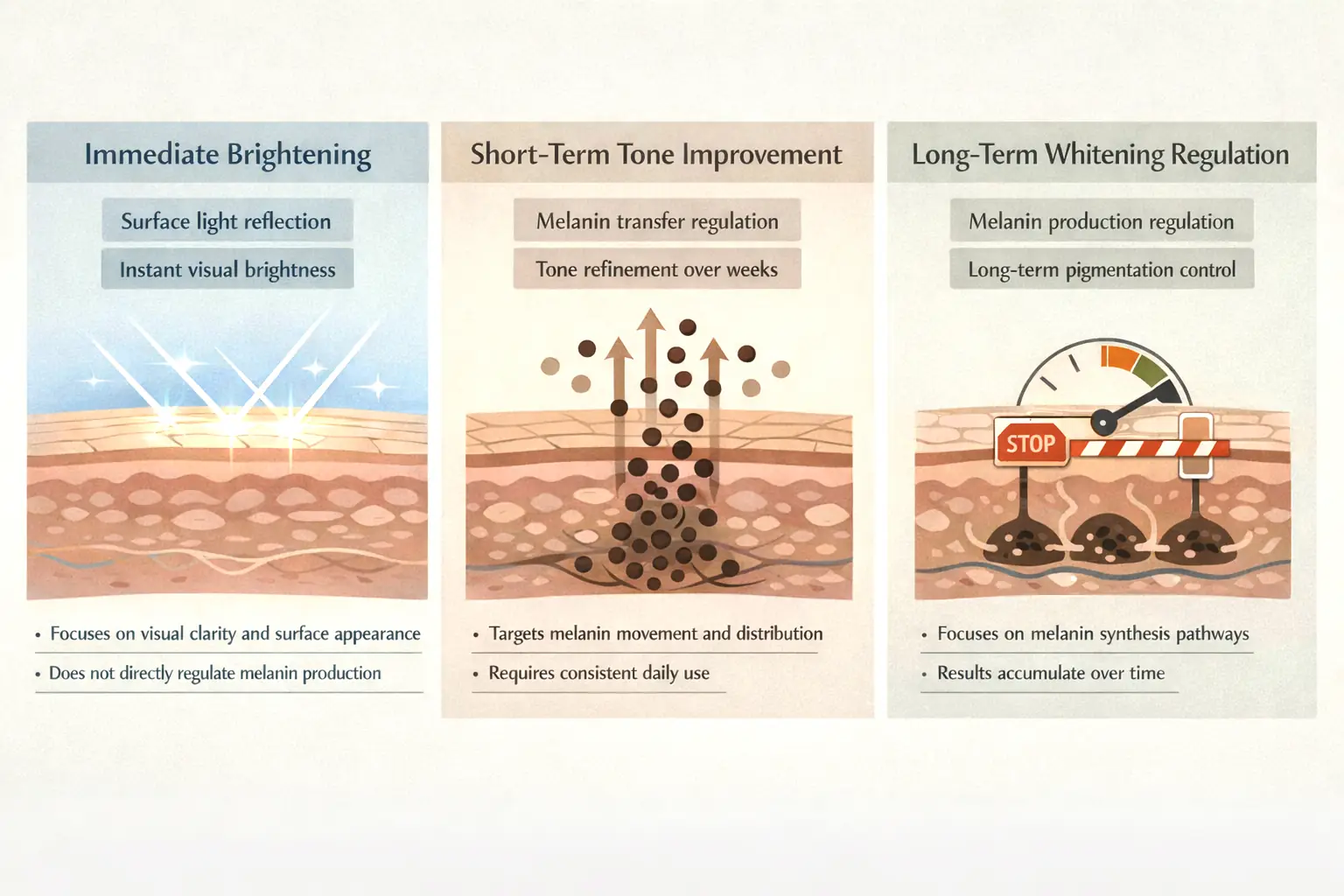
A clearer starting point is defining your performance intent:
-
Are you targeting immediate visual brightness?
-
Short-term tone refinement over weeks?
-
Or long-term pigmentation regulation?
As discussed in our earlier whitening mechanism articles,
these goals correspond to different layers of pigmentation intervention:
-
Immediate brightness → surface light reflection
-
Short-term improvement → melanin transfer regulation
-
Long-term control → melanin production regulation
For a detailed explanation of how these three melanin pathways work together,
see our article:
Defining this goal early allows the OEM to:
-
Design a realistic formula scope
-
Select compatible actives and delivery systems
-
Set appropriate testing and validation timelines
Section 2|Choose the Right Product Format for Your Market
Once the whitening goal is clear, the next decision is product format — not ingredients.
Different formats naturally support different usage patterns and performance expectations:
-
Lightweight serums for daily, long-term tone management
-
Essences or emulsions for balance between comfort and activity
-
Professional-use formats for controlled, short-term visible effects
Format decisions should consider:
-
Target customer (B2C retail vs professional channel)
-
Usage frequency and user compliance
-
Texture tolerance and regional preferences
For example, brands aiming for “lightweight yet effective daily whitening serums” often require delivery strategies that balance skin feel with active absorption — something we previously discussed when introducing advanced delivery and penetration approaches in whitening formulations.
Section 3|What OEM Manufacturers Actually Need From You (and Why)
Many brand owners assume OEMs only need a target ingredient list.
In reality, effective OEM development starts with context, not components.
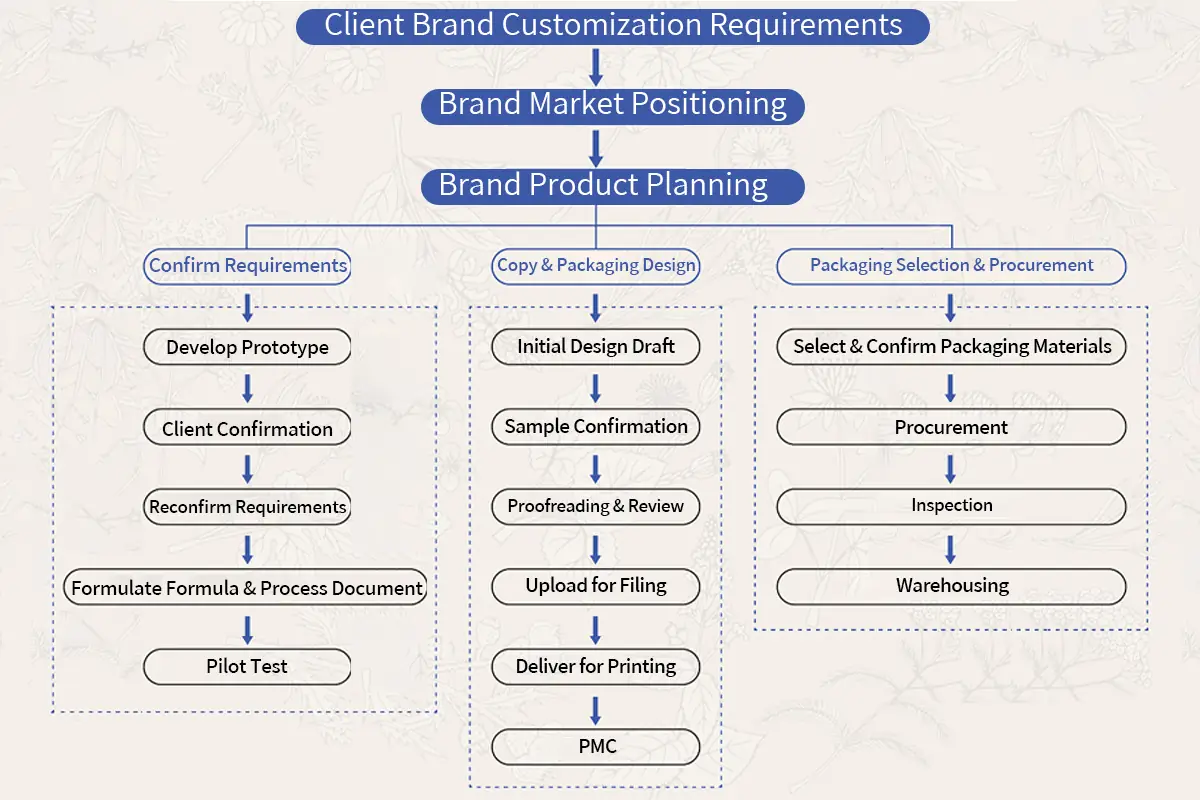
Before formulation begins, OEM manufacturers typically need:
-
Target market & skin type
-
Budget range (not exact cost, but positioning)
-
Regulatory market (EU, US, ASEAN, etc.)
-
Launch timeline expectations
These details are not requested to limit creativity — they exist to prevent misalignment later.
From a factory standpoint, this information allows us to:
-
Recommend appropriate active systems
-
Avoid unnecessary reformulation loops
-
Align testing scope with launch timing
-
Reduce cost overruns caused by late-stage changes
A clear brief early on almost always saves time, cost, and trial-and-error in the first batch.
Section 4|Single-Ingredient vs Multi-Active Whitening: How to Choose
There is no absolute “better” choice between single-ingredient and multi-active whitening formulas.
The right approach depends on product positioning, skin tolerance, and performance goals.
Single-ingredient-focused formulas are often suitable when:
-
Clear, simple messaging is required
-
Skin sensitivity is a primary concern
-
Cost efficiency and stability are priorities
Multi-active whitening systems are often chosen when:
-
Multiple pigmentation pathways are targeted
-
Lower individual concentrations improve tolerance
-
Brands aim for layered or progressive results
From an OEM perspective, both strategies are valid — when the formulation logic matches the intended use scenario.
The mistake is not choosing one approach over the other, but attempting to solve every whitening objective in a single first-batch product.
Section 5|Timeline: What a Realistic First Batch Looks Like
One of the most sensitive questions in whitening projects is timeline.
A realistic first-batch roadmap usually includes:
-
Formula concept & feasibility discussion
-
Lab sampling and internal adjustments
-
Stability and compatibility testing
-
Small pilot production before scale-up
Attempting to compress these steps often leads to unstable formulas or delayed launches later.
The goal of a first batch is not perfection — it is verification:
-
Does the formula behave as expected?
-
Is the performance direction correct?
-
Can it be scaled consistently?
Projects that treat the first batch as a learning and validation phase tend to progress faster in the long run.
Factory Tip|Avoiding Common First-Batch Pitfalls (Without Limiting Performance)
One common misunderstanding is assuming that immediate visible brightness and long-term usability are mutually exclusive.
In practice, the issue is not whether immediate effects can be used long term — but how performance claims are structured.
From factory experience, first-batch challenges usually arise when:
-
A single product is positioned to deliver instant, short-term, and long-term results without priority
-
Performance claims exceed what testing timelines can validate
-
Messaging promises more than the formulation strategy supports
A well-structured project clearly defines what the first batch is meant to prove, while leaving room for later optimization.
Conclusion|From Idea to Execution
Successful whitening projects begin with honest positioning and clear structure.
The first batch does not need to do everything.
It needs to:
-
Deliver what it promises
-
Fit real usage routines
-
Build trust through consistency
For private label brands, clarity at this stage often saves months of trial-and-error later — and sets the foundation for scalable, credible whitening lines.
If you are planning your first whitening serum project, structuring the process correctly from the start is often the most valuable formulation decision you can make.

 Japanese
  English
  Uzbek
Uzbek  Kazakh
  Turkish
  Russian
  Arabic
  Spanish
  Portuguese
  French
  German
  Korean