
Not all pigmentation is created the same. To achieve real and lasting brightening, all three melanin mechanisms must be addressed — not just one.
Introduction
Many whitening or brightening products promise fast results by targeting a single cause of pigmentation — usually by “inhibiting tyrosinase.”
However, melanin formation is not a single-step process.
It is a multi-stage biological pathway involving different enzymes, intermediate reactions, and pigment types.
This is why many products show temporary brightness, uneven tone improvement, or pigmentation rebound over time.
To understand what truly effective brightening requires, we must first understand the three key mechanisms that control melanin formation.
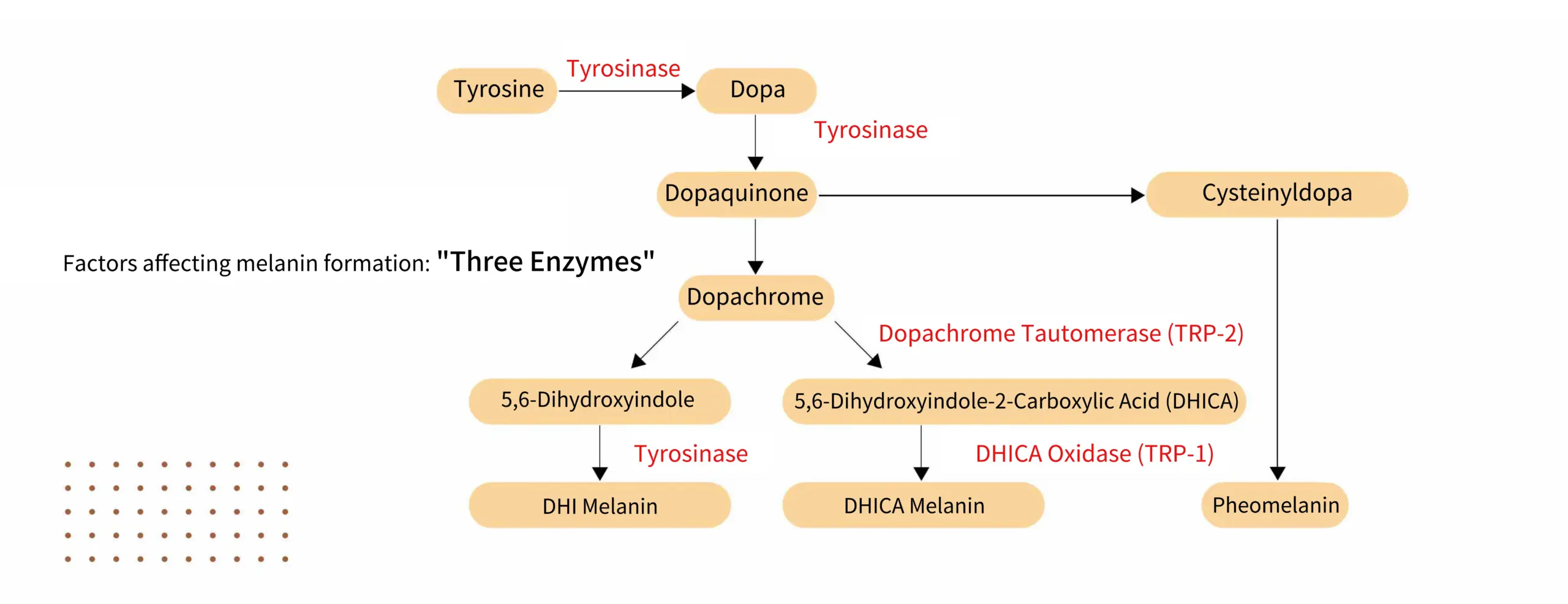
The 3 Core Mechanisms That Control Melanin Formation
The diagram above illustrates how melanin is produced inside the skin through a sequence of enzymatic reactions.
Although the pathway looks complex, effective brightening depends on controlling three critical points.
Mechanism 1 — Tyrosinase Activity (Melanin Initiation)
What this mechanism does
Tyrosinase is the enzyme that initiates melanin production.
It catalyzes the conversion of tyrosine into DOPA and dopaquinone — the very first step of pigment formation.
Because this step starts the entire process, it has become the most common target in whitening products.
Why this alone is not enough
While tyrosinase inhibition can reduce melanin production at the beginning, it does not fully stop pigmentation once downstream reactions are already active.
This is why many formulas that rely only on tyrosinase inhibition deliver:
-
Short-lived brightening
-
Diminishing results over time
-
Visible rebound pigmentation
Key takeaway
Tyrosinase control is essential — but never sufficient on its own.
Mechanism 2 — Intermediate Conversion (TRP-2 Pathway)
What happens at this stage
After initiation, melanin precursors continue through intermediate reactions.
One of the most important regulators here is dopachrome tautomerase (TRP-2).
This enzyme determines:
-
How melanin intermediates are converted
-
How stable pigment formation becomes
-
How resistant pigmentation is to treatment
Why this step matters
Even when tyrosinase activity is reduced, unchecked intermediate conversion allows pigmentation to continue forming beneath the surface.
This explains why some products:
-
Appear to work at first
-
Plateau quickly
-
Fail to improve deeper or persistent discoloration
Key takeaway
Without regulating intermediate pathways, brightening remains incomplete and unstable.
Mechanism 3 — Final Pigment Formation (TRP-1 & Melanin Type)
What this mechanism controls
The final enzymatic steps determine what type of melanin is produced, including:
-
DHI melanin
-
DHICA melanin
-
Pheomelanin
These pigment types differ in:
-
Color intensity
-
Oxidative behavior
-
Long-term visibility on the skin
Why pigment type matters
Even if total melanin production is reduced, unfavorable pigment composition can still result in:
-
Dull skin tone
-
Uneven coloration
-
Persistent yellow or brown undertones
Key takeaway
True brightening depends not just on how much melanin is formed — but what kind.
Why Single-Mechanism Brightening Often Fails
Most conventional brightening products focus on only one of these mechanisms.
As a result, they often lead to:
-
Temporary improvement without long-term stability
-
Uneven tone correction
-
Pigmentation rebound after discontinuation
Effective brightening requires coordinated control across all three mechanisms, not higher concentrations or harsher ingredients.
What Truly Effective Brightening Requires
A successful brightening strategy must be designed to:
-
Regulate melanin initiation
-
Control intermediate conversion pathways
-
Influence final pigment formation
This shift — from single-target inhibition to multi-pathway regulation — is why modern brightening approaches focus increasingly on precision and delivery, rather than strength alone.
Conclusion
Brightening is not about being more aggressive.
It is about being more biologically precise.
Understanding these three melanin mechanisms is the foundation for evaluating whether a brightening formula can deliver real, lasting results — or only short-term visual improvement.

 English
  Uzbek
Uzbek  Kazakh
  Turkish
  Russian
  Arabic
  Spanish
  Portuguese
  French
  German
  Japanese
  Korean