
Why gentle brightening requires more than lowering active concentration
Introduction|Why Sensitive Skin Whitening Is Often Misjudged
Sensitive skin whitening is often treated as a simplified version of standard brightening formulations.
The common assumption is straightforward:
reduce concentration, remove aggressive actives, and irritation risks will disappear.
In real OEM practice, this approach frequently fails.
Sensitive skin does not respond poorly because whitening actives are present.
It reacts because the formulation fails to manage penetration behavior, inflammation triggers, and cumulative skin stress.
Whitening for sensitive skin is not about doing less.
It is about designing differently.
A successful sensitive-skin whitening formula requires alignment between ingredient choice, delivery behavior, and skin tolerance management.
Section 1|Why Sensitive Skin Reacts Differently to Whitening Formulas
Sensitive skin is defined less by a single condition and more by a lowered tolerance threshold.
Compared to normal skin, it is more prone to:
-
Barrier disruption
-
Inflammatory responses
-
Reactive pigmentation following irritation
When whitening formulations ignore these characteristics, even mild actives can trigger redness, rebound pigmentation, or inconsistent results.
This explains why many products labeled “gentle whitening” still underperform or cause complaints after extended use.
Section 2|Ingredient Selection: Gentle Does Not Mean Ineffective
In sensitive-skin whitening, ingredient selection must focus on multi-pathway moderation rather than aggressive inhibition.
Commonly used approaches include:
-
Brightening actives that influence melanin transfer rather than direct suppression
-
Anti-inflammatory components that reduce post-irritation pigmentation
-
Stabilized derivatives that minimize oxidative stress
Rather than relying on a single “hero ingredient,” effective formulas distribute whitening activity across multiple low-irritation mechanisms.
This strategy aligns with the broader principle that whitening effectiveness depends on pathway coordination rather than ingredient intensity.
To better understand how different stages of pigmentation are coordinated in whitening design, it is helpful to look at melanin regulation pathways in more detail.
Section 3|Why Delivery Behavior Matters More for Sensitive Skin
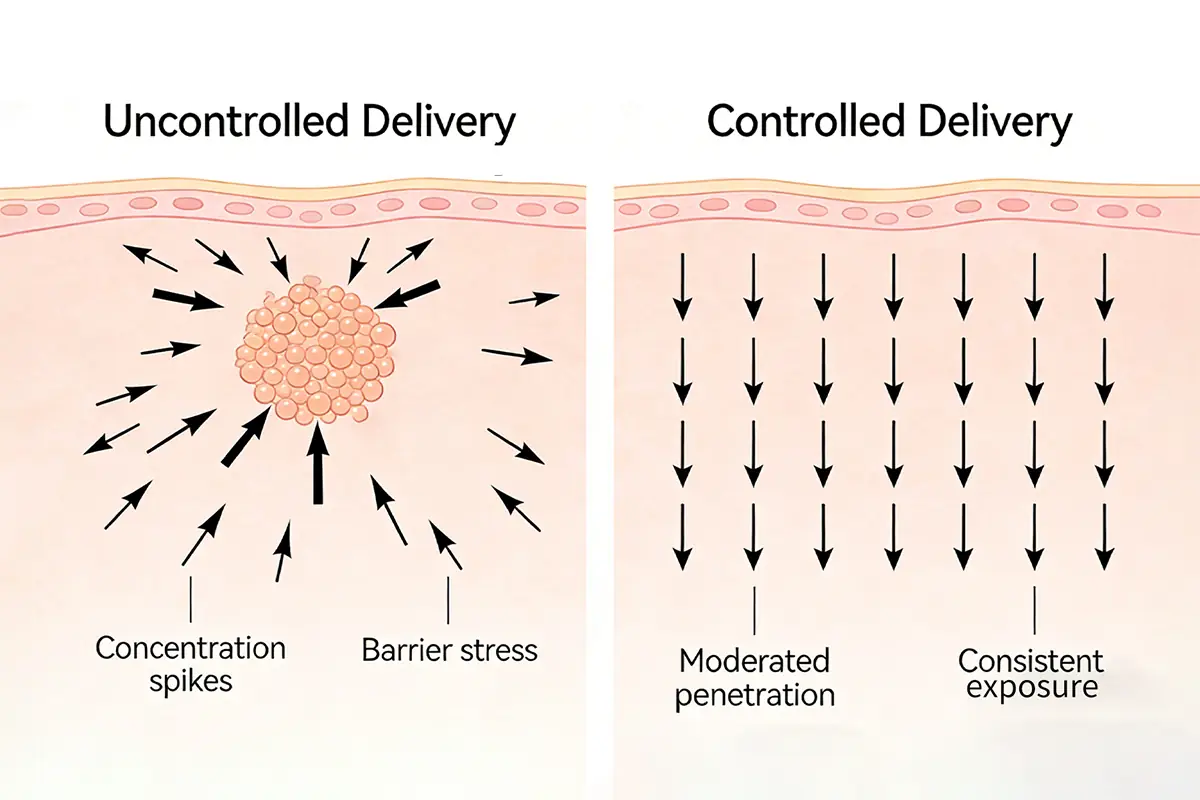
For sensitive skin, how an ingredient reaches the skin often matters more than what the ingredient is.
Poorly controlled delivery can:
-
Create localized concentration spikes
-
Overstimulate compromised barriers
-
Increase cumulative irritation over time
Conversely, controlled delivery systems help:
-
Moderate penetration speed
-
Reduce surface accumulation
-
Maintain consistent exposure levels
In sensitive-skin whitening, delivery control is a tolerance strategy, not a performance shortcut.
This consideration becomes especially relevant when delivery systems are used to support mild actives rather than amplify strength.
This distinction becomes clearer when examining how delivery systems in whitening formulations are engineered to balance penetration, stability, and irritation risk.
Section 4|Testing Priorities in Sensitive Skin OEM Projects
Testing requirements for sensitive-skin whitening projects differ from standard brightening products.
Beyond basic stability testing, OEM projects often emphasize:
-
Patch testing for irritation potential
-
Repeated-use tolerance evaluation
-
Observation of delayed pigmentation responses
Without these evaluations, even well-designed formulas can fail during real-world use.
These trade-offs are especially common in a first project, where first whitening batch expectations often differ from real-world formulation constraints.
Section 5|Texture and Sensory Design as a Stability Factor
For sensitive skin, sensory experience is not a secondary concern.
Texture influences:
-
Application behavior
-
Frequency of use
-
Perceived comfort and safety
Lightweight, non-occlusive bases with minimal fragrance load often support better long-term compliance, reducing the risk of over-application or irritation stacking.
Formulation success, in this context, depends as much on user behavior as on ingredient science.
Conclusion|Gentle Whitening Is a System, Not a Compromise
Sensitive-skin whitening does not succeed by simply removing strong ingredients.
It requires a system-level approach that balances mechanism selection, delivery moderation, testing discipline, and sensory comfort.
When designed responsibly, gentle whitening formulas can deliver consistent results—without forcing sensitive skin to tolerate unnecessary stress.
To address some of the most common practical questions brands raise when developing whitening products for sensitive skin, the following FAQs provide additional clarification.
FAQ 1|Can sensitive skin achieve visible whitening results?
A:Yes. When whitening pathways are carefully selected and irritation triggers are managed, gradual and consistent improvement is achievable.
FAQ 2|Should strong whitening actives always be avoided?
A:Not necessarily. The issue is less about strength and more about delivery behavior and cumulative exposure.
FAQ 3|Is sensitive-skin whitening development more time-consuming?
A:Often yes. Additional testing and tolerance validation are typically required to ensure long-term stability and safety.

 Arabic
  English
  Uzbek
Uzbek  Kazakh
  Turkish
  Russian
  Spanish
  Portuguese
  French
  German
  Japanese
  Korean