Systematic Anti-Inflammatory Design for Consistent Whitening Results & Lower Complaint Rates
Why “Adding Soothing Ingredients” Often Fails in Whitening
In OEM anti-inflammatory whitening projects, a common shortcut is simple: “If the formula irritates, toss in a soothing ingredient such as centella or chamomile and call it anti-inflammatory.”
In real formulation development, inflammation should not be treated as a temporary side effect. It is a functional skin state that can affect barrier stability, oxidative stress, active delivery, and the way pigmentation rebounds after use.
This “add-on” approach leaves OEMs facing familiar pitfalls:
- Dark spots improve at first, then rebound in real-world use.
- Complaints increase among acne-prone, post-acne, or sensitive-skin users.
- First-batch formulas work “on paper” but underperform after launch.
For a broader overview of whitening ingredient selection, stability, and OEM development logic, you can also read our whitening formulation OEM guide.
Anti-Inflammation Is a Formula Design Logic — Not a Marketing Claim
Brands often frame “anti-inflammatory whitening” as a buzzword tied to one star ingredient.
For OEMs, though, effective anti-inflammation is a foundational design logic that covers four non-negotiable layers:
-
Penetration control:
Not “maximizing absorption,” but regulating how actives reach skin layers—avoiding sudden, high-concentration exposure that triggers stress responses. -
Barrier support:
Building the formula around barrier-compatible matrices (not just adding a single “barrier ingredient”) to reduce ongoing inflammation from compromised skin. -
Stimulus source management:
Eliminating hidden irritants (e.g., harsh preservative systems, extreme pH) that keep inflammation signaling active, even with soothing ingredients added. -
Usage rhythm stability:
Ensuring the formula performs consistently across daily use (not just in lab tests)—avoiding peaks/valleys in active delivery that disrupt skin state.
This is why inflammation reshapes how melanin behaves—and why anti-inflammation can’t be an afterthought in OEM whitening. Anti-inflammation can’t be an afterthought—it must be baked into the formula’s core.
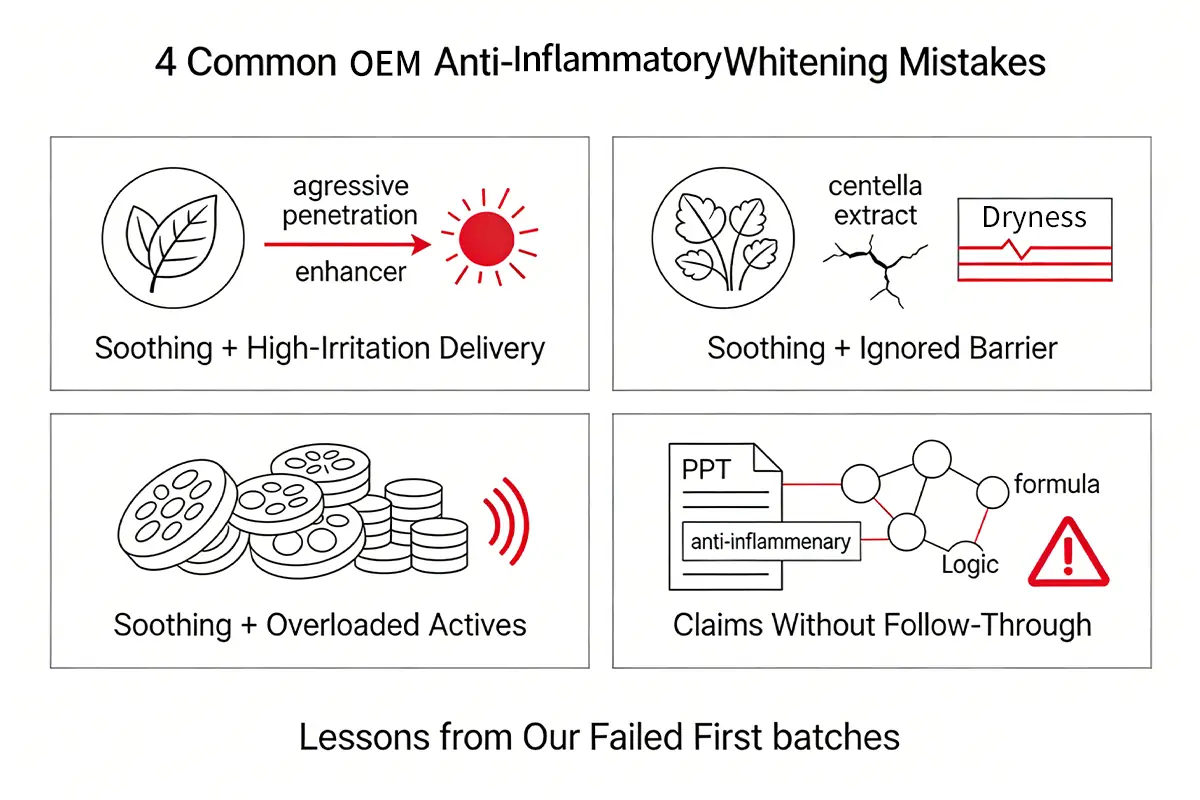
4 Common OEM Mistakes in Anti-Inflammatory Whitening Formulations
OEM teams often stumble not from bad ingredients, but misaligned design choices:
-
Anti-inflammatory ingredients + high-irritation delivery
Pairing soothing extracts with aggressive penetration enhancers—overloading inflamed skin and worsening sensitivity. -
Anti-inflammatory ingredients + ignored barrier repair
Adding centella while using alcohol-based carriers or stripping surfactants—leaving the barrier compromised. -
Anti-inflammatory ingredients + overloaded actives
Piling whitening, anti-aging, and anti-acne actives on top of soothing components—spiking skin’s metabolic load. -
Anti-inflammatory claims without design follow-through
Listing “anti-inflammatory” on the formula PPT, but skipping penetration control or stimulus management in real formulation logic.
These are the 4 recurring mistakes we’ve seen (and made) in OEM anti-inflammatory whitening projects—illustrated below:
To fix these mistakes, we now use a step-by-step systematic framework for anti-inflammatory whitening formulations:
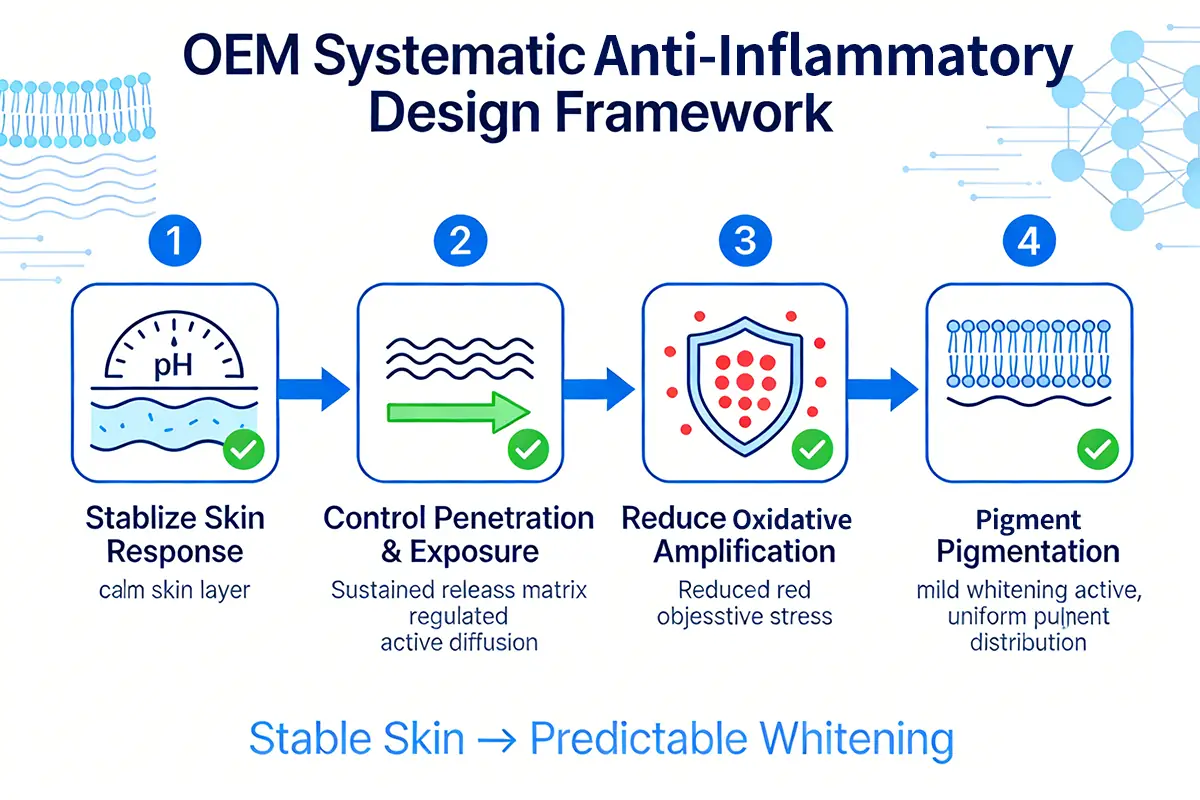
OEM’s Systematic Anti-Inflammatory Design Framework
The goal isn’t “perfect ingredients”—it’s a framework that stabilizes skin state first, then delivers whitening.
Step 1|Stabilize skin response first
Prioritize reducing skin’s stress triggers: control pH, avoid extreme osmotic pressure, and use low-irritation emulsifiers to minimize barrier disruption.
Step 2|Control penetration & exposure
Regulate how actives interact with skin: use sustained-release matrices to avoid local concentration spikes, especially in post-acne zones.
Step 3|Reduce oxidative amplification
Pair anti-inflammatory logic with low-irritation antioxidant systems that address oxidative stress without provoking sensitivity.
Step 4|Then regulate pigmentation
Once skin state is stable, integrate mild, targeted whitening actives for predictable, non-rebounding results.
How Systematic Anti-Inflammation Drives OEM Commercial Value
For OEMs, this framework isn’t just “better formulation”—it directly impacts bottom-line performance:
-
Repeat purchase stability
Consistent whitening (without rebound) improves end-user loyalty and reorder rates from brand partners. -
Lower complaint rates
Reduced sensitivity in acne-prone or sensitive users cuts post-launch support costs for both OEMs and brands. -
Wider user retention
Stable, anti-inflammatory formulas serve niche segments (e.g., post-procedure or acne-recovery skin) that generic whitening products cannot. -
Faster launch cycles
A systematic whitening formulation reduces repeated “test–revise–retest” loops, aligning development timelines with realistic OEM whitening test cycles for first batches.
Conclusion
Whitening formula development should not be treated as a simple ingredient-stacking exercise.
A formula with whitening actives, soothing extracts, and a pleasant texture may still fail if it does not control
inflammation, barrier stress, and delivery rhythm.
Anti-inflammation isn’t about adding one ingredient—it’s about designing a formula that stabilizes skin state as its foundation.
For OEMs, this isn’t just a better approach—it’s a competitive edge.
Formulas that deliver consistent, low-complaint whitening results earn stronger brand trust, higher reorders, and longer-term partnerships.
This logic is especially important for facial serum products, because serums often carry higher active concentration,stronger performance expectations, and higher consumer sensitivity to irritation. For brands developing brightening,
tone-evening, or post-acne mark serum lines, working with a reliable private label serum manufacturer
can help connect formulation design, stability testing, packaging selection, and OEM/ODM production planning.
Before closing, here are the most common OEM-side questions brands ask when shifting toward systematic anti-inflammatory whitening design.
FAQ
Is anti-inflammation necessary for all whitening products?
Not always. But it becomes critical for formulas targeting post-acne marks, PIH, sensitive skin,
long-term daily use, or markets where users are prone to redness and rebound pigmentation.
Can soothing ingredients alone solve inflammation-related whitening issues?
Usually not. Without penetration control, barrier logic, pH balance, and delivery system design,
soothing ingredients only provide partial support. The overall formula structure matters more than one isolated extract.
Does systematic anti-inflammation slow whitening results?
In many cases, it improves consistency rather than slowing results. A stable formula may reduce rebound,
support better tolerance, and help users stay with the product longer.
Can this framework be used for private label serum products?
Yes. This framework is especially useful for private label facial serums, brightening serums,
post-acne mark serums, and tone-evening formulas where active concentration, skin tolerance,
and repeat purchase performance all matter.
Recommended Reading
- Whitening Formulation Guide | Ingredients, Stability & OEM Development
- Private Label Serum Manufacturer | Custom Facial Serum OEM/ODM
- The OEM Whitening Formulation Playbook | A Flexible Toolkit for Consistent Low-Complaint Results